

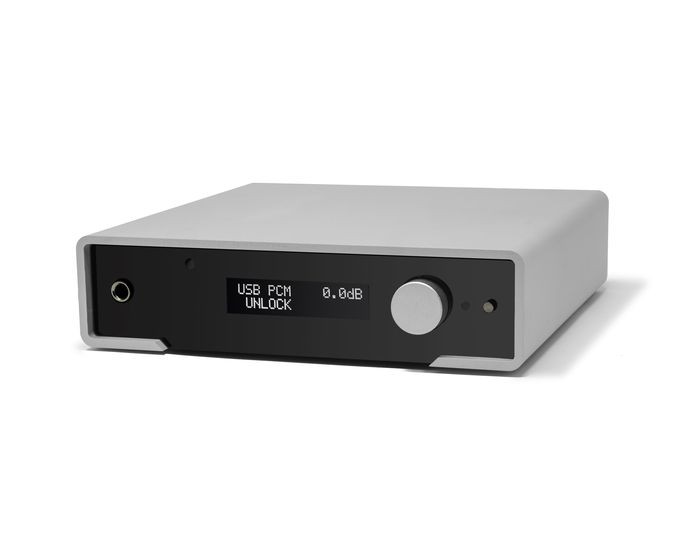
The M2Tech Young MkIV is positioned as more than a conventional standalone DAC. As part of the Italian company’s Rockstars series, it combines digital-to-analog conversion with preamplifier duties, giving it a practical role at the center of a compact but capable hi-fi system. Its appeal lies in the way it gathers several useful functions into one component: multiple digital inputs, an analog input path, balanced and unbalanced outputs, a front-panel headphone socket, Bluetooth, high-resolution PCM and DSD support, and native MQA decoding. For listeners building a system around digital sources, powered loudspeakers, a power amplifier, or headphones, that combination makes the Young MkIV an interesting example of a modern DAC/preamp designed for flexibility rather than single-purpose minimalism.
A Rockstars-Series Design with a Compact Footprint
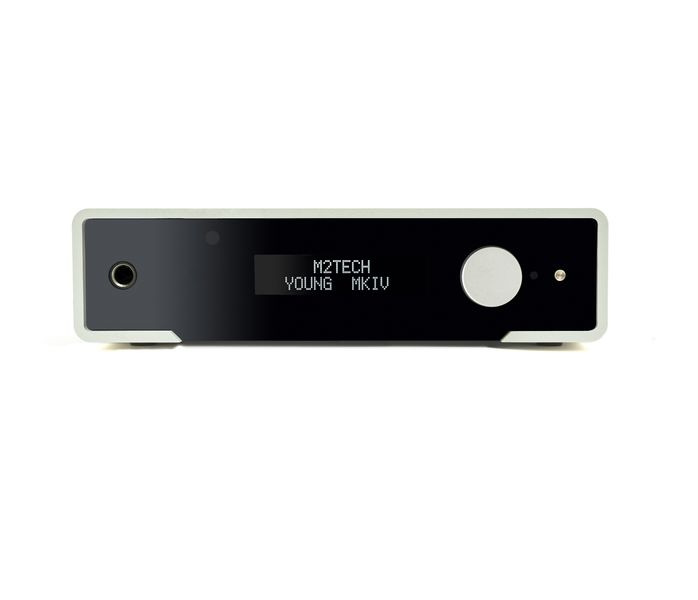
The Young MkIV follows the aluminum-case approach associated with M2Tech’s Rockstars series. The documented enclosure measures 200 x 200 x 500 mm and weighs 2.5 kilograms, giving it a relatively compact presence for a component that combines DAC, preamplifier, Bluetooth receiver and headphone functionality. The use of an aluminum case is also consistent with the kind of construction expected from specialist hi-fi electronics, where rigidity, shielding and visual coherence often matter to owners as much as the internal feature set.
For many systems, size is not a trivial detail. A DAC/preamp may need to sit on a desktop, inside a smaller rack, next to a headphone amplifier, or near a computer-based source. The Young MkIV’s format makes sense for users who want a serious hub without committing to the shelf space of a full-width preamplifier and separate DAC. Its design language also suggests that it is intended to be visible rather than hidden away: a compact aluminum component that can form the control point of a streamlined system.
Digital Connectivity for Several Source Types
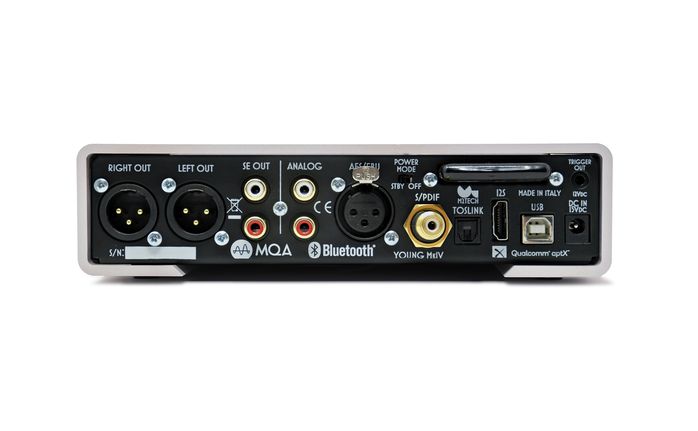
One of the Young MkIV’s strongest documented qualities is the breadth of its digital input panel. It includes USB-B, optical and coaxial digital inputs, AES/EBU, and an HDMI port for I2S signals. That spread covers many common source scenarios: a computer or dedicated streamer through USB, a TV or disc transport through optical or coaxial, professional or higher-end digital transports through AES/EBU, and compatible digital interfaces through I2S over HDMI.
This matters because digital systems often evolve. A user may begin with a laptop over USB, later add a dedicated network bridge, and eventually connect a CD transport or another digital component. A DAC with only one or two inputs can become restrictive as the system grows. The Young MkIV’s input selection gives owners more room to change sources without replacing the central converter/preamp. The presence of AES/EBU and I2S over HDMI is particularly notable in a compact unit, because those connections are typically associated with more specialized digital front ends rather than simple consumer plug-and-play devices.
The USB-B port is also significant for contemporary high-resolution playback. Computer audio and many streamers rely on USB as a primary output, and a DAC/preamp with USB can serve as the main bridge between a digital library and an analog amplification chain. Optical and coaxial inputs add compatibility with traditional digital audio equipment, while AES/EBU broadens the Young MkIV’s usefulness for owners with transports or interfaces that support balanced digital output.
High-Resolution DAC Platform and Format Support
The DAC section is based on AKM’s AK4497 chip and is specified to handle PCM signals up to 32-bit/768 kHz, DSD512, and native MQA decoding. Those figures place the Young MkIV firmly in the high-resolution category from a format-handling perspective. While supported formats do not by themselves determine sound quality, they do determine whether a component can accept the file types and sample rates an owner may use now or in the future.
For prospective owners with large digital libraries, this kind of compatibility can reduce friction. PCM support up to 32/768 means the unit is not limited to standard CD-resolution or modest high-resolution files. DSD512 support is relevant for listeners who maintain DSD collections or use software that can output DSD at high rates. Native MQA decoding is also documented, which may be useful for users whose libraries or streaming workflows include MQA-encoded content.
The practical value here is not merely specification chasing. A DAC/preamp that supports a wide range of incoming formats can act as a long-term digital control center. It allows users to experiment with playback software, servers, streamers and file formats without immediately running into compatibility barriers. For a component intended to sit between many sources and an amplifier, that is a meaningful form of flexibility.
Preamp Functionality, Including Analog Input
The Young MkIV is not limited to digital conversion. It includes a pair of RCA analog inputs, allowing it to be used as a clean preamplifier for an analog source. That single feature changes the product’s role in a system. Instead of being only a DAC feeding an integrated amplifier or separate preamp, it can potentially serve as the central control unit for both digital and analog playback.
This is especially useful in systems where the owner wants to minimize component count. A digital-first listener may still have one analog source to accommodate, such as a phono stage, tuner or other line-level component. The RCA input means that source does not necessarily require a separate analog preamp or integrated amplifier with multiple line inputs. The Young MkIV can handle source selection and output to a power amplifier or active loudspeakers, depending on the rest of the system.
The output options reinforce that preamplifier role. The unit provides balanced XLR outputs and unbalanced RCA outputs. Balanced connections are useful for systems with compatible power amplifiers or active speakers, particularly where cable runs are longer or where a balanced signal path is preferred. RCA outputs preserve compatibility with the widest range of conventional hi-fi amplifiers and powered speakers. The documented output voltage is 10 V via XLR and 5 V via RCA, indicating that the unit is designed to provide robust line-level drive for downstream components.
Headphone and Wireless Convenience
The Young MkIV also includes a 6.35 mm headphone jack on the front panel. That makes the unit more versatile for listeners who split time between loudspeaker and headphone listening. A front-mounted full-size headphone connector is practical: it avoids reaching behind the unit, keeps cable routing simple, and suits the kind of desktop or nearfield environment where a compact DAC/preamp might be used.
The presence of Bluetooth adds another layer of convenience. It allows quick wireless playback from compatible devices without requiring every listening session to involve a wired digital source. Bluetooth should not be confused with the unit’s high-resolution wired input capability, but as a day-to-day feature it can be genuinely useful. Guests can connect easily, casual listening becomes simpler, and a phone or tablet can be used without rearranging a more permanent USB, optical or coaxial setup.
Together, the headphone output and Bluetooth module make the Young MkIV more adaptable than a conventional DAC with fixed line outputs. It can serve formal listening through a connected amplifier, private listening through headphones, and casual playback through wireless input. That breadth is part of the product’s appeal: it is designed to be used often, not only in one tightly defined audiophile scenario.
External Power and Upgrade Path
The Young MkIV is powered by an external adapter, with the option to replace it with M2Tech’s Van Der Graaf MkII high-level power supply unit. An external supply can help keep the main chassis compact and can also provide a clear upgrade path for users who want to build a system gradually. Rather than forcing every owner into the same power-supply configuration from the start, M2Tech gives the Young MkIV a modular power arrangement.
The availability of a proprietary upgraded supply may appeal to owners who prefer system refinement through manufacturer-matched components. It also reflects the product’s position as a serious hi-fi unit rather than a simple desktop accessory. Importantly, the Young MkIV remains a complete component with its standard external adapter; the optional supply is an expansion path, not a separate feature that must be assumed for the base unit.
Who the M2Tech Young MkIV Is Most Suitable For
The Young MkIV is best suited to listeners who want one compact component to manage digital conversion and preamplifier duties. It makes particular sense for digital-heavy systems built around a computer, streamer, digital transport, power amplifier or active loudspeakers. Its broad digital input selection gives it relevance for users with multiple source types, while the RCA analog input is useful for those who still need to integrate one line-level analog component.
It should also suit owners who value flexibility in a smaller chassis. The headphone jack and Bluetooth module broaden its usefulness beyond a traditional rack-based setup, while balanced and unbalanced outputs make it easier to match with different downstream equipment. Users who maintain high-resolution PCM, DSD or MQA libraries may also appreciate the documented format support.
It may be less appropriate for someone seeking a purely analog preamplifier with numerous line inputs, or for a listener who needs extensive analog source switching. Likewise, buyers who only require a basic USB DAC may not need the Young MkIV’s wider input array, preamp functions, output options and upgradeable power arrangement. Its strengths are most relevant when the system benefits from consolidation, digital flexibility and multiple connection paths.
Conclusion
The M2Tech Young MkIV stands out as a compact DAC/preamp built around practical system integration. Its documented strengths include an aluminum Rockstars-series chassis, a wide range of digital inputs, AK4497-based conversion with PCM 32/768, DSD512 and native MQA support, an RCA analog input, balanced XLR and unbalanced RCA outputs, a front 6.35 mm headphone jack, Bluetooth, and an external power arrangement that can be upgraded with M2Tech’s Van Der Graaf MkII supply. It is most attractive for listeners who want a flexible digital control center that can also function as a preamplifier, especially in systems built around multiple digital sources, a power amplifier, active speakers or mixed loudspeaker/headphone use.
