Serious-Listening AV Receivers Worth Considering
Explore serious-listening AV receivers from Sony, Denon and Arcam, with clear guidance on speaker layouts, HDMI connectivity, external amplification and room correction. The guide also identifies the listed products that are sources, speakers, stereo components or software rather than AV receivers.

An AV receiver for serious listening has to do more than decode a surround soundtrack.
It must provide the amplification, channel layout, video connectivity and system controls required by the room, while remaining convincing when the focus shifts from films to music.
The strongest options in the supplied material range from an accessible 7.2-channel Sony to ambitious Denon models designed for systems with multiple height speakers and subwoofers. Channel count is only the starting point. Buyers should also examine the number and standard of the HDMI connections, supported speaker configurations, room-correction options, subwoofer outputs and preamplifier expansion. Power figures require context as well: ratings measured with two channels driven are not directly comparable with figures taken using one channel and a single test tone. Several entries in the source list are not AV receivers at all. They are retained here in their original positions, but identified clearly as a desktop audio system, disc player, wireless speaker system, stereo network receiver, room-correction upgrade or stereo preamplifier. That distinction matters because none can replace the surround decoding, multichannel amplification and video switching of a genuine AV receiver.
1. Sony STR-DH790
The slim Sony STR-DH790 combines 7.2-channel amplification with Dolby Atmos, DTS:X and 4K HDR support.
The Sony STR-DH790 is a slim 7.2-channel AV receiver intended for relatively straightforward home-cinema installations.
Dolby Atmos and DTS:X decoding support immersive sound, including a 5.1.2 speaker layout with height information, while 4K HDR compatibility covers the video requirement described in the source.
Its combination of surround processing, multiple connections and a space-conscious chassis makes it the most conventional starting point among the genuine receivers listed here.
Best for: Straightforward 5.1.2 home cinema
- 7.2-channel architecture
- Dolby Atmos and DTS:X support
- Supports a 5.1.2 speaker layout
- 4K HDR compatibility
Verdict: A practical choice for buyers who want immersive surround decoding and 4K HDR support without moving to a very high-channel-count receiver.

2. Yamaha TSX-N237D MusicCast 200
The Yamaha TSX-N237D MusicCast 200 is a connected desktop system with streaming, physical media playback and wireless charging.
The Yamaha TSX-N237D is a desktop audio system rather than an AV receiver, so it should not be considered a substitute for multichannel amplification or HDMI switching.
Its strengths lie elsewhere: Wi-Fi, MusicCast, AirPlay, Bluetooth, USB, CD and digital radio are combined in a compact system, while wireless smartphone charging adds everyday convenience.
MusicCast also allows it to join a network of compatible Yamaha soundbars, receivers, wireless speakers and hi-fi components.
Best for: Compact desktop and multiroom audio
- Wi-Fi, AirPlay and Bluetooth connectivity
- MusicCast multiroom integration
- CD, USB and digital radio playback
- Wireless smartphone charging
Verdict: A versatile MusicCast desktop system, but not the right product for surround decoding, multichannel speakers or AV source switching.

3. Pioneer UDP-LX500
The Pioneer UDP-LX500 universal player provides extensive disc support, dual HDMI outputs and a reinforced chassis.
The Pioneer UDP-LX500 is a universal disc player, not an AV receiver, but it can serve as a high-quality source in a suitably equipped theater.
It plays CD, DVD, DVD-Audio, DVD-Video, SACD and Ultra HD Blu-ray, and supports HDR10 and Dolby Vision.
Two HDMI outputs can separate audio and video, while PQLS is designed to minimize jitter when the player is paired with a compatible Pioneer AV receiver. Its rigid, compartmentalized construction is intended to reduce mechanical noise and interference between sections.
Best for: Disc-focused home-theater source systems
- Broad CD, DVD, SACD and Ultra HD Blu-ray compatibility
- HDR10 and Dolby Vision support
- Separate HDMI outputs for audio and video
- Rigid, isolated internal construction
Verdict: A comprehensively equipped universal player for a receiver-based system, but it still requires separate amplification and surround processing.

4. Harman/Kardon Citation Tower
The Harman/Kardon Citation Tower pairs floorstanding wireless speakers with a touchscreen, Chromecast and voice control.
The Harman/Kardon Citation Tower is a smart wireless floorstanding speaker system rather than an AV receiver.
The source describes it as a two-channel stereo solution for music and films, with a full-color touchscreen, Chromecast built-in and Google Assistant voice control.
It can also sit within the wider Citation family, which includes a soundbar, subwoofer and surround speakers, but its operating model is fundamentally different from a conventional receiver connected to passive loudspeakers.
Best for: Wireless stereo with smart-home features
- Two-channel wireless stereo design
- Chromecast built-in
- Google Assistant voice control
- Full-color touchscreen
Verdict: An integrated smart-speaker alternative for buyers prioritizing wireless stereo and design, not a replacement for a conventional AV receiver.

5. Cocktail Audio N25Amp
The slim Cocktail Audio N25Amp integrates network playback, stereo amplification, a color display and front-panel controls.
The Cocktail Audio N25Amp combines network playback with a stereo amplifier rated at 75 watts per channel, but the source does not describe surround decoding or HDMI video switching.
It should therefore be treated as a two-channel network receiver rather than an AV receiver.
The slim, standard-width chassis includes a color LCD, rotary controls and programmable presets. Wired networking is built in, Bluetooth supports several codecs, and Wi-Fi requires a separately purchased USB dongle. A second optional Bluetooth module can send audio to wireless headphones, compensating in part for the absence of a front-panel headphone output.
Best for: Networked two-channel audio
- Built-in 75-watt-per-channel stereo amplifier
- Gigabit wired networking
- Bluetooth with aptX, aptX LL and aptX HD
- Color display and programmable presets
Verdict: A flexible stereo streaming amplifier whose lack of stated surround and video-switching features keeps it outside the AV-receiver category.

6. Denon AVC-A1H
The Denon AVC-A1H provides fifteen amplified channels, four independent subwoofer outputs and extensive HDMI connectivity.
The Denon AVC-A1H is the most ambitious receiver in the supplied selection.
Fifteen discrete amplification channels support a Dolby Atmos 9.1.6 configuration, while four independent subwoofer outputs accommodate elaborate low-frequency systems.
Its video section includes eight HDMI inputs and three outputs; the source states that seven inputs and all three outputs operate at up to 40 Gbps and support features including 4K at 120 frames per second, 8K at 60 frames per second, VRR, ALLM, eARC, QMS and QFT. This is a receiver for installations that can make meaningful use of its extensive channel capacity and connectivity.
Best for: Large, high-channel-count theater systems
- Fifteen discrete amplification channels
- Supports a Dolby Atmos 9.1.6 layout
- Four independent subwoofer outputs
- Extensive 40 Gbps HDMI connectivity
Verdict: A heavily equipped flagship receiver suited to complex theaters with numerous speakers, multiple subwoofers and demanding HDMI requirements.

7. Dirac Live Bass Control for Denon and Marantz
Dirac Live Bass Control is a software upgrade for managing one or more subwoofers with compatible Denon and Marantz hardware.
Dirac Live Bass Control is an optional room-correction extension, not hardware and not an AV receiver.
It is intended to address uneven frequency and phase behavior by coordinating subwoofer operation, particularly in acoustically difficult rooms.
The supplied list of compatible products includes selected Denon receivers, among them the AVC-A1H, and selected Marantz receivers and processors. Activation requires the appropriate paid license, and the source says that a recommended Dirac microphone must be purchased separately rather than using the receiver's supplied Audyssey microphone.
Best for: Bass optimization in difficult rooms
- Controls subwoofer frequency and phase behavior
- Supports single- and multiple-subwoofer systems
- Available for selected Denon and Marantz models
Verdict: A potentially valuable upgrade for compatible systems, provided the additional license and measurement-microphone requirements are included in the budget.
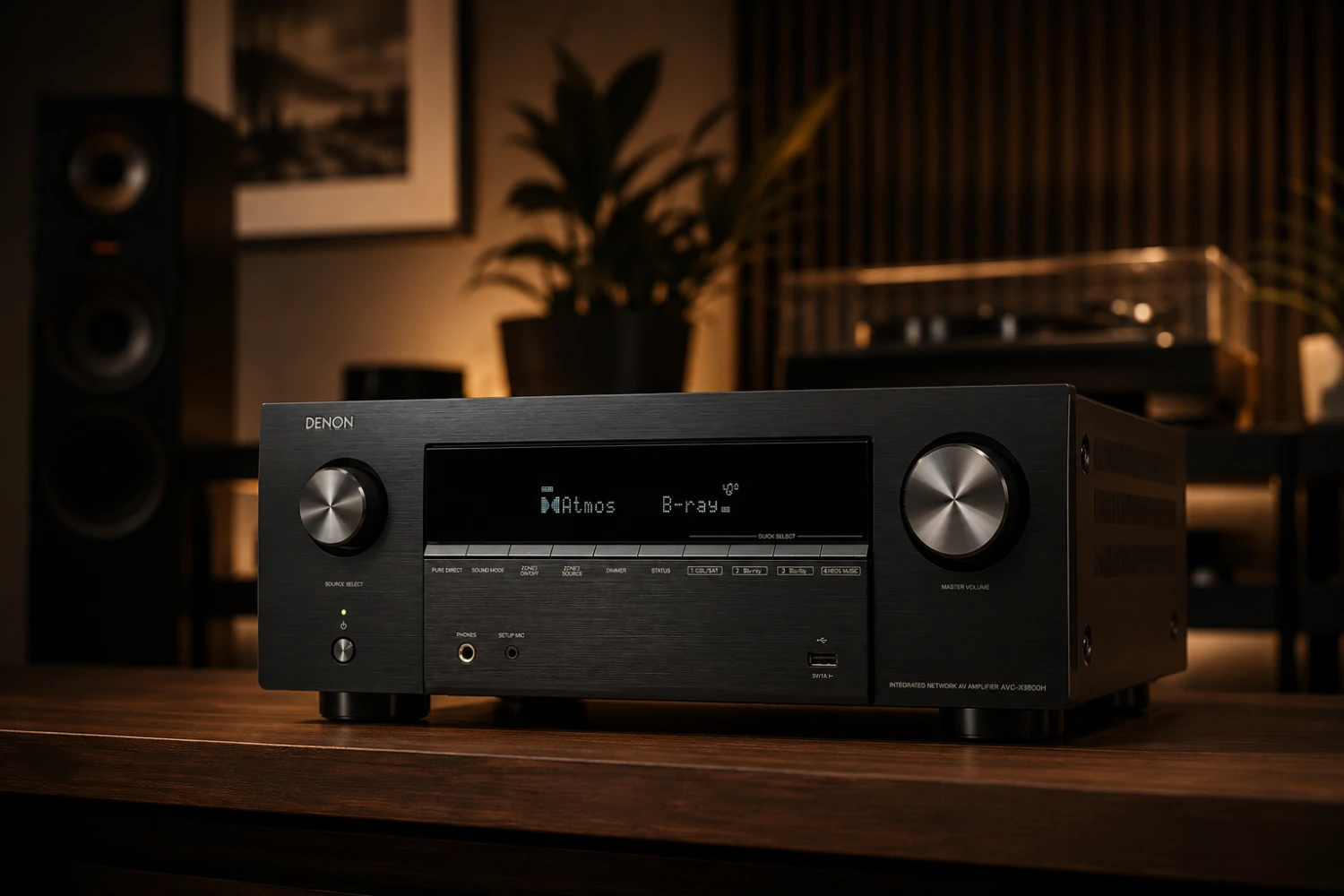
8. Denon AVC-X3900H
The Denon AVC-X3900H combines nine amplified channels, 11.4-channel pre-outs, four subwoofer connections and HEOS streaming.
The Denon AVC-X3900H balances substantial onboard capability with a clear expansion path.
It supplies nine amplified channels and four subwoofer outputs, allowing 7.4.2 or 5.4.4 layouts without another power amplifier.
Its 11.4-channel pre-outs can support larger 7.4.4 or 5.4.6 systems when external amplification or active speakers are added. Denon specifies 105 watts under two-channel, full-bandwidth conditions and a higher 180-watt figure with one channel driven at 1 kHz, illustrating why power claims must be compared using the same test conditions. HDMI 2.1 connectivity and HEOS multiroom streaming round out a receiver designed for systems that may expand.
Best for: Expandable immersive-audio systems
- Nine onboard amplification channels
- 11.4-channel pre-out expansion
- Four subwoofer outputs
- HDMI 2.1 and HEOS support
Verdict: A versatile middle ground for users who need nine channels now and the option to build a larger externally amplified system later.

9. Arcam AVR5
The Arcam AVR5 offers seven Class A/B channels, immersive-audio decoding and processor outputs for a 7.1.4 system.
The Arcam AVR5 is a seven-channel Class A/B receiver presented as capable with both film soundtracks and music.
Dolby Atmos and DTS:X decoding are included, and processor outputs allow a system to expand as far as 7.1.4 channels with additional amplification.
Seven HDMI inputs and two outputs support 4K Ultra HD signals and HDCP 2.2. Dirac Live is relevant to the design, but the source specifically notes that an automatic-calibration microphone is not included, so buyers should verify the additional hardware and licensing needed for their intended setup.
Best for: Music-conscious 4K theater systems
- Seven Class A/B amplification channels
- Dolby Atmos and DTS:X decoding
- Expandable to 7.1.4 with external amplification
- Seven HDMI inputs
Verdict: A seven-channel receiver with useful processor expansion, though its Dirac calibration requirements deserve attention before purchase.

10. Naim NAC 252
The Naim NAC 252 is an analog stereo preamplifier with DIN and RCA connectivity, regulated supplies and a unity-gain option.
The Naim NAC 252 is a high-end analog stereo preamplifier, not an AV receiver.
Its connectivity includes traditional DIN inputs, two configurable RCA inputs and a configurable unity-gain input that can help integrate it into a wider system.
Ten independently regulated power supplies are fed by a matched SuperCap supply, while the digital control and relay sections receive separate regulated supplies. It requires separate power amplification and provides none of the surround decoding or HDMI switching expected from an AV receiver.
Best for: Dedicated high-quality analog stereo systems
- DIN and configurable RCA inputs
- Configurable unity-gain input
- Separately regulated control and relay sections
- Matched SuperCap power supply
Verdict: A specialized stereo preamplifier for an existing separates system rather than a solution for multichannel home cinema.
Frequently asked questions
How can I tell whether a product is a genuine AV receiver?
A conventional AV receiver combines multichannel amplification, surround-format decoding and video-source switching, usually through HDMI.
A stereo network receiver, wireless speaker, disc player or analog preamplifier may belong in the same system, but it does not perform all three roles.
How many amplified channels do I need?
Match the receiver to the intended speaker layout.
A 5.1.2 system needs seven amplified channels, while layouts such as 5.4.4 or 7.4.2 require nine.
Larger configurations may need eleven or fifteen channels, or a receiver with suitable pre-outs for external power amplifiers.
Why do AV-receiver power ratings need careful comparison?
Power figures change with the test conditions, including the number of channels driven, speaker impedance, frequency range and distortion limit.
A full-bandwidth rating with two channels driven should not be compared directly with a higher figure measured using one channel and a 1 kHz test tone.
Should room correction influence the buying decision?
Yes, especially in irregular rooms or systems with several subwoofers.
Confirm whether the desired correction software is included, whether advanced bass control needs a separate license, and whether a compatible measurement microphone must be purchased.
Choosing the Right Receiver for the Room and System
Begin with the speaker layout rather than the longest feature list.
The Sony STR-DH790 covers a conventional 5.1.2 installation, the Arcam AVR5 offers seven-channel Class A/B amplification with a route to 7.1.4, and the Denon AVC-X3900H provides nine channels plus 11.4-channel pre-outs for later expansion.
The Denon AVC-A1H belongs in a different class of installation, where fifteen amplified channels and four independent subwoofer outputs can actually be used. Video requirements should be defined just as carefully. Count every source and display that needs HDMI, then check bandwidth and feature support for the specific inputs and outputs rather than relying on an HDMI version label alone. Features such as 4K high-frame-rate video, 8K transmission, eARC, VRR and ALLM matter only when the connected sources and displays use them. Allow for the complete system cost and setup process. External amplifiers may be necessary to reach the maximum processor configuration, while advanced room and bass correction can require separate software licenses and measurement microphones. Multiple subwoofer outputs are most useful when they can be managed independently and integrated properly with the room. Finally, keep source components, speakers and stereo electronics in their proper roles. The Pioneer player can feed an AV receiver, the Citation Tower and Yamaha MusicCast system offer alternative approaches to integrated audio, and the Naim and Cocktail Audio products address stereo systems. None should be mistaken for a multichannel receiver simply because it can occupy a central position in an entertainment setup.