
A convincing home cinema system is not built from one specification alone.
The components here cover different roles, from powerful AV receivers and a dedicated surround processor to a universal disc player, a complete entry-level package, and a cinema-focused center speaker.
Each one earns attention for a clear reason found in the source material, whether that is channel count, room correction, HDMI support, disc compatibility, or front-channel dialogue performance. This guide is organized as an editorial shortlist rather than a single ranking of identical products. Some models are designed to anchor ambitious immersive systems with external amplification, while others are better suited to compact rooms, straightforward 5-channel setups, or users who want modern video features without a full-scale separates installation. The key is matching the component to the system you actually plan to build. A 12-channel processor or 11-amplifier receiver is compelling only if your speaker layout can use it; a slim 7.2-channel receiver makes more sense where space matters; and a serious center speaker can be the most audible upgrade in a movie system where dialogue clarity is the priority.

1. Arcam AVR11: High-performance 12-channel AV receiver
Arcam AVR11 AV receiver with prominent front-panel volume control and premium surround processing focus.
The Arcam AVR11 is aimed at systems where surround processing, calibration, and amplifier quality matter as much as the feature list.
It is described as a premium 12-channel AV receiver with Class AB amplification, support for Dolby, DTS, and IMAX Enhanced technologies, and full 12-channel Dirac Live calibration.
The source notes that it is compatible with Dolby Atmos in a 5.1.2 setup from the receiver itself, while a 7.1.4-channel configuration requires adding a 4-channel power amplifier or two stereo amplifiers. That makes the AVR11 especially relevant for owners who are willing to expand the system rather than expecting the receiver alone to power every possible channel.
Best for: Serious Atmos systems with room calibration and planned amplification expansion
- 12-channel surround platform
- Class AB amplification
- Full 12-channel Dirac Live calibration
- AirPlay 2 and Chromecast streaming
Verdict: The Arcam AVR11 is a strong choice for enthusiasts who want premium surround processing and Dirac Live, provided they understand the extra amplification needed for a full 7.1.4 layout.

2. Denon AVC-X6800H: Premium AV receiver equipped with 11 built-in power amplifiers
Denon AVC-X6800H premium AV receiver designed for large multi-speaker home cinema layouts.
The Denon AVC-X6800H is positioned as a highly versatile premium AV receiver with 11 built-in power amplifiers and processing that can support larger home theater layouts.
The source highlights decoding for popular surround formats, IMAX Enhanced certification, modern HDMI support across inputs and outputs, and ARC/eARC for routing TV audio through a single HDMI connection.
It can be configured for Dolby Atmos, DTS:X, and Auro-3D systems such as 9.2.4 or 7.4.4, while its 13.4-channel processor output allows expansion with external power amplifiers. Support for up to four subwoofers is another important distinction for users trying to achieve smoother bass coverage in the room.
Best for: Large immersive theaters needing many amplified channels and flexible bass setup
- 11 built-in power amplifiers
- IMAX Enhanced certified
- 13.4-channel processor output
- Supports up to four subwoofers
Verdict: The Denon AVC-X6800H suits ambitious home cinemas that need high channel flexibility, modern HDMI features, and the option to expand beyond its built-in amplification.

3. Pioneer VSX-534: Entry-Level AV Receiver That Delivers Serious Home Cinema Power
Pioneer VSX-534 entry-level AV receiver with traditional black front panel and rotary controls.
The Pioneer VSX-534 represents the entry point into Pioneer's VSX receiver range and keeps to a classic five-channel design.
The source describes it as a traditional black hi-fi component with a relatively short chassis, large rotary selectors, and visible emphasis on 4K signal handling.
Its appeal is straightforward: it is not trying to be a large immersive-audio centerpiece, but rather a practical AV receiver for a conventional surround setup. For buyers building a first home cinema or replacing an older receiver, that simpler five-channel approach can be easier to place, wire, and operate.
Best for: Simple 5-channel home cinema systems
- Entry-level AV receiver
- Classic five-channel design
- Relatively short chassis
- 4K signal indication
Verdict: The Pioneer VSX-534 is most persuasive as a straightforward, space-conscious receiver for users who want a conventional surround system rather than a complex height-channel layout.
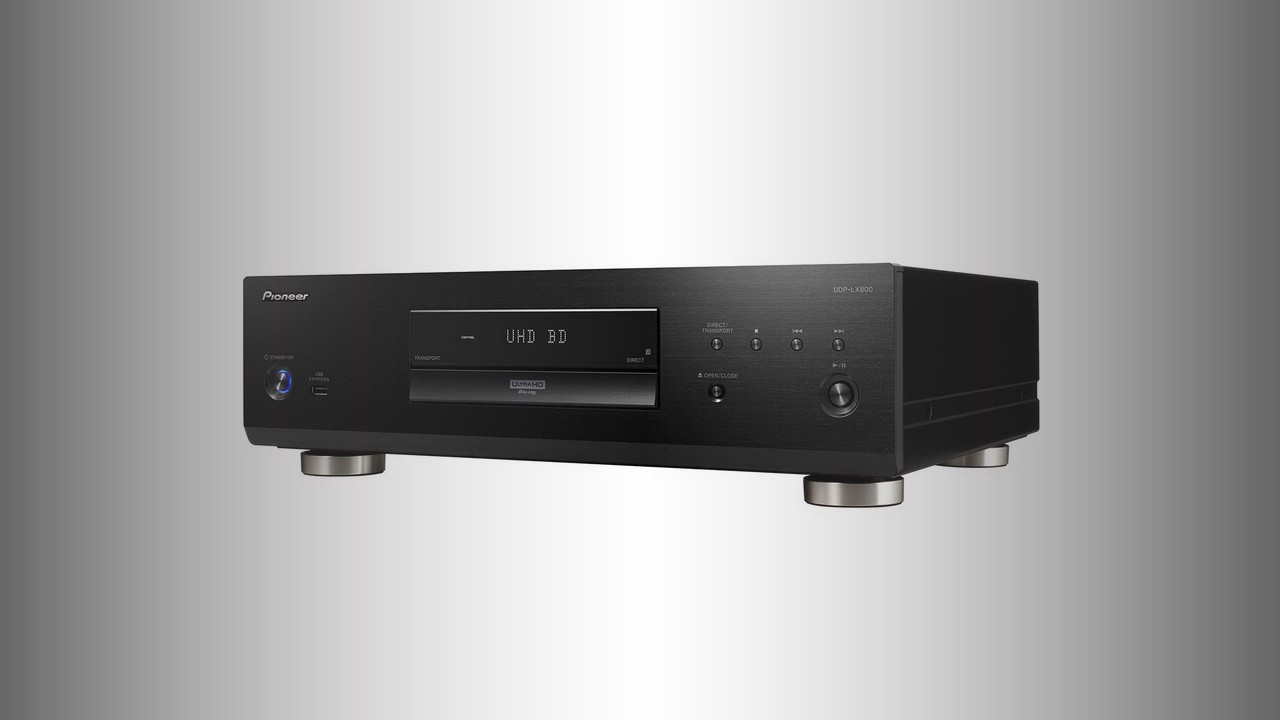
4. Pioneer UDP-LX800: Top-class universal player
Pioneer UDP-LX800 universal disc player built for Ultra HD Blu-ray, SACD, and other physical media formats.
The Pioneer UDP-LX800 is the source component in this guide, and its strength is broad disc support combined with a heavily engineered chassis.
It plays CD, DVD, DVD-Audio, DVD-Video, SACD, and Ultra HD Blu-ray discs, while also supporting Dolby Vision and HDR10.
The source emphasizes anti-vibration construction, a floating drive, internal isolation between power supply, digital, and analog sections, and two HDMI outputs for separating video and audio streams. Its audio section borrows from Pioneer's PD-70AE SACD player design and uses 32-bit ESS Sabre DACs, but the article makes clear that its main talents are still in video.
Best for: Disc-based home cinemas and universal media collections
- Plays major disc formats including Ultra HD Blu-ray and SACD
- Dolby Vision and HDR10 support
- Separate HDMI outputs for video and audio
- Anti-vibration construction
Verdict: The Pioneer UDP-LX800 is for viewers who still value a serious universal disc player with robust construction and high-grade video handling.

5. Onkyo HT-S3705: Home cinema system with true high-resolution surround sound
Onkyo HT-S3705 home cinema system centered on an entry-level receiver with five-channel surround capability.
The Onkyo HT-S3705 article focuses on an entry-level home cinema system built around Onkyo's TX-SR333 receiver.
The source highlights five channels of discrete WRAT amplification, support for ultra-high-definition video signals up to 60 Hz, six HDMI 2.0 inputs, built-in Bluetooth, HDMI pass-through, Hybrid Standby mode, and USB high-resolution audio transmission.
It is presented as an accessible route into true high-resolution surround sound rather than a high-channel immersive installation. For buyers who want a practical package with the core functions covered, its value lies in combining amplification, HDMI connectivity, and wireless convenience in one system-oriented proposition.
Best for: Entry-level surround systems with practical HDMI connectivity
- Five-channel WRAT amplification
- Six HDMI 2.0 inputs
- Built-in Bluetooth
- HDMI pass-through with Hybrid Standby
Verdict: The Onkyo HT-S3705 is best viewed as a sensible starting point for true surround sound, especially where five channels and everyday connectivity are the priority.

6. Marantz Cinema 70s: Modern 7.2-channel AV receiver
Marantz Cinema 70s slim AV receiver designed for modern 7.2-channel home cinema installations.
The Marantz Cinema 70s is a low-profile 7.2-channel AV receiver for users who want current video features and immersive-audio options without a full-height chassis.
The source states that it supports 8K at 60 Hz through three of its six HDMI inputs, along with HDR10+, Dynamic HDR, VRR, QMS, ALLM, QFT, 4K at 120 Hz video broadcasting, and 8K upscaling.
On the audio side, it handles Dolby Atmos and DTS:X in a 5.1.2-channel configuration, plus virtual Dolby and DTS height modes for systems without dedicated height speakers. Audyssey MultEQ, Dynamic Volume, and Dynamic EQ are included for room-based setup and optimization.
Best for: Compact cabinets and modern 7.2-channel systems
- Low-profile 7.2-channel design
- Three HDMI inputs with 8K 60 Hz support
- Dolby Atmos and DTS:X in 5.1.2
- Audyssey MultEQ calibration
Verdict: The Marantz Cinema 70s is a smart fit where space is limited but current HDMI features, room calibration, and modest immersive audio remain important.

7. Lyngdorf MP-40 2.1: The brain of a home cinema that actually understands your room
Lyngdorf MP-40 2.1 surround processor for a separates-based immersive home cinema system.
The Lyngdorf MP-40 2.1 is the dedicated surround processor in this selection, meaning it is intended for systems using separate power amplification.
The source describes it as a fully digital 12-channel surround processor with HDMI 2.1, 8K support, immersive audio format handling, and Lyngdorf's RoomPerfect room-correction system.
It sits below the flagship MP-60 and is presented as offering the same sound quality, digital architecture, and RoomPerfect processing without expansion options that some users may not need. With three HDMI inputs and two HDMI outputs noted in the source, it is clearly aimed at carefully planned, higher-end systems rather than simple receiver-based setups.
Best for: High-end separates-based home cinemas
- Fully digital 12-channel processor
- RoomPerfect room correction
- HDMI 2.1 with 8K support
- Three HDMI inputs and two HDMI outputs
Verdict: The Lyngdorf MP-40 2.1 is the specialist choice for a serious processor-led theater where room correction and digital signal control are central to the design.

8. Dali launches Rubikore Cinema center speaker
DALI RUBIKORE CINEMA center speaker with rotating hybrid tweeter for horizontal or front-channel use.
The DALI RUBIKORE CINEMA addresses one of the most important loudspeaker roles in a home cinema: the front soundstage, especially dialogue and screen-centered effects.
The source describes it as the central speaker in the RUBIKORE series and notes that it can also be used across the front left, right, and center channels.
It features two 6.5-inch SMC Clarity Cone bass/midrange units and DALI's double hybrid tweeter, with the hybrid tweeter module able to rotate 90 degrees for horizontal placement beneath a TV or screen. The article also says it can deliver strong results in a surround setup even without a separate subwoofer, making it more than a conventional dialogue-only center.
Best for: Front-stage upgrades and center-channel clarity
- Designed for dialogue and film effects
- Two 6.5-inch SMC Clarity Cone drivers
- Rotating hybrid tweeter module
- Can be used across front channels
Verdict: The DALI RUBIKORE CINEMA is a focused upgrade for systems where the center speaker and front soundstage need greater precision and placement flexibility.

9. Marantz SR7015: IMAX Enhanced 9.2-channel AV receiver
Marantz SR7015 9.2-channel AV receiver with IMAX Enhanced certification and extensive surround-format support.
The Marantz SR7015 is a 9.2-channel AV receiver with IMAX Enhanced certification and wide support for immersive audio and current video formats.
The source lists DTS:X and Dolby Atmos up to a 7.1.4-channel version with an additional stereo amplifier, Auro-3D, and DTS Virtual:X for height effects without ceiling speakers.
Its video feature set includes 8K at 60 Hz, 8K upscaling, HDR10+, Dolby Vision, Dynamic HDR, HLG, HDR10, 4K at 120 Hz, QFT, and ALLM. Marantz HDAM modules, current feedback, 125 W per channel at 8 ohms, 32-bit AK4458 DAC conversion, network and USB Hi-Res playback, and Audyssey MultEQ XT32 calibration give it a broad feature base for a serious receiver-led theater.
Best for: Feature-rich 9.2-channel receiver-based theaters
- IMAX Enhanced certified
- Supports Dolby Atmos, DTS:X, Auro-3D, and DTS Virtual:X
- 8K video and 4K 120 Hz support
- Audyssey MultEQ XT32 calibration
Verdict: The Marantz SR7015 remains compelling for users who want a full-size receiver with advanced calibration, broad format support, and room to build toward 7.1.4 with extra amplification.

10. Denon AVR-X2700H: AV Receiver equipped with a automatic home theater calibration system
Denon AVR-X2700H AV receiver with 7.2-channel layout and modern HDMI connectivity.
The Denon AVR-X2700H is a 7.2-channel AV receiver that combines discrete high-current amplification with a modern HDMI feature set.
The source notes six HDMI inputs and two outputs, eARC for HD and 3D TV audio return, support for 8K at 60 Hz and 4K at 120 Hz, and 8K upscaling available on all six HDMI inputs.
HDR support includes HDR10, HDR10+, Dynamic HDR, HLG, and Dolby Vision. Gaming-relevant features such as VRR and ALLM are also highlighted, making this a practical mid-level choice for users who need both movie playback and responsive modern video connectivity.
Best for: Modern 7.2 systems with strong HDMI needs
- 7.2-channel configuration
- Six HDMI inputs and two outputs
- eARC support
- 8K 60 Hz and 4K 120 Hz video support
Verdict: The Denon AVR-X2700H is a well-rounded receiver for users who want current video compatibility, eARC, and a manageable 7.2-channel speaker layout.
Quick comparison
These products do not all solve the same problem.
The receivers differ by channel count, amplification, calibration, and HDMI capability; the Lyngdorf is a processor for separates; the Pioneer UDP-LX800 is a source component; and the DALI RUBIKORE CINEMA is a loudspeaker upgrade for the front of the room.
| Product | Best for | Verdict |
|---|---|---|
| Arcam AVR11: High-performance 12-channel AV receiver | Premium surround processing with Dirac Live and expansion to larger Atmos layouts | Strong for calibrated immersive systems, especially when external amplification is part of the plan. |
| Denon AVC-X6800H: Premium AV receiver equipped with 11 built-in power amplifiers | Large theaters needing many powered channels and up to four subwoofers | The most flexible receiver option here for ambitious multi-channel and multi-subwoofer installations. |
| Pioneer VSX-534: Entry-Level AV Receiver That Delivers Serious Home Cinema Power | Straightforward five-channel surround systems | A simpler entry-level choice for users who do not need height-channel complexity. |
| Pioneer UDP-LX800: Top-class universal player | Physical disc collections and high-grade video playback | The dedicated source component in the group, built for broad disc compatibility and robust construction. |
| Onkyo HT-S3705: Home cinema system with true high-resolution surround sound | Affordable five-channel home cinema foundations with HDMI and Bluetooth | A practical starting point centered on core surround and everyday connectivity. |
| Marantz Cinema 70s: Modern 7.2-channel AV receiver | Slim installations needing current video features and 5.1.2 immersive audio | The space-conscious option for users who want modern HDMI support in a low-profile chassis. |
| Lyngdorf MP-40 2.1: The brain of a home cinema that actually understands your room | Separates-based theaters built around digital processing and RoomPerfect | A specialist processor for systems where external amplification and room correction are central. |
| Dali launches Rubikore Cinema center speaker | Improving dialogue, front-channel precision, and screen-focused effects | The loudspeaker-focused recommendation for strengthening the front soundstage. |
| Marantz SR7015: IMAX Enhanced 9.2-channel AV receiver | Full-size receiver systems with IMAX Enhanced, Audyssey XT32, and broad format support | A feature-rich receiver for users building a serious surround system with possible 7.1.4 expansion. |
| Denon AVR-X2700H: AV Receiver equipped with a automatic home theater calibration system | 7.2-channel systems needing eARC, 8K support, and gaming-friendly HDMI features | A balanced receiver for modern living-room theaters that need strong connectivity without extreme channel counts. |
Frequently asked questions
Should I choose an AV receiver or a surround processor?
Choose an AV receiver if you want processing and power amplification in one box, as with the Denon, Marantz, Arcam, Pioneer, and Onkyo models here.
Choose a processor such as the Lyngdorf MP-40 2.1 only if you plan to use separate power amplifiers and want a more specialized separates-based system.
How many channels do I really need for home cinema?
A five-channel receiver such as the Pioneer VSX-534 or the Onkyo system can cover a basic surround setup.
A 7.2-channel model such as the Marantz Cinema 70s or Denon AVR-X2700H adds more layout flexibility.
Larger systems with Dolby Atmos, DTS:X, or Auro-3D may benefit from models with more amplification or processing, such as the Denon AVC-X6800H, Arcam AVR11, or Marantz SR7015.
When is external amplification necessary?
External amplification is needed when the speaker layout exceeds what the receiver can power internally.
The Arcam AVR11 requires additional amplification for a 7.1.4-channel setup, and the Marantz SR7015 needs an additional stereo amplifier for Dolby Atmos or DTS:X up to 7.1.4.
The Denon AVC-X6800H can also use additional power amplifiers through its 13.4-channel processor output.
What should I prioritize for clearer movie dialogue?
Start with the center speaker and room setup.
The DALI RUBIKORE CINEMA is specifically described as handling dialogue and film effects in a home cinema system, with driver and tweeter arrangements designed for front-channel use.
Receiver calibration systems such as Dirac Live, Audyssey MultEQ, Audyssey MultEQ XT32, and RoomPerfect can also help align speakers with the room.
How to Choose the Right Home Cinema Component
Begin with the speaker layout you can realistically install.
If the room and budget point toward a straightforward 5-channel system, the Pioneer VSX-534 or Onkyo HT-S3705 concept is more appropriate than a complex processor or 11-amplifier receiver.
If you want a compact 7.2-channel solution with current video features, the Marantz Cinema 70s and Denon AVR-X2700H are easier to justify than a full-scale flagship-style installation. For larger immersive systems, pay close attention to the distinction between processing channels and powered channels. The Arcam AVR11, Denon AVC-X6800H, and Marantz SR7015 all support ambitious layouts, but the sources make clear that some configurations require additional amplification. That is not a drawback if planned properly, but it should be part of the system budget from the beginning. Room correction is another major separator. Dirac Live on the Arcam, Audyssey systems on the Marantz and Denon receivers, and RoomPerfect on the Lyngdorf processor all address the reality that the room strongly affects what you hear. In difficult rooms or high-end installations, this can be more important than simply adding more channels. Do not overlook source and speaker fundamentals. The Pioneer UDP-LX800 is relevant if physical discs remain central to your viewing, especially across multiple formats including Ultra HD Blu-ray and SACD. The DALI RUBIKORE CINEMA, meanwhile, is a targeted front-stage upgrade for dialogue and film effects. The strongest home cinema choice is the one that fixes the weakest part of your actual system rather than the one with the longest specification list.