
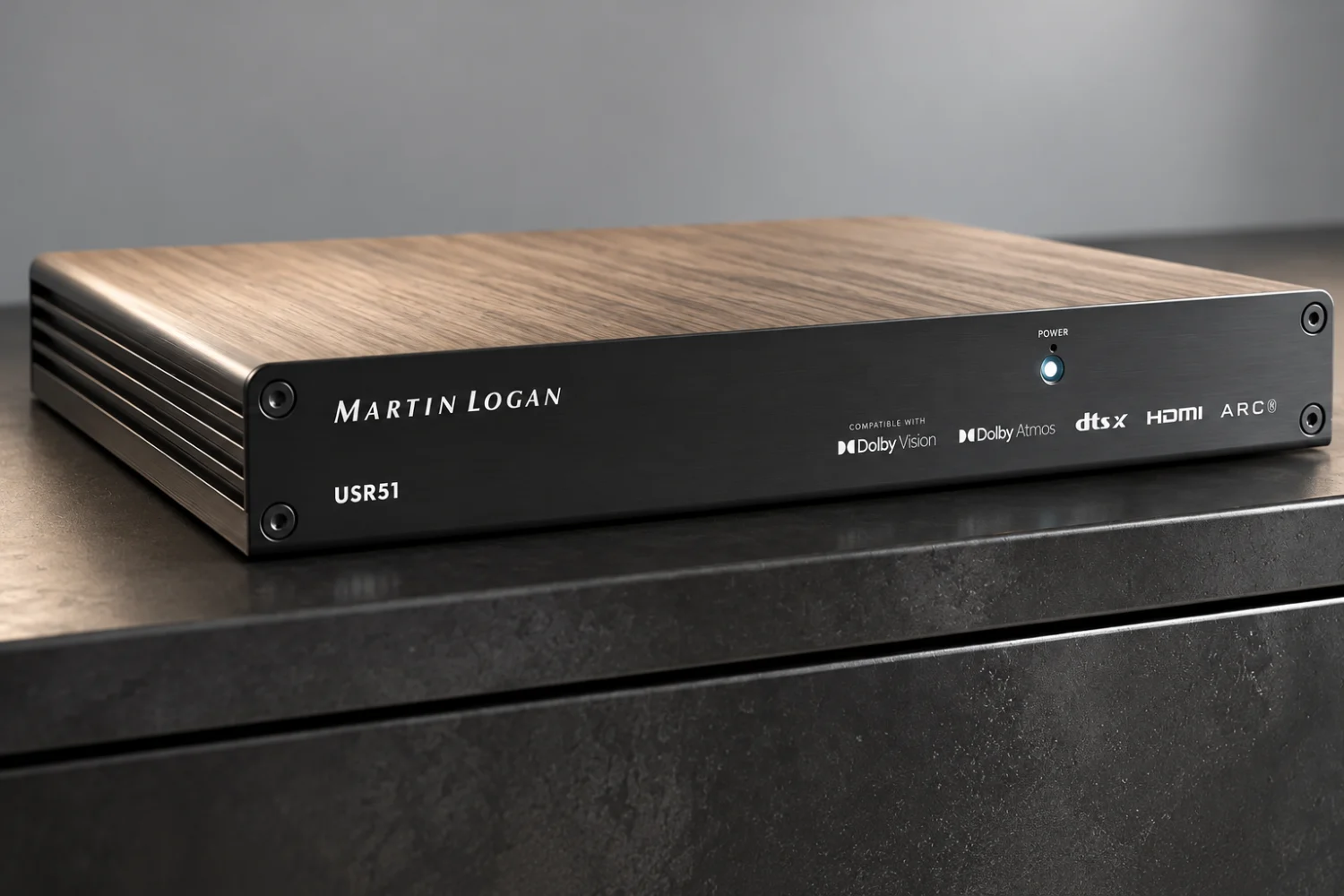
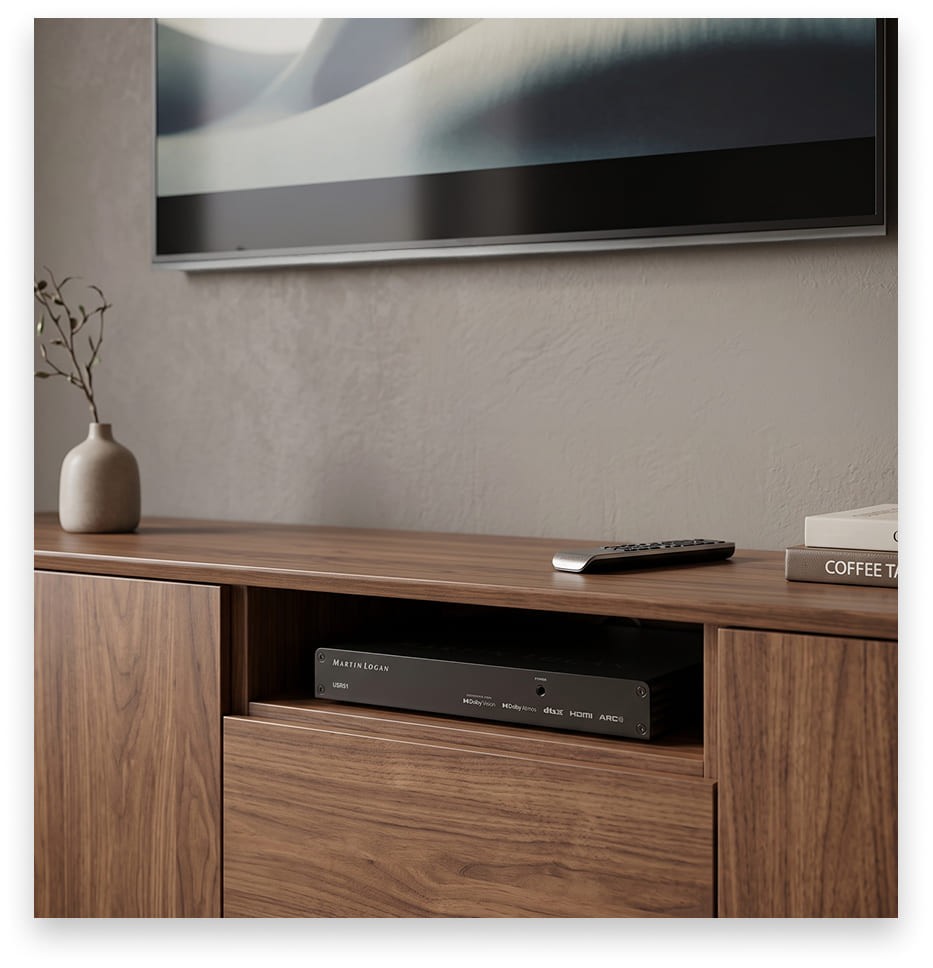
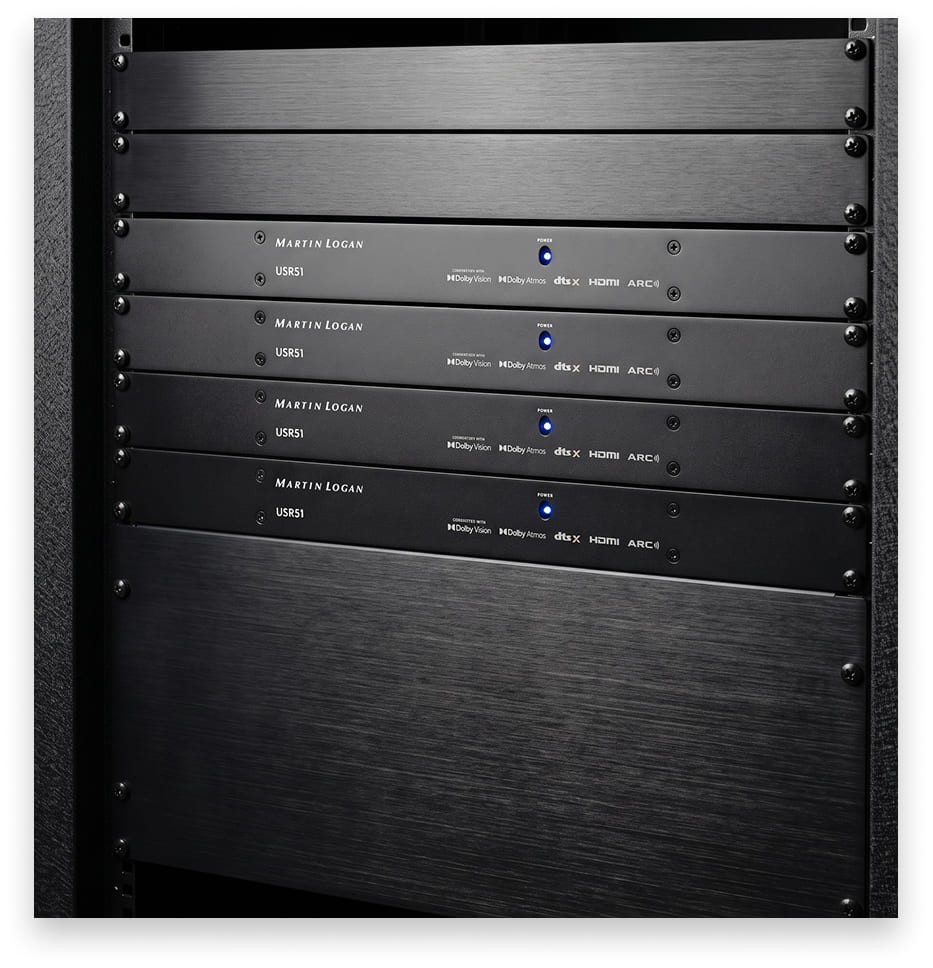
Home cinema electronics usually demand their own shelf, but MartinLogan is taking a different approach with the USR51. This compact 5.1-channel AV receiver is designed to live out of sight behind a television, inside a wall-mounting recess or within shallow furniture. Despite that installation-led format, it includes five channels of Class D amplification, Dolby Atmos and DTS:X support, Dolby Vision video compatibility and Anthem ARC Genesis room correction. The result is a receiver conceived as part of the architecture of a room rather than an obvious component within it, particularly when paired with discreet installed speakers such as MartinLogan’s Motion Discrete Cinema range.

The receiver becomes part of the installation
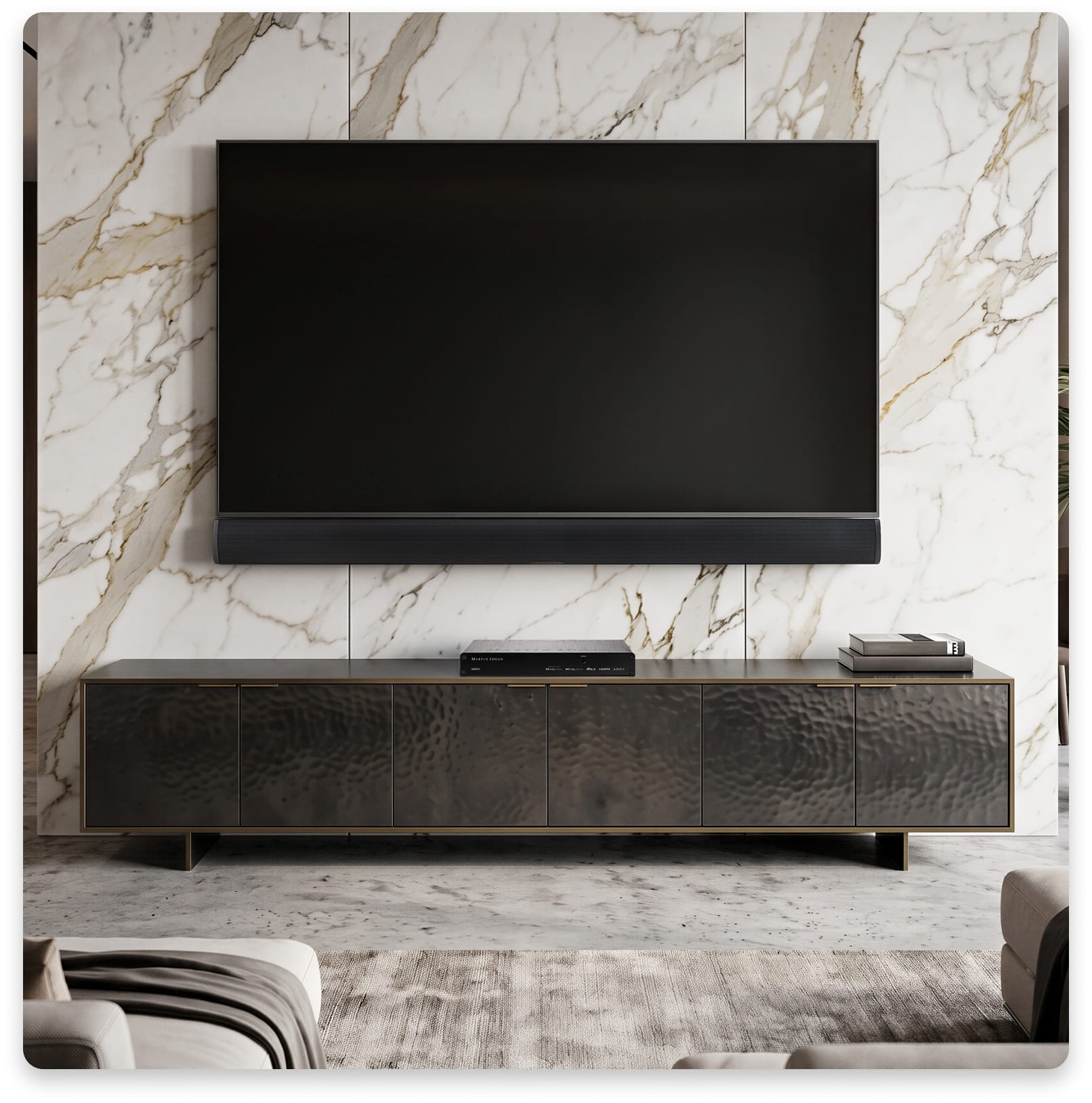
Concealment is the central idea behind the USR51. Instead of treating the receiver as a conventional black box that must remain visible and accessible in an equipment rack, MartinLogan has shaped the product around spaces that are often left unused. A position behind the television is the clearest example, although wall niches and low-depth cabinets are also explicitly supported installation scenarios.
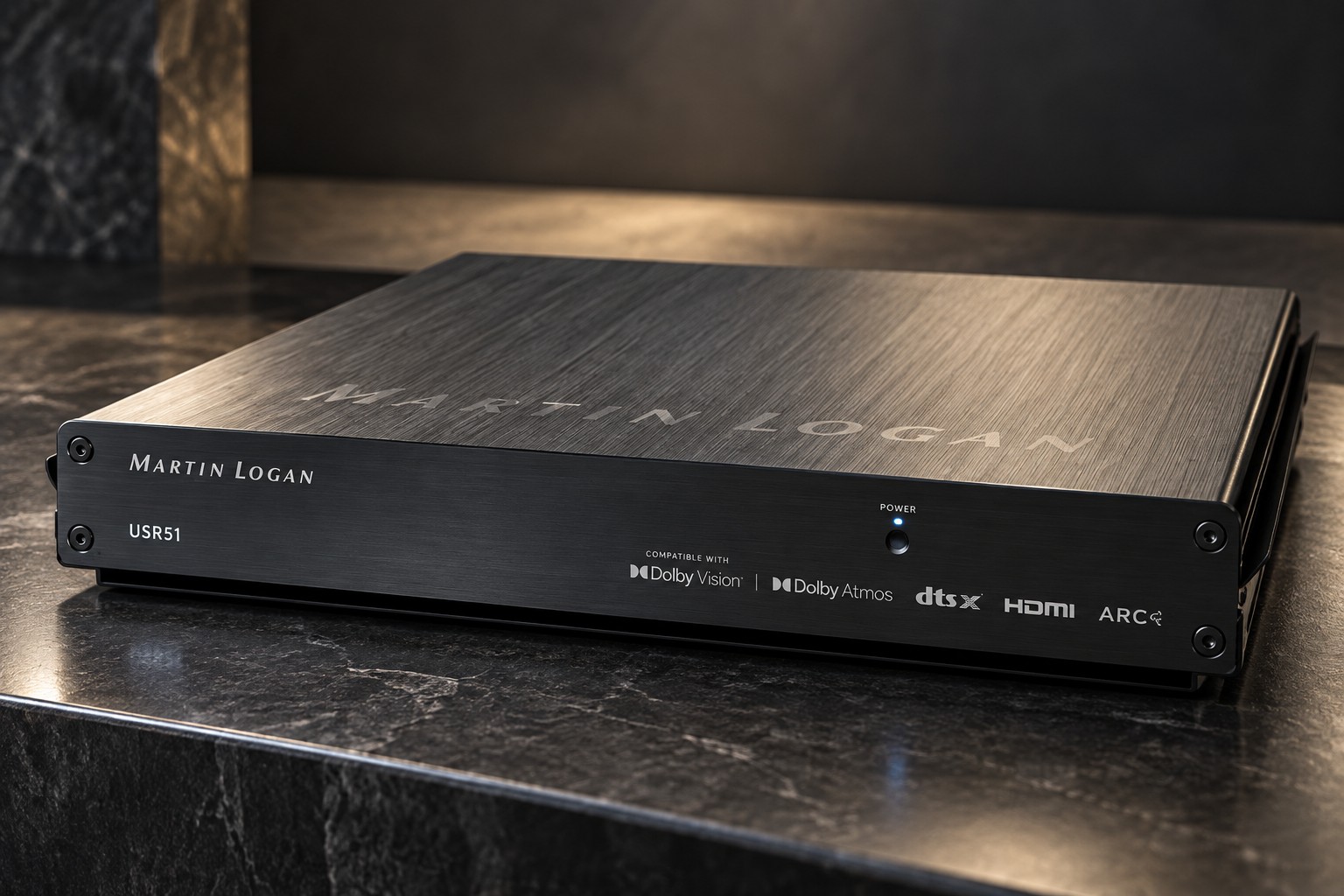
That physical concept has consequences for the type of system the receiver is intended to serve. The USR51 is aimed at rooms where a complete surround arrangement is wanted without allowing the electronics to dominate the interior. MartinLogan specifically connects it with unobtrusive speaker solutions, including the recently introduced Motion Discrete Cinema series. Used together, those products point toward a cinema system that is integrated into the room rather than assembled as a display of separate components.
A shallow, hidden location can also reduce the freedom normally available when choosing AV hardware. MartinLogan addresses that constraint by concentrating five amplified channels, surround decoding and room correction within one compact unit. The announcement does not detail installation clearances or ventilation requirements, so those practical considerations will still need to be checked before the receiver is enclosed in furniture or a mounting cavity.
Familiar Anthem foundations under MartinLogan branding
The USR51 is MartinLogan’s version of the Anthem MRX SLM, with the same stated technical specifications and functionality. That relationship is significant because the compact format is not being introduced as an entirely separate engineering platform. Instead, MartinLogan is placing an established slim receiver design within its own home-cinema ecosystem and giving installers and customers a matching electronics option for its discreet speaker lines.
Five Class D amplifier channels are built in. Each is rated at 50 watts into 8 ohms or 92 watts into 4 ohms, with two channels operating simultaneously. The two-channel condition is an important part of the specification: it should not be interpreted as a claim that the same output is available from all five channels at once. Even so, accommodating lower-impedance 4-ohm loads broadens the range of passive speakers that can be considered, provided the complete installation follows the relevant speaker and receiver requirements.
Class D amplification fits the receiver’s space-conscious brief because it allows the required channels to be housed in a small enclosure. MartinLogan has not supplied further details here about the amplifier topology or thermal management, so the emphasis remains on the combination of channel count, rated output and compact placement rather than on undocumented internal design claims.
A defined 5.1 system rather than an expandable centerpiece
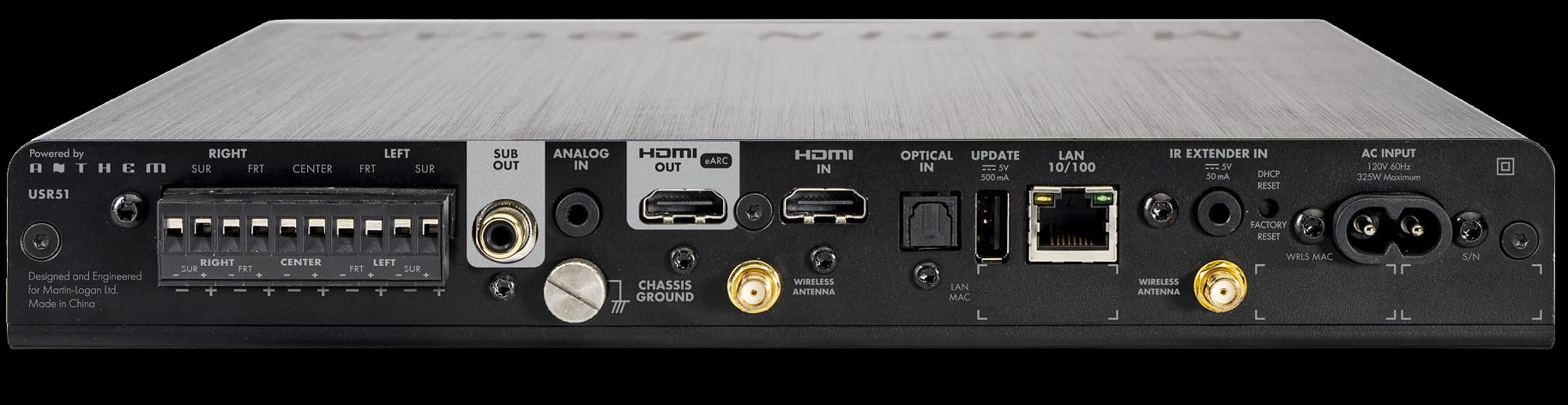
The receiver is designed to power five passive speakers in a 5.1-channel home theater, with bass handled by an active subwoofer. That establishes a clear system boundary: front left and right speakers, a center channel and two surrounds can all be driven directly, while the subwoofer supplies its own amplification. For buyers seeking a conventional surround layout without a large receiver, that focused architecture may be more relevant than a longer list of channels that the room cannot accommodate.
Dolby Atmos and DTS:X format support are included, although the onboard amplification remains a five-channel design. The supplied information does not describe additional amplification paths or a larger speaker configuration, so the USR51 should be understood first as a compact 5.1 receiver rather than as the hub of an extensive multichannel installation. Codec compatibility still matters because it allows the unit to work with current object-based soundtrack formats within its supported system arrangement.
On the video side, Dolby Vision signals are supported. That makes the USR51 suitable for integration into a modern television-based cinema setup where high-dynamic-range video forms part of the source chain. No further video specifications are provided in the announcement, so details beyond Dolby Vision compatibility should not be assumed.
ARC Genesis adapts a hidden system to the room
A receiver intended for discreet speakers and unconventional placement also needs a way to address the acoustic effects of the finished room. The USR51 includes Anthem ARC Genesis automatic room correction and is supplied with a calibrated USB microphone. Measurements gathered through that microphone are used by the software to compensate for room influence and adjust the system’s frequency response.
ARC Genesis runs on Windows and macOS, shifting the detailed calibration process to a computer rather than limiting it to basic controls on the receiver. This is particularly relevant to installed systems, where speaker positions may be governed by architecture, furniture or visual requirements instead of being freely optimized for acoustics. Room correction cannot alter those physical positions, but it provides a documented means of adapting the receiver’s output to the measured environment.
Up to four independent profiles can be stored. MartinLogan presents these as a way to accommodate different listening conditions, speaker arrangements and types of material. Multiple profiles could therefore be useful when a room has more than one seating or usage pattern, although the precise setup choices remain with the user or installer. The feature also gives the USR51 more flexibility than its tightly defined 5.1 hardware layout might initially suggest.
The USR51 appears aimed at homeowners, system designers and installers who have already decided that the electronics should disappear, but who still want passive speakers and a calibrated 5.1 arrangement rather than a single-enclosure audio solution. Its most important design decision is not an exotic processing mode; it is the ability to move the receiver away from the equipment rack and into the television installation itself. Anthem-derived hardware, five Class D channels and ARC Genesis provide the technical structure needed to make that concept workable. Questions remain around exact installation clearances, connection details, release timing and pricing, none of which were specified in the supplied announcement. Those details will determine how easily the USR51 can be incorporated into real projects, especially when space behind a display or inside furniture is tightly controlled.


Sound Off
0Join the discussion if you have something to add.