

2026 has barely started, yet for me it already feels like a continuation of how 2025 ended: deep dives into compact speaker systems that promise far more than their size suggests. This time the spotlight falls on Adam Audio, a name that needs little introduction. Over the past 25 years, the German manufacturer has carved out a formidable reputation in professional audio, particularly for its unmistakable AMT tweeters and studio monitors that balance precision with musicality.
The subject of this review is the Adam Audio D3V, the smallest active monitor in the company’s lineup. On paper, it looks almost toy-like: compact dimensions, light weight, plastic enclosure. In reality, it’s a far more serious piece of equipment—one that challenges expectations of what desktop monitors can deliver, especially in the low end.
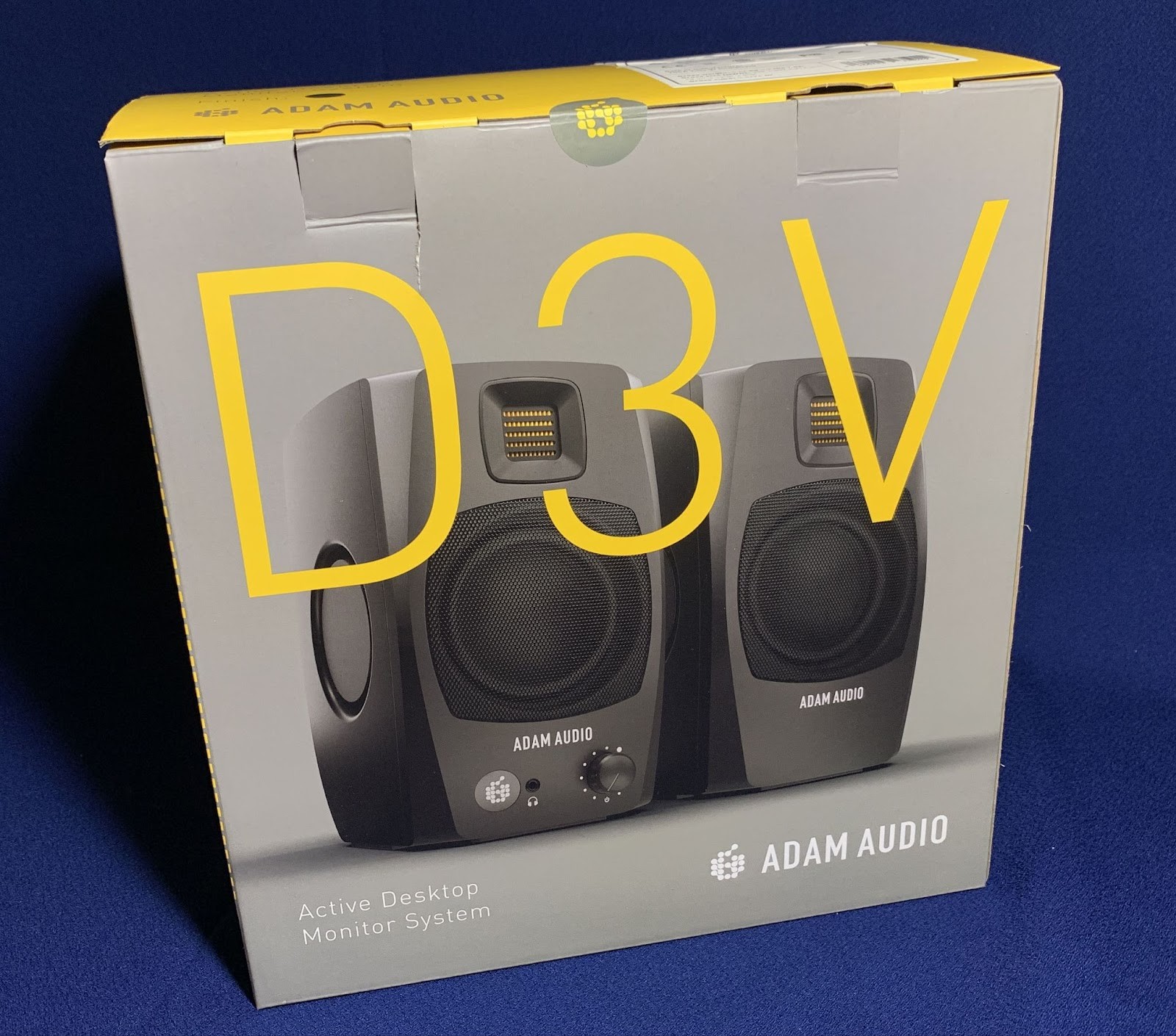
First Impressions and Build Quality
Unboxing the D3V immediately gives a sense that this is a well-considered product. Adam Audio ships the monitors in a double-layer package: a robust outer shipping box and a clean, modern inner box finished in the brand’s familiar yellow-and-grey design language. Everything inside is tightly organized, well protected, and clearly meant to survive real-world transport.
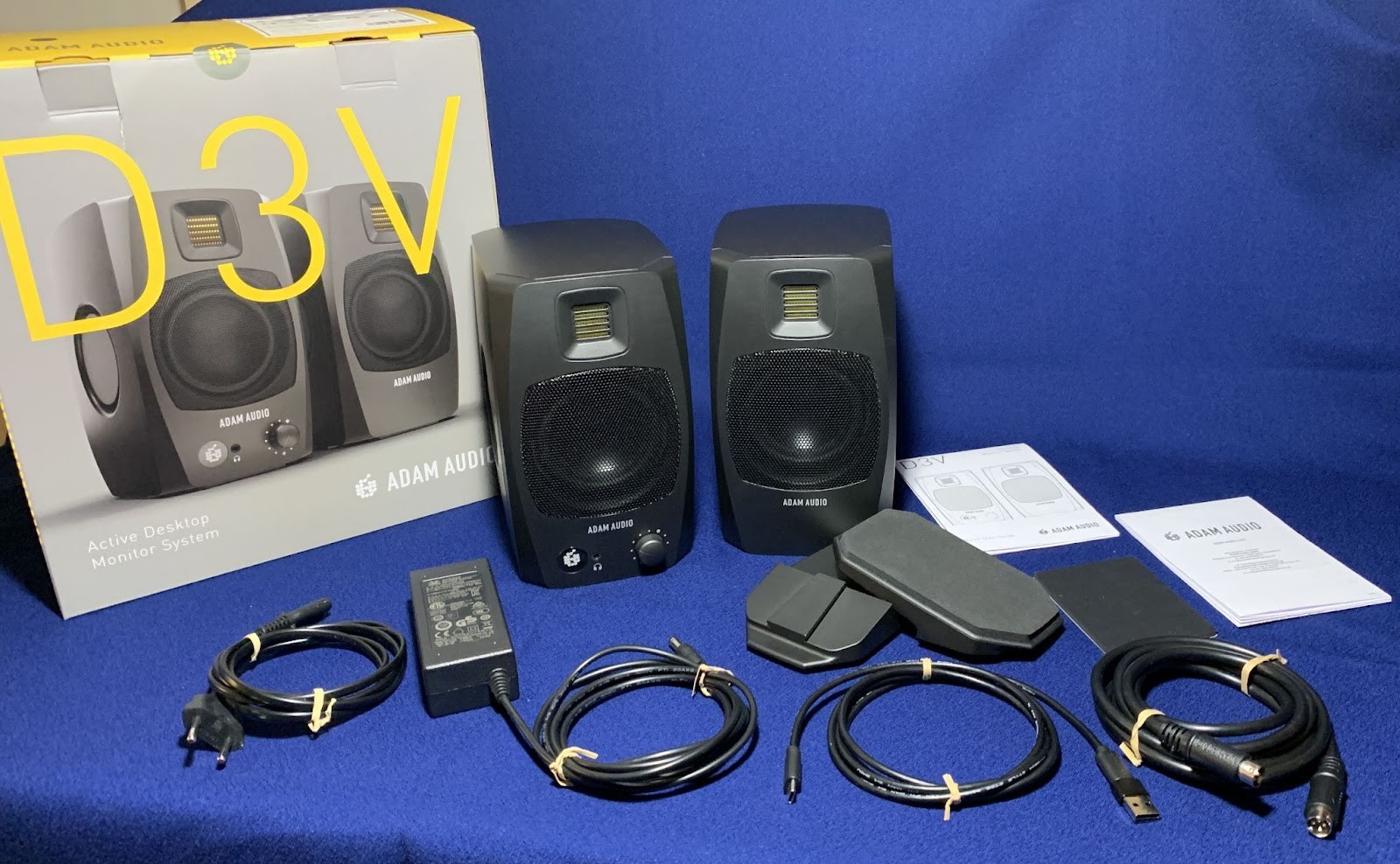
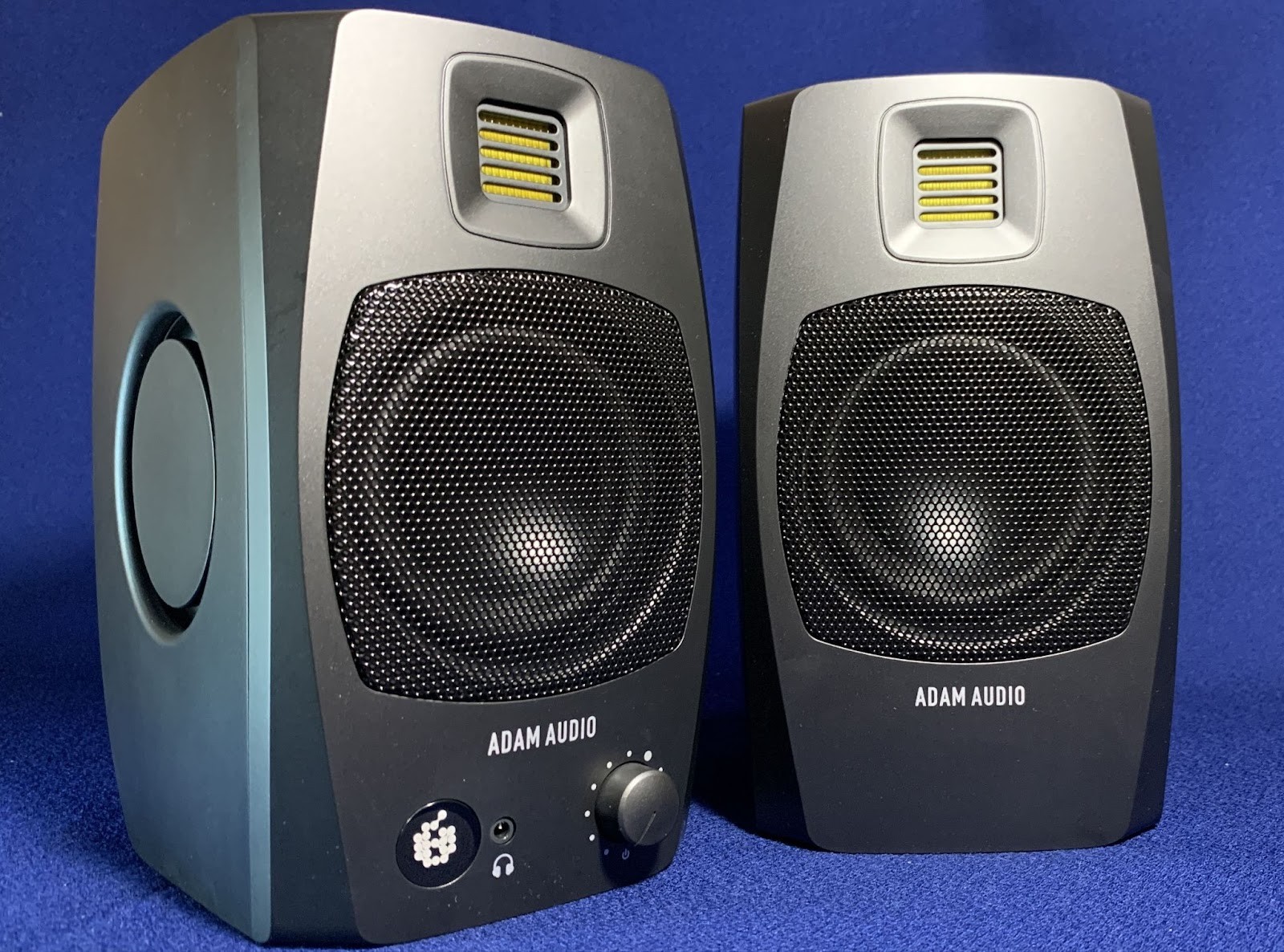
Despite their modest size, the D3V monitors feel solid in hand. The enclosure is made from thick ABS plastic with internal bracing, and while plastic may raise eyebrows among traditional hi-fi enthusiasts, here it works to Adam Audio’s advantage. The cabinet is acoustically inert, free from audible resonances, and the rounded edges help minimize diffraction at higher frequencies.
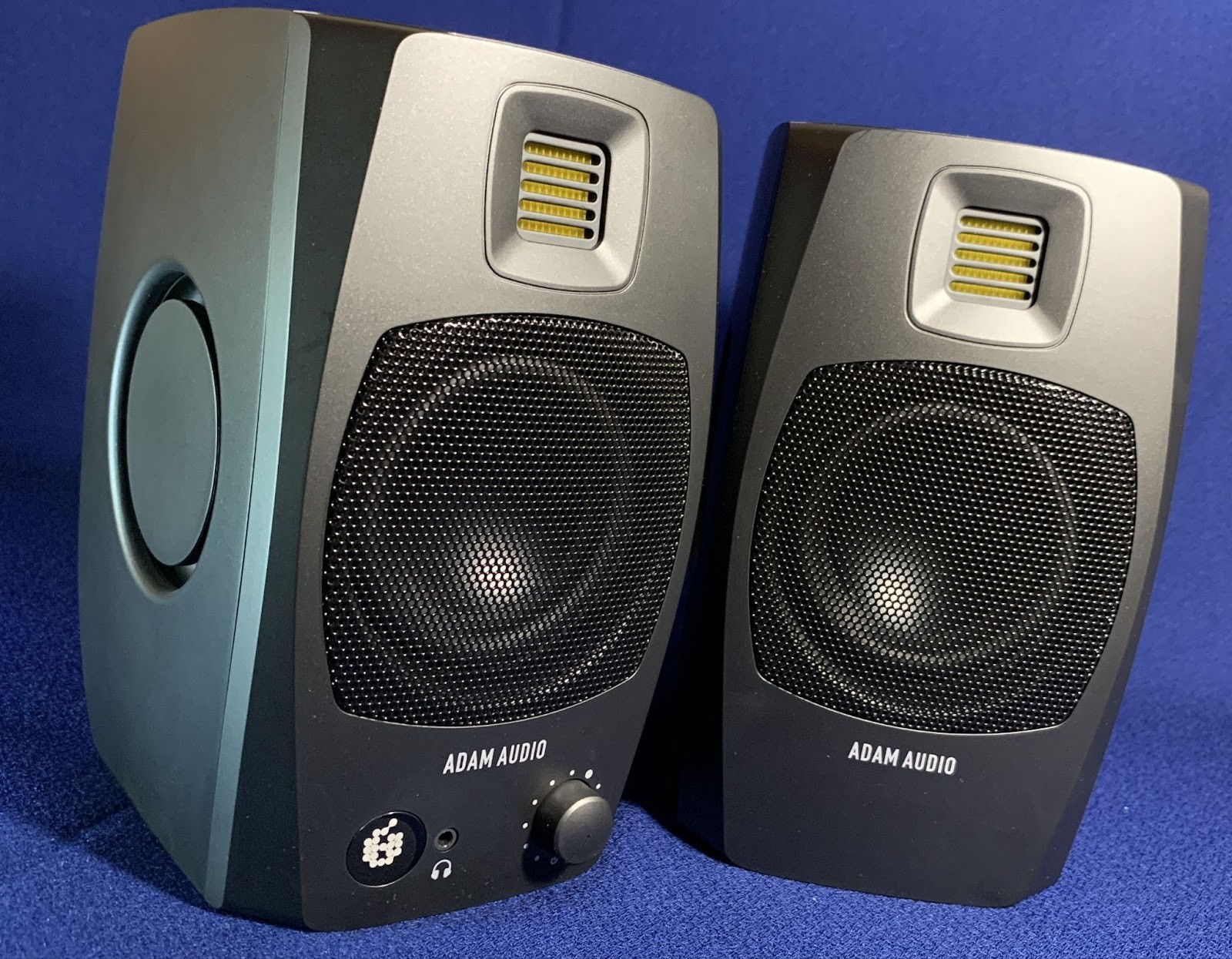
Visually, the D3V is understated and functional. Available in black or white, the slightly tapered shape widens toward the center to increase internal volume, while remaining compact enough for even the most crowded desks. They look modern, professional, and purpose-built rather than decorative.
Compact Design
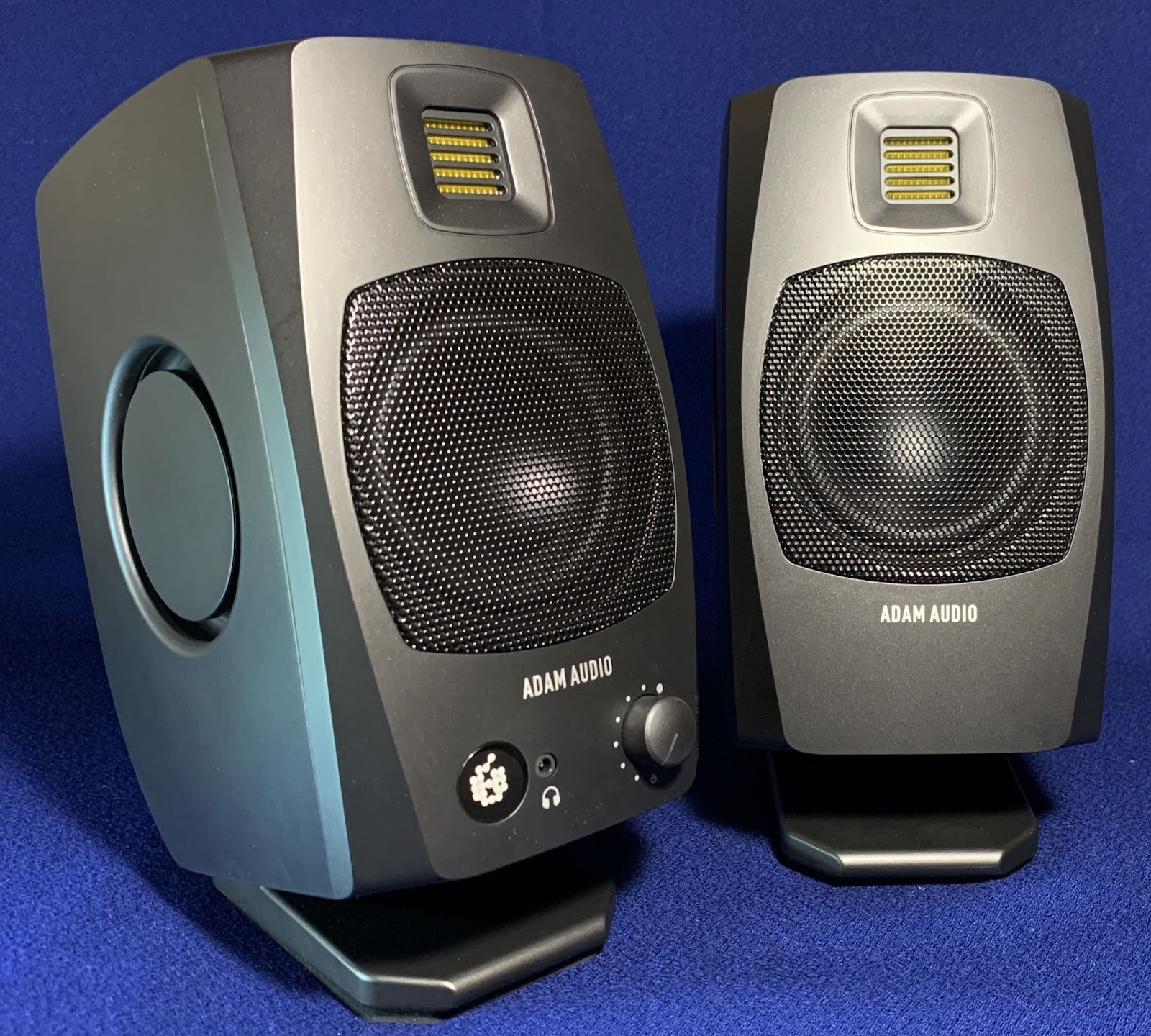
Given their size, placement flexibility is a major strength of the D3V. Adam Audio clearly understands that these monitors will live on desks, shelves, and small stands rather than in large studios. The included angled desktop stands tilt the speakers upward by 15 degrees, ideal for nearfield listening when the monitors sit below ear level. Dense foam padding on the stands helps with isolation and vibration control.
For more traditional setups, a threaded 3/8-inch mount on the bottom allows the D3V to be installed on microphone stands. This option significantly improves performance in larger rooms or when listening distances exceed one meter. Rubber feet are also included for simple surface placement, though using the monitors flat on a desk without isolation quickly reveals why proper positioning matters—these little boxes can move when pushed hard.
Controls and Everyday Usability
On the front panel, Adam Audio keeps things refreshingly simple. A multi-function volume knob doubles as a control button, handling muting, input switching, channel assignment, and sleep mode through various press combinations. Once learned, it becomes second nature.
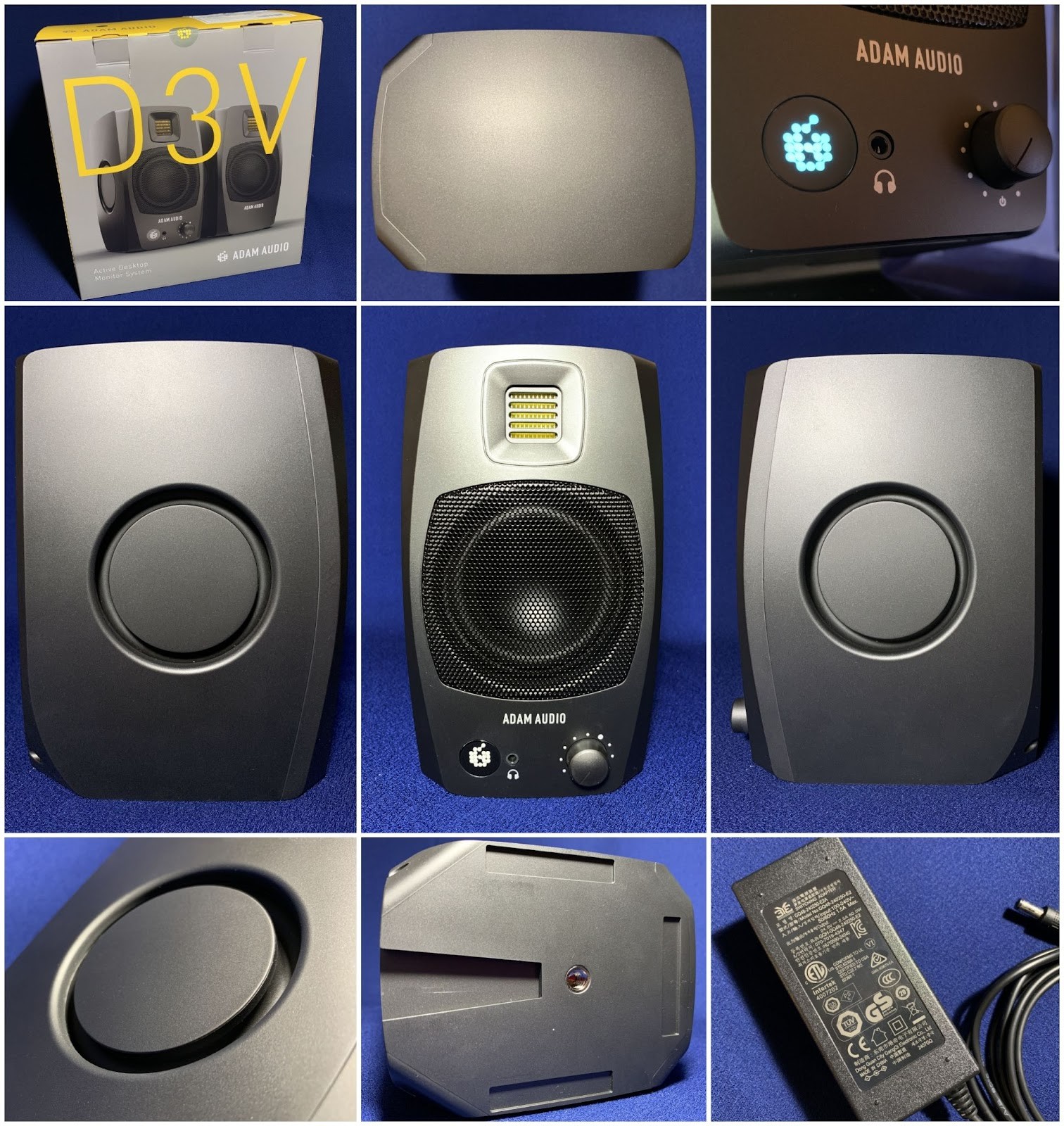
The illuminated Adam Audio logo serves as a multi-color status indicator, clearly communicating input type, operating state, and firmware updates. It’s functional, discreet, and avoids the “gamer RGB” aesthetic that plagues many compact audio products.
A front-mounted headphone output is a welcome addition, especially for late-night sessions or apartment living. Plugging in headphones instantly turns the D3V into a compact desktop monitoring hub, removing the need for an external interface in simple setups.
Connections and DSP Intelligence
The D3V offers both USB-C digital input and balanced TRS analog input, making it equally at home with laptops, phones, tablets, and professional audio interfaces. USB-C connectivity is particularly convenient, allowing direct digital playback without drivers on most modern systems.
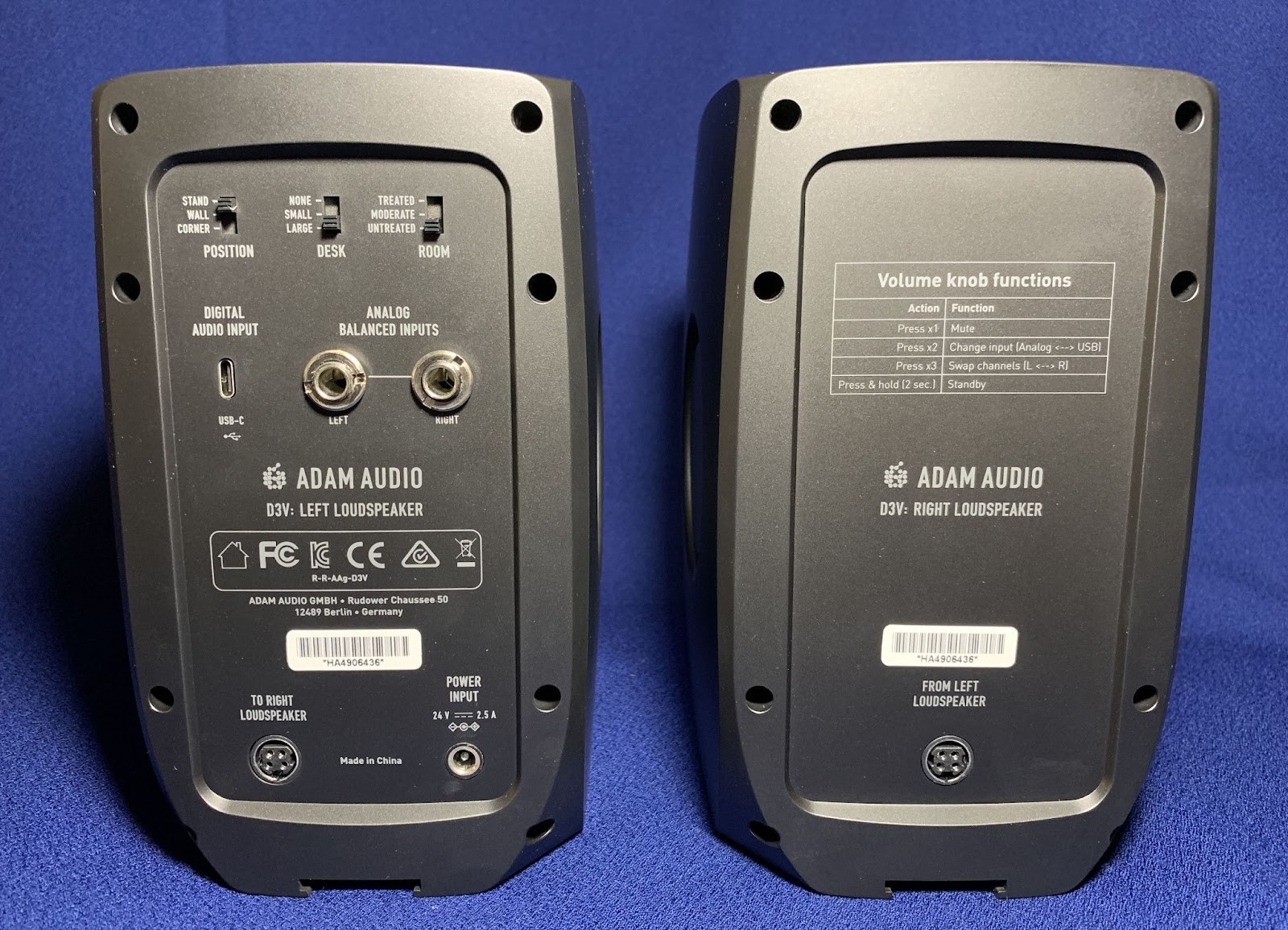
Internally, the system relies on DSP and four dedicated amplifiers—one for each driver—to shape and control the sound. Three rear switches allow adjustment based on speaker position, desk placement, and room acoustics. These aren’t gimmicks; they make a real, audible difference. Small changes in bass and treble behavior can mean the difference between tight, controlled playback and boomy, fatiguing sound in less-than-ideal rooms.
One omission stands out: there is no Bluetooth. For a studio-focused monitor, that’s understandable. For casual listening, some users may miss the convenience. Still, Adam Audio’s priorities here are clearly accuracy and reliability, not lifestyle features.
Driver Technology and Engineering Choices
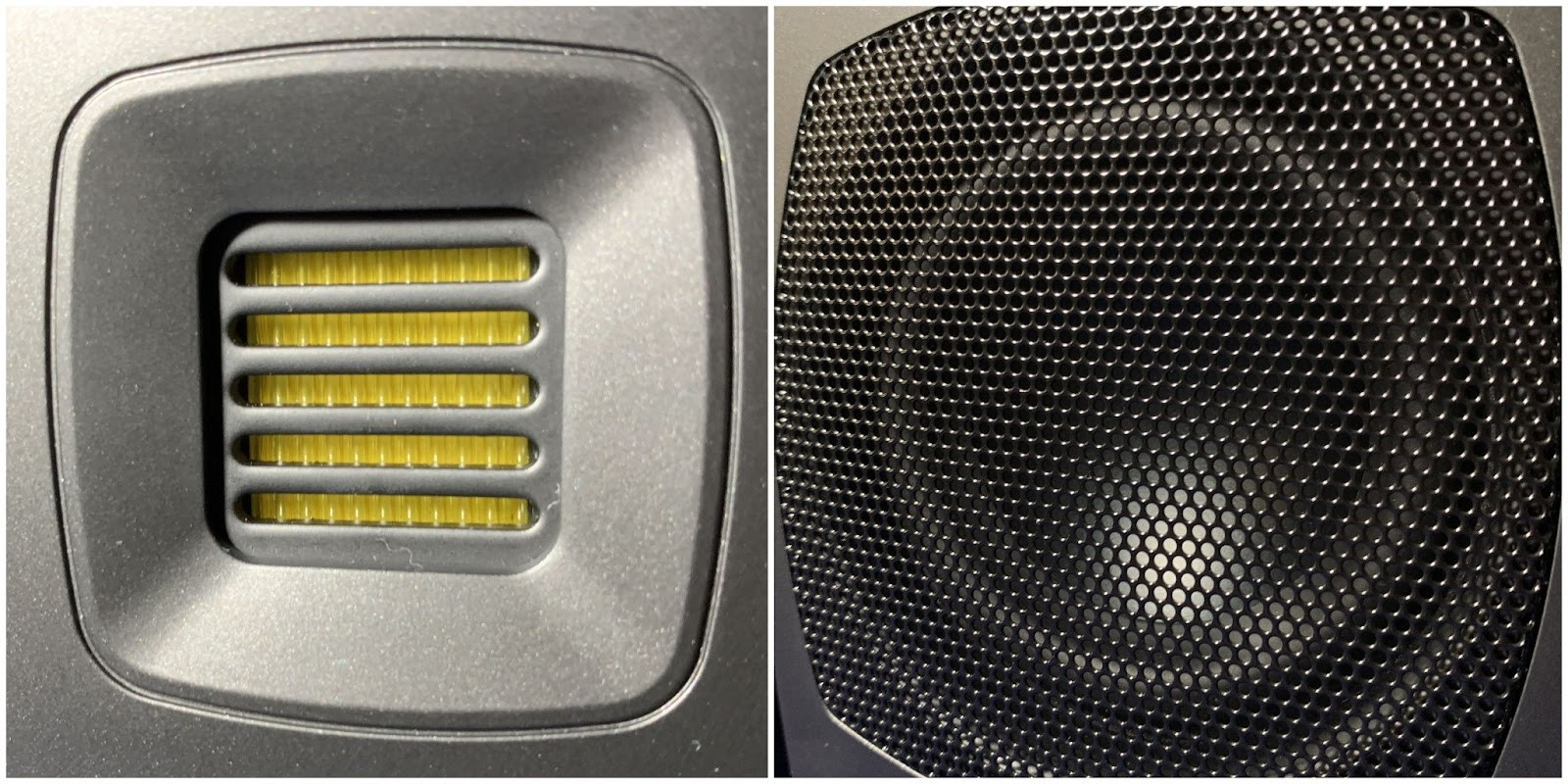
At the heart of the D3V is Adam Audio’s signature D-ART AMT tweeter, a compact implementation of the Air Motion Transformer principle. Instead of pushing air like a conventional dome, the folded diaphragm squeezes and releases it, resulting in extremely fast transient response and exceptional detail retrieval.
The mid-bass duties are handled by a 3.5-inch aluminum woofer, partnered with dual passive radiators of the same size. This choice replaces traditional bass reflex ports and is key to the D3V’s low-frequency performance. The passive radiators allow the system to reach impressively low frequencies without port noise, making the bass feel dense, controlled, and surprisingly deep for such a small enclosure.
Sound Quality
Listening to the D3V for the first time is genuinely surprising. Expectations are modest—then the first track plays, and everything changes.
The bass immediately stands out. It’s not just present; it’s confident, textured, and clean. For a monitor of this size, reaching down to the mid-40 Hz range feels borderline absurd. While it won’t replace a dedicated subwoofer, it delivers enough low-end authority to satisfy both analytical work and casual listening in small rooms.
The midrange is forward, precise, and revealing. Vocals sit slightly closer to the listener than strict neutrality would dictate, which makes flaws in recordings easy to spot. For mixing and editing, this is a strength. For relaxed, background listening, it can occasionally feel intense.
High frequencies are where the D3V truly shines. The AMT tweeter delivers an almost microscopic level of detail. Micro-dynamics, room ambience, string texture, and breath noise are rendered with clarity that borders on addictive. This level of resolution is rare in active monitors of this size and price.
The soundstage, when properly set up in an equilateral triangle, is sharply defined. Imaging is stable, precise, and reliable, provided the speakers aren’t placed too far apart. Despite the wide dispersion of the AMT tweeter, slight toe-in toward the listener yields the best results.
Who Are These Monitors For?
The Adam Audio D3V is not a “warm and forgiving” speaker. It doesn’t smooth over bad recordings or hide imperfections. Instead, it tells the truth—sometimes bluntly. That makes it an excellent tool for producers, editors, and anyone who values insight over comfort.
As pure hi-fi speakers, they may not suit listeners seeking a relaxed, romantic presentation. As compact studio monitors, however, they punch far above their weight.
Conclusion
The Adam Audio D3V is a bold statement in miniature form. It proves that serious engineering, intelligent DSP, and distinctive driver technology can overcome physical limitations. These monitors don’t just compete within their size class—they redefine it.
They are compact, powerful, analytical, and unmistakably Adam Audio. If you need a desktop monitor that tells you exactly what’s in your music—and does so with authority well beyond its dimensions—the D3V deserves your attention.
Small boxes. Big ambition. And sound that refuses to play small.




Sound Off
0Join the discussion if you have something to add.