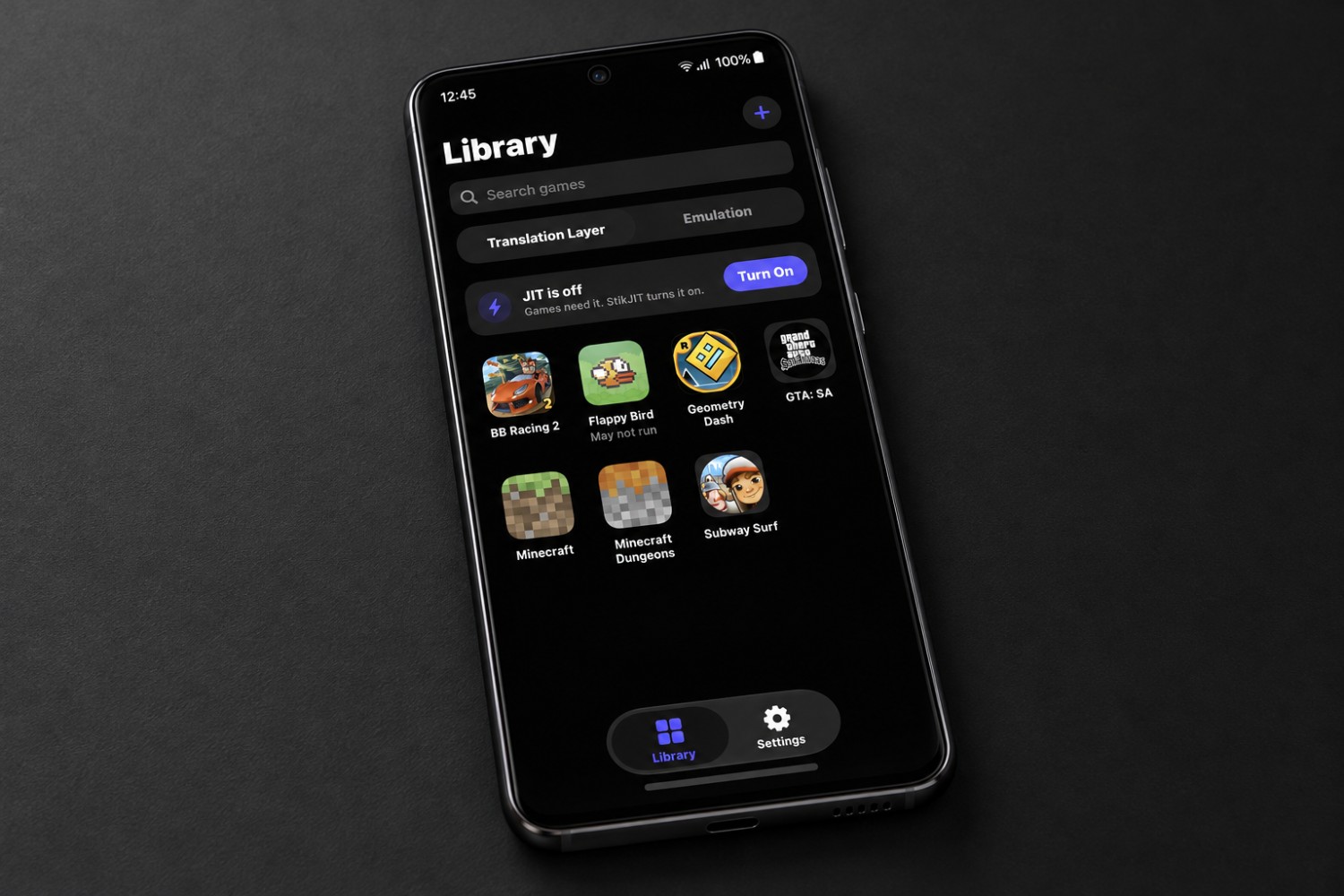
Husk is a project designed to run Android games and applications on the iPhone, using two different approaches to address compatibility. Its primary Translation Layer executes supported native Android code directly on the iPhone processor rather than emulating an Android device. When that method cannot handle an application, Husk can instead load LineageOS inside a QEMU virtual machine. Both options require JIT compilation and sideloading, keeping the software outside Apple’s official App Store.
Translation Layer runs supported code without emulation
Husk’s main operating mode is called Translation Layer. Instead of starting a complete Android operating system, it provides its own implementations of required system libraries and intercepts Java calls made by applications. Native code from supported Android software can then execute directly on the iPhone’s processor.
Graphics translation is another central part of this mode. Husk routes OpenGL ES through ANGLE, while Vulkan is handled through MoltenVK. These established translation components allow graphics calls made by Android games to work with the software environment available on Apple devices.


Avoiding a complete Android system reduces the amount of software that must be loaded before a game can begin. According to the project details, compatible titles can start within seconds. This approach is intended to provide the quickest route for games built with engines and frameworks that Husk already recognizes.
Support covers several widely used game engines
The current compatibility list includes Unity, Unreal Engine 4, Godot 3, Godot 4, cocos2d-x, SDL2 and SDL3. Husk can also work with some proprietary technology. Grand Theft Auto: San Andreas has been launched successfully through the project, demonstrating support for a title based on Rockstar Games’ own engine.
Engine support does not mean every Android application can automatically use the translation route. Software may rely on components that Husk has not implemented, be written entirely in Java or require 32-bit libraries. Those cases are handled through the project’s second, more comprehensive operating mode.
QEMU and LineageOS provide a broader fallback
For applications that cannot run through Translation Layer, Husk can boot a complete Android environment based on LineageOS. This system operates inside a QEMU virtual machine integrated into the project.
The virtual-machine approach is necessary because iOS does not give applications access to a hypervisor. QEMU provides an alternative route, but its additional processing overhead makes this mode significantly slower than executing compatible code through the translation layer.
Despite the performance trade-off, the LineageOS environment expands the range of software Husk can attempt to run. It accommodates applications built exclusively with Java as well as those that depend on 32-bit libraries, both of which fall outside the main translation mode’s supported scenarios.
JIT requirements keep Husk outside the App Store
Both modes depend on just-in-time compilation. Within Apple’s ecosystem, the required JIT access is available only when a debugger is connected, so Husk offers several methods for enabling it.
Devices running iOS 26 or later can use the integrated StikJIT tool. Other options include the separate StikDebug application or exploits intended for older iOS versions. The appropriate method therefore depends on the system release installed on the device.
Husk cannot be installed through the official App Store. Its GPLv2 licensing and need to obtain runtime debugging permissions prevent distribution through Apple’s storefront, leaving sideloading as the only installation route. The project requires iOS 16.0 or later.
Husk approaches Android compatibility on the iPhone as a two-tier system: direct translation for supported games and a slower virtualized LineageOS environment for software with additional requirements. Its engine coverage and dual operating modes make the project technically notable, although mandatory JIT activation and sideloading place clear limits on how it can be installed and used.