Editor’s Picks and Essential Reading for Home Cinema
A carefully differentiated guide to home cinema receivers, processing, physical-media playback and integrated surround sound, with practical advice on channels, connections and expansion.

A well-planned home cinema system starts with the right type of component.
An AV receiver can provide processing and amplification in one chassis, an AV processor is intended for use with separate power amplifiers, and a soundbar package offers a more compact route to multichannel playback.
Disc players remain relevant for physical media collections, even as streaming changes the wider market. This selection covers those distinct approaches rather than treating every entry as interchangeable. The receivers range from space-conscious five-channel hardware to models capable of supporting elaborate Dolby Atmos, DTS:X and IMAX Enhanced systems. The Marantz processor is aimed at separates-based installations, while the LG package includes rear speakers and a wireless subwoofer. Room size, speaker layout, source requirements and connection count should guide the decision. Check the number of amplified channels, whether expansion requires external amplification, and whether the available HDMI, optical and analogue inputs suit the equipment you already own.

1. Onkyo TX-RZ840: Classic 9.2-channel mid-range AV receiver
The Onkyo TX-RZ840 is a 9.2-channel AV receiver with IMAX Enhanced support and a streamlined connection set.
The Onkyo TX-RZ840 is a 9.2-channel AV receiver built for a substantial surround system.
Its notable addition over the preceding TX-RZ830 is IMAX Enhanced, including an IMAX Mode intended for compatible remastered content and a dedicated version of DTS:X.
Buyers should examine the revised connections carefully: the receiver has one optical input, one fewer component input than its predecessor and fewer speaker terminals, including the removal of two amplification channels for the second zone.
Best for: A multichannel system built around IMAX Enhanced content
- 9.2-channel architecture
- IMAX Enhanced support
- Dedicated IMAX Mode
Verdict: The TX-RZ840 offers extensive home-cinema channel capacity, provided its reduced optical and second-zone connectivity fits the planned installation.
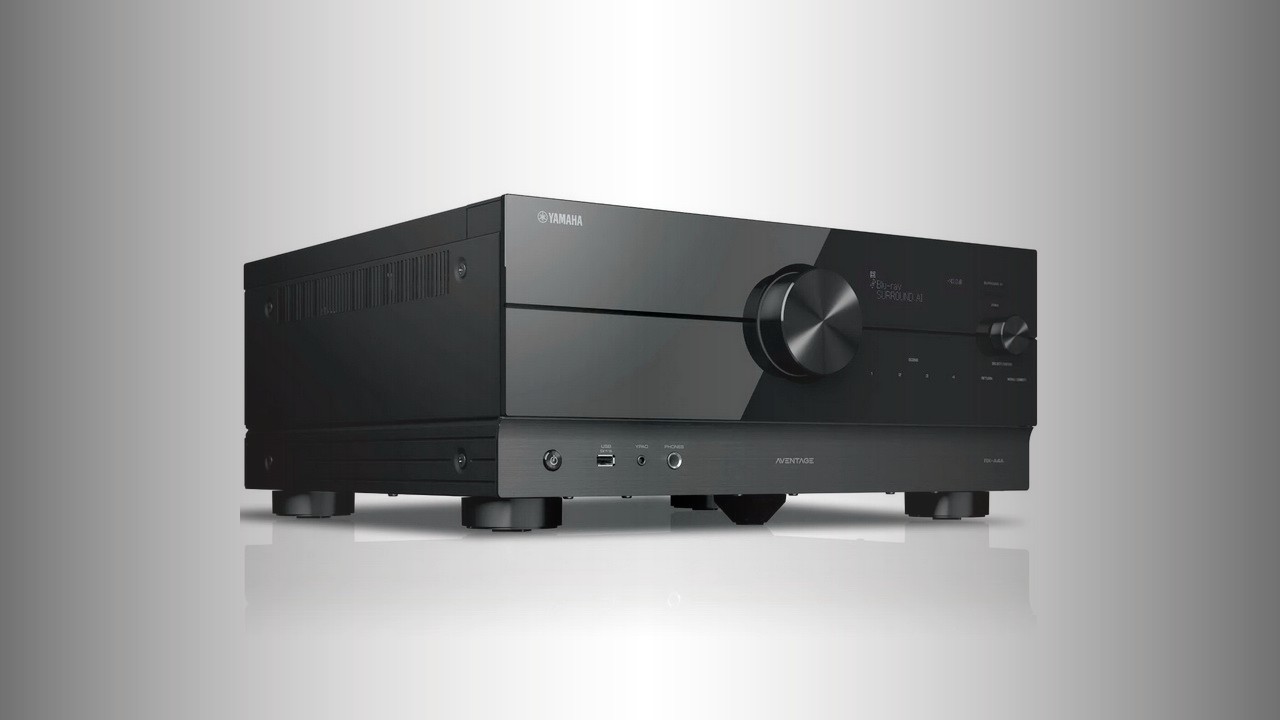
2. Yamaha RX-A4A: Superior AV Receiver with 7.2 channels, Wi-Fi & Bluetooth
The Yamaha RX-A4A combines 7.2-channel processing, wireless connectivity and Yamaha’s central anti-resonance foot.
Yamaha’s RX-A4A combines a 7.2-channel configuration with Wi-Fi, Bluetooth, Dolby Atmos and DTS:X.
Its SURROUND:AI processing analyses elements such as dialogue, music and effects to adjust the surround presentation, while Cinema DSP HD3 uses measured sound-field data and digital processing to create a three-dimensional sound field.
An ESS SABRE ES9007S Premier DAC and Qualcomm QCS407 chipset handle digital audio duties, and Yamaha’s central Anti Resonance Technology foot is designed to reduce vibration from internal components and the supporting surface.
Best for: Listeners who want automated surround processing and wireless connectivity
- Dolby Atmos and DTS:X
- Wi-Fi and Bluetooth
- SURROUND:AI processing
- Anti Resonance Technology construction
Verdict: The RX-A4A is a versatile 7.2-channel receiver distinguished by Yamaha’s adaptive surround processing and vibration-control design.

3. Denon DBT-3313UD: Blu-ray and network player combined
The Denon DBT-3313UD is a universal disc and network player with dual HDMI outputs and a front USB port.
The Denon DBT-3313UD is a universal source component for collections spanning Blu-ray, DVD, DVD-Audio, SACD and CD.
It also reads media from a PC or NAS, including FLAC files up to 24-bit/192 kHz, and accepts portable storage through its front USB port.
Two HDMI outputs can separate audio and video or feed two displays, while Denon Link HD is available for compatible Denon AVR-3313 and AVR-4520 receivers. Its network-service support should be verified before purchase because availability can change independently of the player.
Best for: Physical-media owners with mixed music and film disc libraries
- Blu-ray, DVD-Audio and SACD playback
- PC and NAS media access
- Two HDMI outputs
- Front USB connection
Verdict: The DBT-3313UD is a flexible universal player whose strongest case rests on broad disc support and dual-HDMI integration.

4. Marantz AV7706: AV processor with superior dynamics
The Marantz AV7706 is an AV processor with balanced outputs, HDMI 2.1 connectivity and no built-in power amplifiers.
The Marantz AV7706 provides AV processing without built-in power amplification, so every system based on it requires suitable external power amplifiers.
Its line outputs include balanced connections and are controlled by a dedicated HDAM sound card.
Each channel uses a 32-bit AKM AK4458 DAC, with support for high-resolution formats including DSD up to 11.2 MHz over USB and a local network. HDMI 2.1 connectivity passes 8K at 60 Hz or 4K at 120 Hz, alongside eARC, HDR10+, ALLM, VRR, QMS and QFT.
Best for: A separates-based cinema using external power amplifiers
- Balanced line outputs
- HDMI 2.1 connectivity
- 8K 60 Hz and 4K 120 Hz passthrough
- High-resolution and DSD playback
Verdict: The AV7706 is the specialist choice here for installations that need modern AV processing but deliberately keep amplification separate.

5. Pioneer VSX-S520 AV Receiver: Compact Design with Wireless Connectivity and 4K Support
The slim Pioneer VSX-S520 stands 70 mm high and provides five-channel amplification with Wi-Fi and Bluetooth.
At 70 mm high and 4 kg, the Pioneer VSX-S520 addresses installations where a full-height receiver would be intrusive.
It provides five amplified channels, Wi-Fi, Bluetooth and 4K support, while a sixth channel can power a passive subwoofer.
Compactness brings compromises: the receiver lacks pre-outs, uses clip-style speaker terminals, has one subwoofer output and does not provide a rear USB port. Those limitations matter if future expansion or heavier speaker cabling is part of the plan.
Best for: Space-conscious five-channel installations
- 70 mm-high chassis
- Wi-Fi and Bluetooth
- Five amplified channels
- 4K support
Verdict: The VSX-S520 makes sense when low-profile dimensions matter more than pre-outs, premium terminals or extensive subwoofer connectivity.

6. Denon AVC-X4800H: The ideal companion for a high-end home theater setup
The Denon AVC-X4800H offers nine built-in amplifiers, extensive HDMI connectivity and 11.4-channel processor output.
The Denon AVC-X4800H has nine built-in amplifiers and decoding for Dolby Atmos and DTS 3D formats, allowing a 5.2.4 layout without separate amplification.
Its 11.4-channel processor output permits expansion with external power amplifiers, including a 7.2.4 configuration.
Audyssey MultEQ XT32 provides microphone-based room calibration. Eight HDMI inputs and three outputs support flexible source and display arrangements, while the video features include 8K input and upscaling, HDR10+, Dolby Vision, eARC, VRR and QFT. An MM phono input also accommodates a compatible turntable.
Best for: An expandable home cinema with multiple sources and height speakers
- Nine built-in amplifiers
- 11.4-channel processor output
- Audyssey MultEQ XT32 calibration
- Eight HDMI inputs and three outputs
Verdict: The AVC-X4800H is a strong foundation for a complex system because it combines nine-channel amplification with processor outputs for later expansion.

7. LG SN11R: 7.1.4-channel system that turns your home into a cinema experience
The LG SN11R package consists of a 7.1.4-channel soundbar, two rear speakers and a wireless subwoofer.
The LG SN11R packages a 7.1.4-channel soundbar, two rear speakers and a wireless subwoofer as a coordinated system.
Dolby Atmos and DTS:X provide object-based surround support, while AI Room Calibration adjusts the system for the listening space and AI Sound Pro adapts playback to the content.
Meridian digital signal processing is included, and HDMI eARC can carry uncompressed 5.1- and 7.1-channel audio as well as high-bit-rate formats when connected to a compatible television.
Best for: Immersive surround sound without a separate AV receiver
- 7.1.4-channel configuration
- Rear speakers included
- Wireless subwoofer
- Dolby Atmos and DTS:X
Verdict: The SN11R offers a more integrated route to 7.1.4 playback by including the soundbar, rear channels and wireless subwoofer in one system.

8. Denon AVR-X1800H: Fully equipped AV receiver
The Denon AVR-X1800H is a 7.2-channel receiver designed to support a 5.2.2 immersive speaker layout.
The Denon AVR-X1800H uses seven built-in amplifiers in a 7.2 configuration and can form a 5.2.2 Dolby Atmos or DTS:X system.
DTS Virtual:X offers virtual height effects where dedicated height speakers are impractical, while DTS Neural:X can expand conventional material.
Audyssey MultEQ XT uses the supplied microphone to assess several listening positions and balance the system for the room. Six HDMI inputs and one output provide the core video connectivity, with support for signals up to 8K and HDCP 2.3.
Best for: A practical 5.2.2 receiver-based cinema
- Seven built-in amplifiers
- 5.2.2 Dolby Atmos and DTS:X capability
- Audyssey MultEQ XT calibration
- Six HDMI inputs
Verdict: The AVR-X1800H covers the essentials of a modern 5.2.2 system without the added complexity of an eleven-channel installation.

9. Sony ends production of Blu-ray recorders as streaming takes over
Sony is ending Blu-ray recorder production while continuing to manufacture standard Blu-ray and DVD players.
This is market context rather than a hardware recommendation.
Sony’s decision to stop producing Blu-ray recorders reflects declining demand as streaming, cloud storage and digital downloads replace physical recording for many households.
The distinction between recording and playback is important: standard Sony Blu-ray and DVD players remain in production, so the announcement does not mean the immediate end of optical-disc playback. Anyone specifically requiring television recording or disc archiving should confirm recorder availability before planning a system around that function.
Best for: Understanding the changing availability of physical video recorders
- Standard Blu-ray players remain in production
- DVD player production continues
Verdict: Sony’s recorder exit is a reminder to distinguish declining disc-recording hardware from the continuing availability of ordinary disc players.
10. Pioneer SC-LX904: Fully equipped AV receiver
The Pioneer SC-LX904 is an 11-channel receiver supporting Dolby Atmos, DTS:X, IMAX Enhanced and four ceiling channels.
The Pioneer SC-LX904 is an 11-channel AV receiver designed for elaborate immersive-audio layouts, including systems with four ceiling channels.
It supports Dolby Atmos, DTS:X and IMAX Enhanced, while its sound processor is intended to place and track effects precisely within the surround field.
Sixth-generation Direct Energy HD amplification is specified at 11 x 140 watts into 8 ohms, with simultaneous multichannel amplification. At 18.3 kg and 44 cm deep, it also requires meaningful rack space and ventilation.
Best for: A large immersive system with four ceiling channels
- Eleven amplified channels
- Four-ceiling-channel layouts
- Dolby Atmos, DTS:X and IMAX Enhanced
- Direct Energy HD amplification
Verdict: The SC-LX904 provides the channel count and format support needed for an ambitious three-dimensional cinema, but its substantial chassis demands suitable furniture.
Frequently asked questions
Should I choose an AV receiver, an AV processor or a soundbar system?
Choose an AV receiver when you want processing and speaker amplification in one chassis.
An AV processor such as the Marantz AV7706 requires separate power amplifiers but suits a separates-based installation.
A package such as the LG SN11R reduces component count by combining a soundbar with rear speakers and a wireless subwoofer.
How many amplified channels do I need for Dolby Atmos?
Match the receiver to the exact speaker layout.
A 5.2.2 system needs seven amplified channels, while 5.2.4 needs nine.
An eleven-channel layout such as 7.2.4 may require either an eleven-channel receiver or a receiver with processor outputs and additional external amplification.
Why does room calibration matter in a home cinema system?
Room calibration measures the system from one or more listening positions and adjusts playback to produce a more balanced result in that space.
The Denon AVR-X1800H uses Audyssey MultEQ XT, the AVC-X4800H uses MultEQ XT32, and the LG SN11R provides AI Room Calibration.
What connections should I check before buying?
Count every source, display, subwoofer and legacy component you intend to connect.
Confirm the number of HDMI inputs and outputs, optical and analogue inputs, subwoofer outputs, speaker terminals and pre-outs.
Also check whether features such as eARC, 4K at 120 Hz, 8K passthrough or a phono input are relevant to your sources.
How to choose the right home cinema foundation
Begin with the room and speaker plan rather than the receiver’s feature list.
A compact five-channel arrangement has different requirements from a 5.2.2, 5.2.4 or 7.2.4 installation, and unused channels do not compensate for missing inputs or unsuitable placement.
Decide whether height speakers are practical, how many subwoofers will be connected and whether a second listening zone is needed. Next, audit the sources and displays. Count HDMI devices, identify any optical or analogue equipment, and determine whether the television will return sound through eARC. Gamers should examine support for the video formats used by their display and console, while physical-media owners should distinguish between universal disc playback, ordinary Blu-ray playback and increasingly scarce Blu-ray recording. Expansion deserves equal attention. The Denon AVC-X4800H can move beyond its nine internal amplifiers through its processor outputs, whereas the Marantz AV7706 requires external amplification from the outset. The slim Pioneer VSX-S520 prioritises compactness but omits pre-outs, making it less appropriate for a system expected to grow. Finally, allow room for the hardware itself. Full-size receivers need stable support and ventilation, particularly a substantial model such as the Pioneer SC-LX904. Once channel count, connections, expansion and physical fit have been settled, processing modes and convenience features can serve as useful differentiators rather than distractions.