Home Cinema Favorites for Serious Movie Rooms
A grounded Stereoindex buying guide to home cinema components, comparing AV receivers, processors, universal players and source options by role, formats and system fit.

A convincing home cinema system is not built around one specification.
It depends on how the source, processor or receiver, speaker layout, video chain and room correction work together.
The products gathered here cover several roles: slim AV receivers, high-channel processors, universal disc transports, Blu-ray players, and an awards overview that helps frame the wider market. This selection is editorially arranged from the supplied Stereoindex source material rather than from fresh listening tests. The emphasis is on practical distinctions: channel capability, HDMI and HDR support, immersive audio formats, room calibration, disc playback, network features, and installation flexibility. For many buyers, the key decision is whether to choose an all-in-one receiver, a processor for use with separate amplification, or a dedicated player feeding an existing system. The notes below are designed to make those differences clearer without overstating what the source material supports.
1. Marantz Cinema 70s: Modern 7.2-channel AV receiver
Marantz Cinema 70s low-profile AV receiver for 7.2-channel home cinema systems with modern HDMI support.
The Marantz Cinema 70s is presented as the top low-profile model in Marantz’s NR-style 7.2-channel line, aimed at systems that need modern home-theater connectivity without a full-height receiver chassis.
Its six HDMI inputs include three that support 8K at 60 Hz, while 4K at 120 Hz video, 8K upscaling, HDR10+, Dynamic HDR, VRR, QMS, ALLM and QFT are also listed in the source.
On the audio side, it supports Dolby Atmos and DTS:X in a 5.1.2-channel configuration, plus virtual height processing for systems without dedicated height speakers. Audyssey MultEQ, Dynamic Volume and Dynamic EQ give it an integrated route to room and speaker optimization.
Best for: Compact modern AV systems needing current HDMI features
- Low-profile 7.2-channel AV receiver design
- Three HDMI inputs support 8K at 60 Hz
- Dolby Atmos and DTS:X support in 5.1.2 configuration
- Audyssey MultEQ room calibration
Verdict: A strong fit where space is limited but immersive audio, gaming-friendly HDMI functions and automatic calibration still matter.
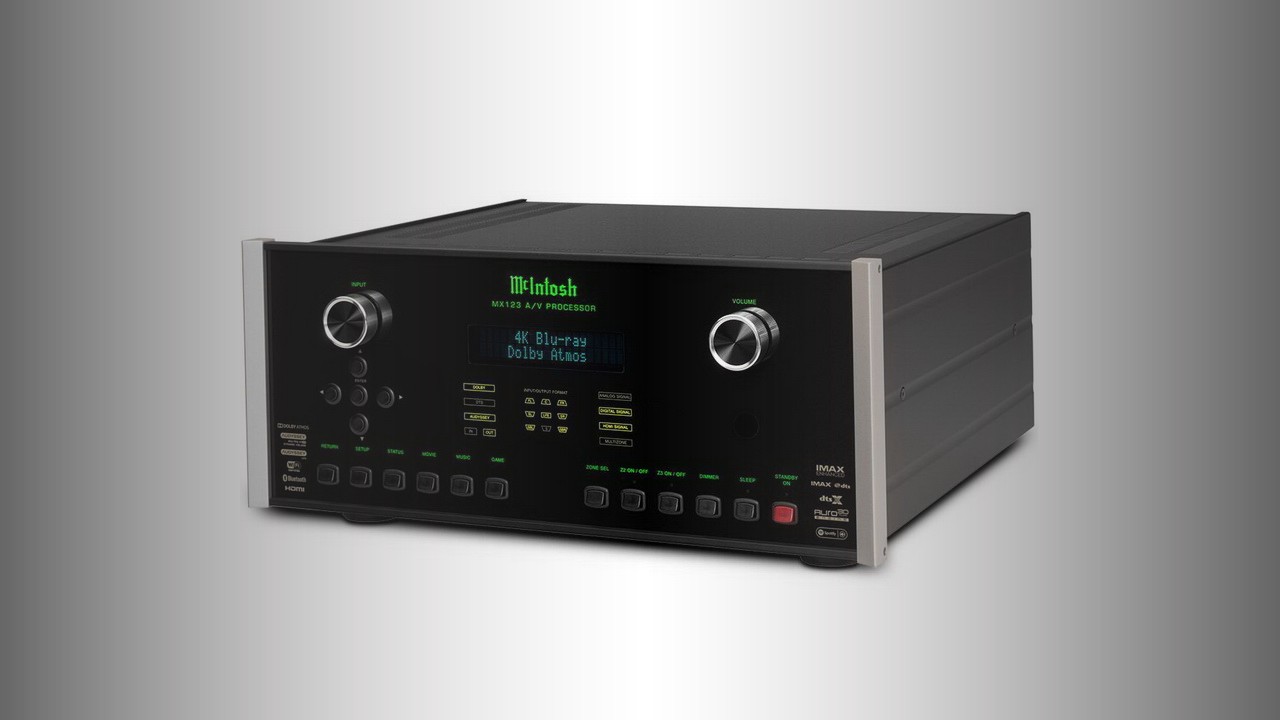
2. McIntosh MX123: AV processor perfect for home theater enthusiasts
McIntosh MX123 AV processor with multi-channel balanced and unbalanced outputs for separate-amplifier theater systems.
The McIntosh MX123 is an AV processor rather than an amplified receiver, so it is intended for home theaters built around separate power amplification.
The source highlights compatibility with Dolby Atmos, DTS:X and Auro-3D, along with 13.2 discrete audio channels available through both balanced and unbalanced outputs.
Its video section includes seven HDMI inputs and three HDMI outputs, with support for Dolby Vision, HDR10, HLG, 4K Ultra HD at 50/60 Hz, 4:4:4 color spacing and 3D video. One HDMI output includes eARC, giving the processor a route to receive higher-resolution audio from a compatible display.
Best for: High-end systems using separate power amplifiers
- 13.2 discrete audio channels
- Balanced and unbalanced audio outputs
- Dolby Atmos, DTS:X and Auro-3D compatibility
- Seven HDMI inputs and three HDMI outputs
Verdict: The MX123 is best viewed as a control center for ambitious theater rooms that need extensive channel support and flexible output options.

3. Cambridge Audio CXUHD: Reference digital player
Cambridge Audio CXUHD universal digital transport with 4K UHD, HDR and broad disc-format support.
The Cambridge Audio CXUHD is described as a universal reference digital transport, not a player with an onboard digital-to-analog converter.
That design choice is presented in the source as a way to avoid adding DAC-related distortion and interference to the AV signal.
It supports 4K UHD playback, handles many disc types including UHD Blu-ray, DVD-Audio and SACD, and can also function as a network media player. The video feature set includes HDR, Dolby Vision, UHD upscaling and decoding support for codecs such as HEVC H.265, H.264, VP9 4K and Hi10P. Via HDMI, it accepts Dolby Digital Plus, Dolby TrueHD, DTS HD High Resolution, DTS-HD Master Audio, Dolby Atmos and DTS:X.
Best for: Systems that already rely on external AV processing or conversion
- Universal disc transport design
- Supports UHD Blu-ray, DVD-Audio and SACD
- HDR and Dolby Vision support
- No onboard DAC by design
Verdict: The CXUHD makes the most sense as a high-quality digital transport for users who want disc versatility and HDMI-based integration.
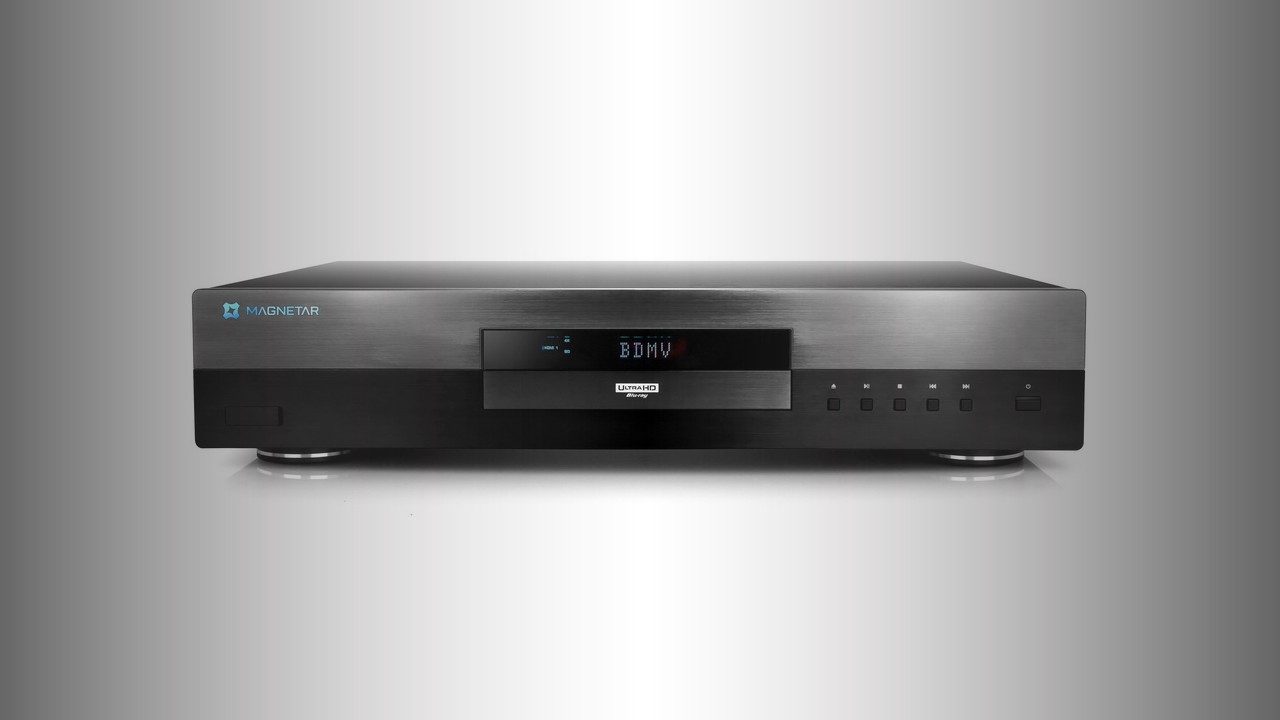
4. Magnetar UDP800: Classic 4K UHD Blu-ray Player
Magnetar UDP800 4K UHD Blu-ray player with metal chassis, HDR support and media-file playback.
The Magnetar UDP800 is a full-size 4K UHD Blu-ray media player built around a MediaTek MT8581 quad-core processor.
The source emphasizes support for 4K Ultra HD, HDR, Dolby Vision and HDR10+, along with HDR-to-SDR conversion and BT., BT.709 and BT.601 color profiles.
It can play DVDs, Blu-rays, 4K UHD discs and media files, with h265 and H.264 format support also specified. For audio-file playback, the supplied material lists DSD64/128, multi-channel DSD64 and 192 kHz/24-bit PCM support, while the construction notes point to a durable metal housing, high-quality audio components and a custom transformer.
Best for: Disc-focused cinema rooms needing broad HDR and media-file support
- 4K Ultra HD playback with Dolby Vision and HDR10+
- Supports DVDs, Blu-rays, 4K UHD discs and media files
- 4K upscaling at up to 50/60 fps
- DSD64/128 and 192 kHz/24-bit PCM support
Verdict: The UDP800 is a dedicated player for viewers who still value physical media and want wide HDR compatibility in a full-size component.

5. Harman/Kardon BDS 880 BQ: Innovative, High-performance multimedia system
Harman/Kardon BDS multimedia receiver system with slot-loading disc drive and automatic calibration support.
The supplied material for this Harman/Kardon BDS system focuses on a Blu-ray receiver platform combining disc playback, automatic sound adjustment and app-based control.
It describes a slot-loading disc drive that reads many relevant formats, including Blu-ray 3D with BD-Live support.
Harman’s EzSet/EQ III automatic calibration is used to adjust volume levels, tuning and equalization for the connected speaker system and room conditions. The front panel includes a calibration microphone input combined with a headphone jack, plus a USB port compatible with Apple devices, while control is available through an iOS or Android app as well as the supplied remote.
Best for: Integrated Blu-ray receiver setups with automatic calibration
- Blu-ray 3D playback with BD-Live support
- EzSet/EQ III automatic calibration
- USB port compatible with Apple devices
- iOS and Android app control
Verdict: This BDS system suits buyers looking for a consolidated multimedia receiver rather than separate source and AV receiver components.

6. Anthem AVM 90: Powerful fifteen-channel AV processor
Anthem AVM 90 fifteen-channel AV processor with ARC Genesis calibration and balanced output connectivity.
The Anthem AVM 90 is presented as a flagship fifteen-channel AV processor for home theater, built on newly developed electronics and paired with ARC Genesis room correction.
The source notes an upgraded microphone for more accurate calibration, plus a new-generation multi-core DSP.
Its audio platform supports object-oriented codecs up to 15.4 channels, with balanced XLR audio outputs and independent subwoofer outputs. For video and connectivity, the material lists seven HDMI inputs, two HDMI outputs, Ultra HD bitrates up to 18.2 Gbps, Dolby Vision, HDR, Hybrid Log Gamma, eARC, Bluetooth, Google Chromecast and AirPlay 2, with remote configuration and over-the-air update capability also included.
Best for: Large dedicated theaters using external amplification
- Supports up to 15.4 channels
- ARC Genesis room correction with upgraded microphone
- Balanced XLR outputs
- Remote configuration and over-the-air updates
Verdict: The AVM 90 is aimed at sophisticated installations where channel count, balanced outputs and advanced room correction are central priorities.

7. EISA Awards -: Winners in the Home Theatre Audio category announced
EISA Home Theatre Audio awards overview highlighting recognized products from an international expert group.
This Stereoindex article is not a single component review but an overview of EISA-recognized products in the Home Theatre Audio category.
The source explains that EISA awards are selected through collaboration among international consumer electronics magazines and websites, with attention to products combining advanced technologies and desirable features.
For readers building a home cinema system, the value of this article is context: it highlights products that an external expert group considered notable within home-theater audio. It is best used as a market reference alongside product-specific research, room requirements and system matching.
Best for: Readers wanting broader home-theater audio market context
- Covers Home Theatre Audio award recipients
- Draws on an international expert-group process
- Useful as a market benchmark
- Focuses on products with advanced features
Verdict: The awards overview is a helpful reference point, provided it is treated as guidance rather than a substitute for system-specific selection.

8. JBL Synthesis SDR-40: A 16-channel powerhouse built for modern cinema rooms
JBL Synthesis SDR-40 immersive AV receiver with 16-channel processing and integrated Class-G amplification.
The JBL Synthesis SDR-40 is described as a high-end immersive AV receiver for serious home-cinema installations.
It combines 16-channel processing with nine built-in Class-G amplifier stages, positioning it as an installation-friendly alternative to separate processor and amplifier boxes.
The receiver supports Dolby Atmos, DTS:X Pro, IMAX Enhanced and AURO-3D, while flexible matrix channel assignment is intended to help tailor the system to the room. The source also highlights advanced room correction, pre-outs for expansion and a design aimed at dedicated theater rooms rather than casual living-room use.
Best for: Dedicated theater rooms needing receiver convenience and expansion paths
- 16-channel processing
- Nine built-in Class-G amplifier stages
- Dolby Atmos, DTS:X Pro, IMAX Enhanced and AURO-3D support
- Pre-outs for system expansion
Verdict: The SDR-40 is for installations that want high channel capability and built-in amplification without immediately moving to a full separates stack.

9. McIntosh MX200: Engineered to support extensive Dolby Atmos configurations
McIntosh MX200 home-cinema decoder processor with balanced outputs, HDMI 2.1 inputs and Dirac Live support.
The McIntosh MX200 is an 11.2-channel decoder processor for home cinema, with support for Dolby Atmos and DTS:X.
The source states that it can accommodate systems from 5.1 to 7.2.4 channels and provides 11 balanced XLR outputs, plus two independent subwoofer outputs.
Its HDMI section includes four HDMI 2.1 inputs and one HDMI output, with 4K at 120 Hz, Dolby Vision and HDR10+ support. Dirac Live room correction is included, and the processor can integrate with Control4 and Crestron Home installation systems. A dedicated MM phono input is also specified, giving it an analog source option unusual in many cinema processors.
Best for: Premium home theaters needing balanced outputs in a compact processor role
- 11.2-channel decoder processor
- Supports 5.1 to 7.2.4 configurations
- Four HDMI 2.1 inputs with 4K at 120 Hz support
- Dirac Live room correction
Verdict: The MX200 is a focused McIntosh processor for Atmos-capable systems that also need installation integration and balanced connectivity.

10. Marantz UD7007: Powerful Blu-ray player for a modern home theater system
Marantz UD7007 universal Blu-ray player with disc, USB, Ethernet and dual-HDMI connectivity.
The Marantz UD7007 is described as a universal signal source for a modern home theater system, with support for many disc types plus USB, Ethernet and DLNA 1.5 network operation.
The source lists playback of popular audio and video file types over the network, including FLAC and DivX Plus HD, as well as access to internet services such as YouTube and Netflix.
For disc-based cinema use, it supports BD-Live with 1 GB of built-in memory, HDMI 1.4a with 3D video support, and a second HDMI output for sending audio to a receiver. It can also output DSD streams from SACD over HDMI, supports DVD-Audio, and can upscale video below Full HD to 1080p.
Best for: Legacy and mixed-media systems centered on Blu-ray and network playback
- Universal disc and network source role
- DLNA 1.5 network playback
- BD-Live support with built-in memory
- SACD DSD output via HDMI
Verdict: The UD7007 remains most relevant for systems that need broad disc compatibility, network playback and dual-HDMI integration rather than the latest UHD video features.
Quick comparison
These products do not compete in a single straight line.
Some are source components, some are AV processors, some are receivers with amplification, and one is a market-reference awards article.
The most useful comparison is therefore by system role and installation fit rather than by ranking alone.
| Product | Best for | Verdict |
|---|---|---|
| Marantz Cinema 70s: Modern 7.2-channel AV receiver | Compact receiver-based systems with current HDMI needs | Low-profile 7.2-channel receiver with Atmos, DTS:X, gaming-oriented HDMI features and Audyssey calibration. |
| McIntosh MX123: AV processor perfect for home theater enthusiasts | High-end separates-based theaters | 13.2-channel AV processor with extensive HDMI connectivity and balanced or unbalanced output options. |
| Cambridge Audio CXUHD: Reference digital player | Disc collectors using external processing | Universal 4K UHD digital transport with no onboard DAC and support for HDR, Dolby Vision and major high-resolution disc types. |
| Magnetar UDP800: Classic 4K UHD Blu-ray Player | Physical-media systems requiring modern HDR support | Full-size 4K UHD Blu-ray and media player with Dolby Vision, HDR10+, 4K upscaling and high-resolution audio-file support. |
| Harman/Kardon BDS 880 BQ: Innovative, High-performance multimedia system | Integrated Blu-ray receiver users | A consolidated BDS multimedia receiver concept with Blu-ray 3D, automatic calibration, USB support and app control. |
| Anthem AVM 90: Powerful fifteen-channel AV processor | Large rooms with external amplification and room correction priorities | 15.4-channel-capable processor with ARC Genesis, balanced XLR outputs, eARC and streaming connectivity. |
| EISA Awards -: Winners in the Home Theatre Audio category announced | Readers researching the wider home-theater audio market | An awards-category overview that helps identify externally recognized products and trends. |
| JBL Synthesis SDR-40: A 16-channel powerhouse built for modern cinema rooms | Dedicated cinema rooms wanting integrated amplification plus expansion | 16-channel AV receiver with nine Class-G amplifier stages, object-based audio support and room-correction focus. |
| McIntosh MX200: Engineered to support extensive Dolby Atmos configurations | Atmos-capable premium theaters needing installation integration | 11.2-channel processor with HDMI 2.1 inputs, balanced outputs, Dirac Live and Control4 or Crestron Home compatibility. |
| Marantz UD7007: Powerful Blu-ray player for a modern home theater system | Blu-ray, SACD, DVD-Audio and network-file playback in established systems | Universal Blu-ray source with DLNA playback, BD-Live, dual HDMI and 1080p upscaling. |
Frequently asked questions
Should I choose an AV receiver or an AV processor for home cinema?
Choose an AV receiver when you want processing and amplification in one chassis, as with the Marantz Cinema 70s or JBL Synthesis SDR-40.
Choose an AV processor when you plan to use separate power amplifiers and need output flexibility, as with the McIntosh MX123, Anthem AVM 90 or McIntosh MX200.
How important is room correction in a home theater system?
Room correction can be very useful because speaker placement and room acoustics strongly affect results.
The supplied products include several approaches, such as Audyssey MultEQ on the Marantz Cinema 70s, EzSet/EQ III on the Harman/Kardon BDS platform, ARC Genesis on the Anthem AVM 90 and Dirac Live on the McIntosh MX200.
Do I still need a disc player in a modern home cinema?
A dedicated player still makes sense if you own Blu-ray, UHD Blu-ray, SACD, DVD-Audio or media-file libraries.
The Cambridge Audio CXUHD, Magnetar UDP800 and Marantz UD7007 each focus on source playback, but they differ in video generation, HDR support, DAC approach and network features.
Which HDMI and video features should I check before buying?
Match the product to your display, sources and gaming needs.
For example, the Marantz Cinema 70s lists 8K at 60 Hz, 4K at 120 Hz, VRR, ALLM and HDR10+, while the McIntosh MX200 lists HDMI 2.1 inputs, 4K at 120 Hz, Dolby Vision and HDR10+.
Older or source-focused players may be better suited to established systems rather than the newest video chain.
How to choose the right home cinema component
Start with the role the component must play.
If you need one box to switch sources, decode surround formats and drive speakers, a receiver is the natural starting point.
The Marantz Cinema 70s is the compact option in this group, while the JBL Synthesis SDR-40 is presented for more serious dedicated rooms with higher channel ambitions and built-in amplification. If your system already has or will use separate power amplifiers, look instead at processors. The McIntosh MX123 emphasizes 13.2-channel processing and extensive balanced or unbalanced outputs. The Anthem AVM 90 goes further in channel scope with support up to 15.4 channels, ARC Genesis correction and balanced XLR outputs. The McIntosh MX200 is a more focused 11.2-channel processor with HDMI 2.1 inputs, Dirac Live and installation-control compatibility. For source components, prioritize the formats you actually use. The Cambridge Audio CXUHD is a transport for systems that rely on external conversion and processing. The Magnetar UDP800 is the more UHD- and HDR-oriented disc and media player in the supplied material, with Dolby Vision, HDR10+ and high-resolution audio-file support. The Marantz UD7007 is better understood as a universal Blu-ray-era source with SACD, DVD-Audio, DLNA and dual-HDMI strengths. Finally, do not buy by format logos alone. Count your speakers, check your subwoofer needs, confirm HDMI compatibility with your display and sources, and consider whether the room correction system suits your setup process. A home cinema component should solve the practical problems of your room first; the strongest choice is the one that fits your signal chain, speaker layout and upgrade path without forcing unnecessary complexity.