Stereoindex Picks: Speakers Worth Shortlisting
A practical Stereoindex guide to notable speakers and subwoofers, with clear distinctions between floorstanding models, powered stereo pairs, wireless systems, and bass-focused designs.

Choosing speakers is less about chasing a single ideal and more about matching the design to the room, the system, and the way you listen.
The models and articles collected here cover floorstanding speakers, powered stereo pairs, wireless systems, and dedicated subwoofers, so the useful question is not simply which one is superior, but which one solves the right problem.
Several entries focus on full-range loudspeakers with ambitious driver and cabinet engineering, including designs using flax, ceramic, carbon fiber, diamond, AMT, ribbon, aluminum, and carefully shaped enclosures. Others address bass extension directly through active subwoofers, with room-matching controls, DSP, dual-driver layouts, or wireless integration. This Stereoindex guide keeps the distinctions practical. It highlights what each source article actually supports: construction approach, connectivity, driver technology, cabinet design, and intended use. Specifications are included only where supplied, and the recommendations are framed as shortlist guidance rather than universal rankings.
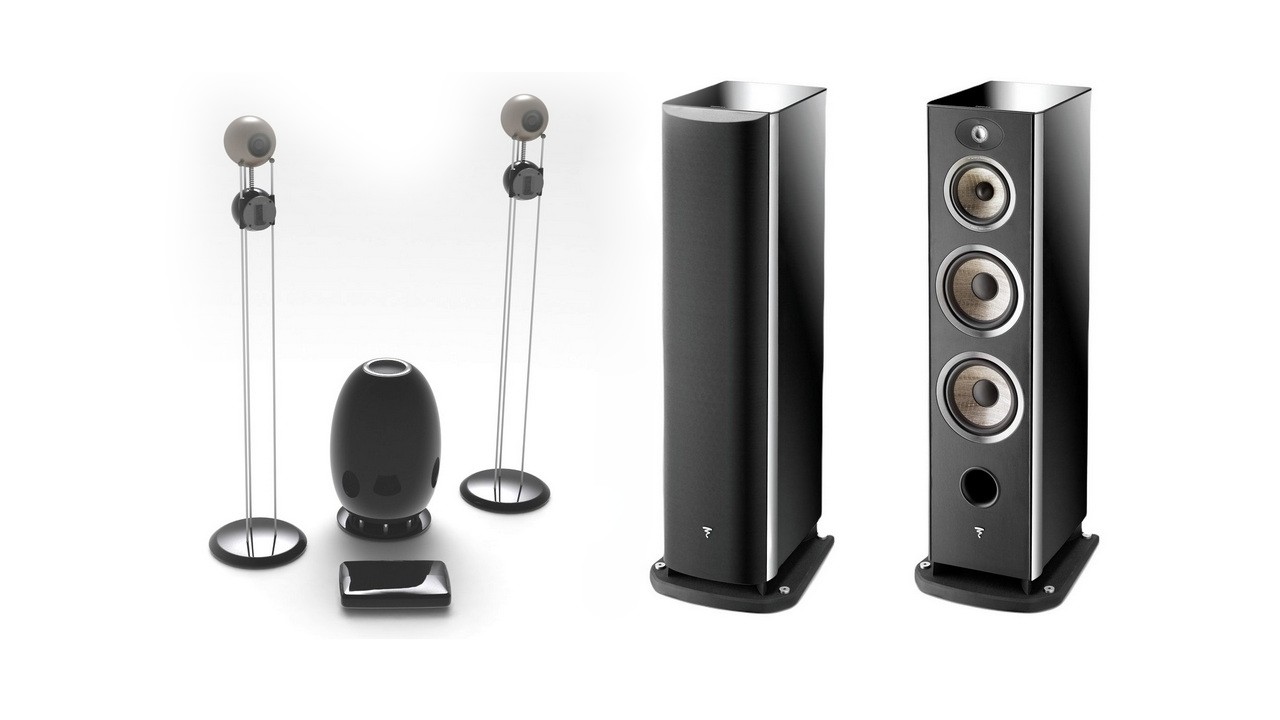
1. Copra Cyclops vs Focal Aria 948
Copra Cyclops and Focal Aria 948 illustrate two contrasting ways to place serious loudspeakers in a domestic interior.
This comparison centers on two very different answers to the same domestic hi-fi problem: how to combine serious sound ambitions with a living space that still looks considered.
The Copra Cyclops is presented as a triphonic system from Copra Acoustic, a company known in the source for original acoustic approaches including coconut-shell midrange housings and polymer-concrete subwoofer enclosures.
The Focal Aria 948 appears here as the more conventional floor-standing counterpoint, making the article useful for readers weighing an integrated-looking loudspeaker against a more sculptural, technology-led system concept.
Best for: Listeners balancing hi-fi ambitions with living-room aesthetics
- Addresses both sound quality and interior fit
- Copra approach uses distinctive natural and composite cabinet materials
- Useful contrast between triphonic and floor-standing speaker concepts
Verdict: A useful comparison for buyers deciding whether a visually distinctive triphonic system or a traditional floor-standing speaker better suits the room.

2. Indiana Line Basso 840: 75W active subwoofer launched
Indiana Line Basso 840 active subwoofer with underside driver placement and rear bass-reflex tuning.
The Indiana Line Basso 840 is a compact active subwoofer aimed at both home theater and music systems.
Its 275 mm driver is mounted beneath the cabinet, while two rear bass-reflex ports are used to reduce the audibility of unwanted interference.
The built-in Class AB amplifier provides 75 watts RMS, and the control set includes crossover frequency, gain, and phase adjustment, giving the user practical tools for matching the subwoofer to speakers and room acoustics.
Best for: Adding adjustable bass support to stereo or home theater systems
- 75W RMS active design
- Crossover, gain, and phase controls
- Line and high-level inputs
- Specified 30 Hz to 180 Hz response
Verdict: A practical active subwoofer choice when manual integration controls and conventional wired connectivity matter more than advanced network features.

3. Albedo Atesia: Flagship floorstanding speakers powered by Helmholtz resonators
Albedo Atesia flagship floorstanding speaker with metal-intensive construction and Helmholtz-resonator-based tuning.
Albedo Atesia is a large flagship floorstanding loudspeaker built around the company’s Helmholine mirror frequency-response equalization system based on Helmholtz resonators.
The construction is notably elaborate, with aluminum side panels, milled aluminum bases and top covers, internal steel rods, and a stated height of 180 cm with a weight of 170 kg per speaker.
The driver array uses Accuton units in a d’Appolito configuration, with four 8-inch ceramic-cone bass drivers, two 5-inch ceramic midrange drivers, and a 1-inch diamond tweeter. With 4-ohm nominal impedance and 87 dB sensitivity, the source specifically notes the importance of careful amplifier matching.
Best for: High-end systems with space and suitable amplification
- Helmholine system based on Helmholtz resonators
- Accuton ceramic drivers and diamond tweeter
- Very rigid metal-intensive cabinet construction
- Specified 27 Hz to 33 kHz operating range
Verdict: A highly engineered flagship floorstander for systems where cabinet construction, driver quality, and amplifier matching can be treated seriously.
4. Focal Aria 948 Floor-Standing Speakers: Revolutionary Flax Diffuser Technology for Precision Sound and Deep Bass
Focal Aria 948 floor-standing speaker showcasing the Aria series’ flax-based driver technology.
The Focal Aria 948 article focuses on the Aria series’ Flax diffuser technology, in which natural flax fiber is sandwiched between thin fiberglass layers.
The source presents this material as light, rigid, well damped, and fast in vibration propagation, positioning it as a key development beyond Focal’s Polyglass technology.
The speakers also use aluminum-magnesium alloy tweeters with Poron suspension and a compact waveguide. Their wood-fiber-board enclosures use 18 mm and 24 mm panels and avoid parallel surfaces, showing attention to cabinet behavior as well as driver design.
Best for: Floorstanding-speaker buyers interested in Focal’s flax-cone approach
- Flax sandwich-cone technology
- Aluminum-magnesium tweeter with Poron suspension
- Cabinet panels made from 18 mm and 24 mm wood-fiber boards
- Non-parallel enclosure surfaces
Verdict: A strong shortlist candidate for listeners drawn to floorstanding speakers with distinctive cone materials and carefully considered enclosure design.

5. Bowers & Wilkins Formation Bass: Powerful active subwoofer
Bowers & Wilkins Formation Bass active subwoofer with barrel-shaped cabinet and opposed-driver layout.
The Bowers & Wilkins Formation Bass is an active subwoofer built around a barrel-shaped cabinet, a form chosen to reduce resonances, internal standing waves, and wall vibration compared with conventional rectangular shapes.
It uses two opposing 6.5-inch woofers with paper-Kevlar cones and an outer aluminum layer, driven by a 250-watt IcePower Class D amplifier.
The source also describes DSP control, dynamic EQ, wireless communication with compatible speakers, and a specified operating range from 20 Hz to 150 Hz.
Best for: Wireless bass extension in compatible Formation-based systems
- Barrel-shaped anti-resonance cabinet
- Dual opposing 6.5-inch woofers
- 250W Class D amplification
- DSP control with dynamic EQ
Verdict: A focused subwoofer for listeners who want Bowers & Wilkins wireless integration plus cabinet and driver measures aimed at cleaner bass.
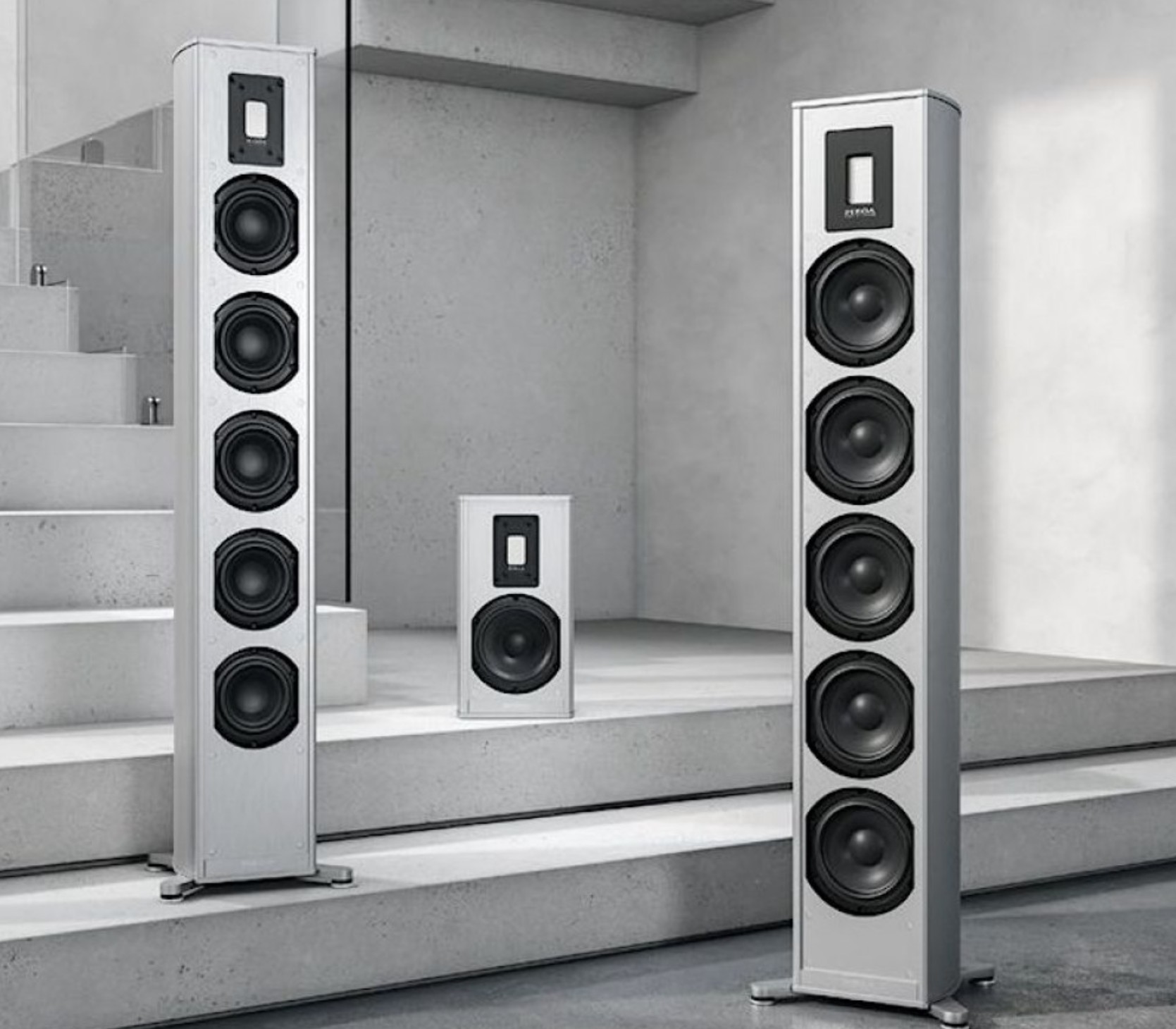
6. Piega unveils Premium Wireless Gen2 speakers
Piega Premium Wireless Gen2 speakers use aluminum cabinets and a Connect Plus hub for wireless system integration.
Piega Premium Wireless Gen2 is a wireless speaker range made up of two floorstanding models, Premium 701 Gen2 and Premium 501 Gen2, plus the Premium 301 Gen2 bookshelf speaker.
The system is built around the Piega Connect Plus hub, which handles wireless signal transmission and includes digital and analog inputs, HDMI ARC, USB-B, Wi-Fi, and Bluetooth.
Platform support listed in the source includes Chromecast, Airplay, Spotify Connect, DLNA, and Roon Ready operation, with control via the Piega Control App. The speakers use aluminum cabinets, Piega ribbon-type high-frequency drivers, and MDS-suspension drivers for mid and low frequencies.
Best for: Listeners wanting a wireless speaker system with broad hub connectivity
- Floorstanding and bookshelf models in the range
- Piega Connect Plus hub with HDMI ARC and USB-B
- Wi-Fi, Bluetooth, Chromecast, Airplay, Spotify Connect, DLNA, and Roon Ready support
- Aluminum cabinets with Piega ribbon-type tweeters
Verdict: A flexible wireless speaker family for buyers who want physical inputs, network playback options, and classic Piega aluminum-cabinet construction.
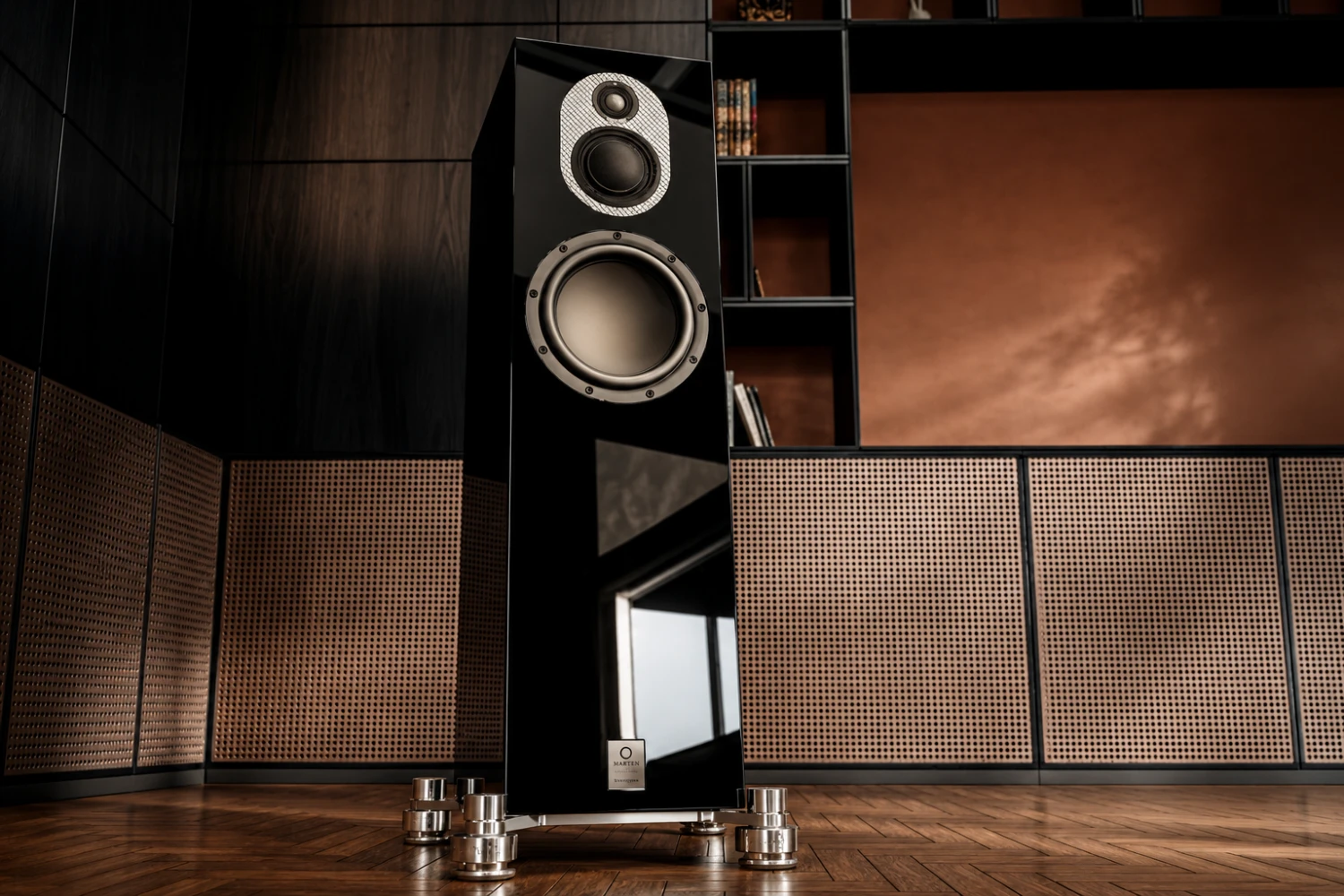
7. Marten Dexter: A New Generation of Swedish High-End Speakers
Marten Dexter series includes monitor and floorstanding speakers built around shared diamond-tweeter and cabinet architecture.
The Marten Dexter series includes the Duo monitor and the Trio, Quartet, and Quintet floorstanding models.
All four share a Marten pure diamond tweeter, M-Core three-layer cabinet construction, internal Jorma Duality wiring, and a newly developed Loaded Reflex Line bass system.
The Quintet and Quartet are three-way designs with ceramic Marten midrange drivers and carbon-fiber Marten bass drivers, while the Trio and Duo use a ceramic Marten midrange/bass driver with the same diamond tweeter. The series is designed and built at Marten’s factory in Sweden, making it a coherent family rather than a single-speaker recommendation.
Best for: High-end buyers comparing a family of related monitor and floorstanding designs
- Four models including monitor and floorstanding options
- Pure diamond tweeter across the series
- M-Core three-layer cabinet construction
- Loaded Reflex Line bass system
Verdict: A coherent high-end speaker range for listeners who want shared core technology across different room and placement needs.

8. Klipsch The Sixes: Classic versatile bookshelf speakers
Klipsch The Sixes powered bookshelf speakers combine Heritage styling with built-in electronics and phono connectivity.
Klipsch The Sixes are powered bookshelf speakers in the Heritage Wireless family, designed as a stereo pair with the electronics built into one speaker.
The source emphasizes their appeal for vinyl users because the active speaker includes a phono stage, along with amplifier, power supply, and connection panel.
Setup is kept simple: the two speakers connect to each other with one cable, while the active speaker connects to power. The system can also be expanded with a subwoofer and connected to a TV or other digital source through optical input.
Best for: Vinyl-friendly powered bookshelf listening without a separate amplifier
- Powered stereo-pair design
- Built-in phono stage
- Subwoofer output
- Optical input for TV or digital sources
Verdict: A convenient powered stereo option for listeners who want classic Klipsch styling, simple cabling, and direct turntable support.

9. Audiovector QR3: A floorstanding speaker that delivers remarkable dynamics in a compact design
Audiovector QR3 compact floorstanding speaker with 2.5-way driver layout and AMT Gold Leaf tweeter.
The Audiovector QR3 is a compact floorstanding speaker built as a 2.5-way design.
Its lower bass driver is filtered at 800 Hz, while the upper driver continues to the tweeter crossover at 3000 Hz, allowing both drivers to support the low-frequency range while one handles the more delicate midrange.
The 15 cm cones use a sandwich structure with aluminum outer layers and a porous polymer core, shaped for rigidity. The QR3 also uses AMT Gold Leaf tweeters, described in the source as Hale-type emitters capable of operating up to 150 kHz, with the air-motion principle created by a lightweight folded ribbon.
Best for: Listeners wanting a compact floorstander with advanced tweeter technology
- 2.5-way floorstanding configuration
- 15 cm sandwich-cone drivers
- AMT Gold Leaf tweeter
- Dual magnetic system for low distortion
Verdict: A technically interesting compact floorstander that combines a 2.5-way bass/midrange layout with Audiovector’s AMT tweeter approach.

10. MartinLogan Depth 212 & 215: Reference Subwoofers with Carbon Aerocore Drivers
MartinLogan Depth 212 and Depth 215 subwoofers use Carbon Aerocore drivers and BalancedForce dual-opposed topology.
MartinLogan Depth 212 and Depth 215 are luxury subwoofers built around the company’s BalancedForce dual-opposed woofer topology, Carbon Aerocore drivers, reference amplification, and DSP.
The source presents them as suitable for both two-channel and multichannel systems, with the dual-opposed configuration intended to deliver clean, low-distortion bass.
While the article does not provide dimensions or output specifications, it clearly positions the Depth models as a high-end low-frequency platform with new cone material and extensive electronic control.
Best for: High-end systems needing serious dedicated bass reinforcement
- BalancedForce dual-opposed woofer topology
- Carbon Aerocore drivers
- Reference amplification and DSP
- Intended for two-channel and multichannel systems
Verdict: A premium subwoofer option for systems where dual-opposed driver architecture, DSP, and MartinLogan’s low-frequency engineering are priorities.
Quick comparison
The strongest way to compare these entries is by role.
Some are complete stereo speaker solutions, some are floorstanding loudspeakers for traditional amplification, some are wireless ecosystems, and several are dedicated subwoofers intended to extend bass rather than replace main speakers.
| Product | Best for | Verdict |
|---|---|---|
| Copra Cyclops vs Focal Aria 948 | Aesthetic and system-concept comparison | Useful when choosing between a distinctive triphonic concept and a conventional floor-standing loudspeaker approach. |
| Indiana Line Basso 840 | Adjustable wired subwoofer integration | The practical choice here for users needing crossover, gain, phase, line, and high-level input flexibility. |
| Albedo Atesia | Large high-end floorstanding systems | The most construction-heavy flagship in the group, with demanding amplifier-matching implications noted in the source. |
| Focal Aria 948 | Flax-cone floorstanding speaker buyers | Distinguished by Focal’s flax sandwich diffuser and non-parallel wood-fiber-board cabinet design. |
| Bowers & Wilkins Formation Bass | Wireless subwoofer use in compatible systems | Stands out for its barrel-shaped cabinet, opposed drivers, DSP, dynamic EQ, and wireless Formation integration. |
| Piega Premium Wireless Gen2 | Wireless speakers with hub-based connectivity | The broadest system-connectivity option, with floorstanding and bookshelf models plus a feature-rich Connect Plus hub. |
| Marten Dexter | A high-end speaker family spanning monitors and floorstanders | Notable for shared diamond-tweeter, M-Core cabinet, Loaded Reflex Line, and Swedish-built architecture across the range. |
| Klipsch The Sixes | Powered bookshelf stereo with turntable support | The simplest self-contained stereo pair here for vinyl users who do not want a separate amplifier. |
| Audiovector QR3 | Compact floorstanding speakers with AMT tweeters | A compact 2.5-way floorstander distinguished by sandwich-cone drivers and AMT Gold Leaf tweeter technology. |
| MartinLogan Depth 212 & 215 | Premium low-frequency reinforcement | The high-end subwoofer entry focused on Carbon Aerocore drivers, DSP, and BalancedForce dual-opposed topology. |
Frequently asked questions
Should I choose floorstanding speakers, bookshelf speakers, or a subwoofer first?
Start with the role you need filled.
Floorstanding speakers such as the Focal Aria 948, Audiovector QR3, Albedo Atesia, and Marten Dexter floorstanders are main loudspeakers.
Bookshelf or monitor options such as Klipsch The Sixes, Piega Premium 301 Gen2, and Marten Dexter Duo suit smaller spaces or simpler placement. Subwoofers such as Indiana Line Basso 840, Bowers & Wilkins Formation Bass, and MartinLogan Depth 212 and 215 are add-ons for bass extension rather than replacements for main speakers.
What matters most when adding a subwoofer to an existing system?
Integration matters more than raw size alone.
Look for controls and connection options that match your system.
Indiana Line Basso 840 provides crossover, gain, phase, line, and high-level inputs. Bowers & Wilkins Formation Bass focuses on wireless Formation integration, DSP, and dynamic EQ. MartinLogan Depth 212 and 215 add DSP and dual-opposed BalancedForce architecture for high-end low-frequency systems.
Are powered speakers a good alternative to a separate amplifier?
Powered speakers can simplify a system when their inputs match your sources.
Klipsch The Sixes include amplification, a phono stage, optical input, and subwoofer output in a stereo pair.
Piega Premium Wireless Gen2 takes a different route with a hub-based wireless system offering physical inputs and network playback support. Traditional passive floorstanders still require careful amplifier selection, especially in demanding cases such as Albedo Atesia, where the source highlights the need for suitable amplification.
How much attention should I pay to cabinet and driver materials?
Materials do not guarantee the right speaker for every listener, but they reveal design priorities.
Focal emphasizes flax sandwich diffusers, Audiovector uses sandwich aluminum/polymer cones and an AMT tweeter, Albedo uses Accuton ceramic drivers and a diamond tweeter, Marten Dexter uses diamond tweeters and M-Core cabinets, and Bowers & Wilkins Formation Bass uses a resonance-reducing barrel-shaped enclosure.
Use those details to understand the engineering approach, then match the speaker type to the room and system.
How to choose from this shortlist
Begin by separating main speakers from bass support.
If you need a complete left-right listening system, focus on the floorstanding, bookshelf, powered, or wireless speaker entries.
Focal Aria 948, Audiovector QR3, Albedo Atesia, and the Marten Dexter floorstanders sit in the traditional loudspeaker path and require external amplification. Klipsch The Sixes reduce system complexity by building amplification and vinyl-friendly connectivity into the speaker pair. Piega Premium Wireless Gen2 shifts the system around a wireless hub with broad physical and network input support. If the system already has main speakers and lacks low-end authority, the subwoofer entries are more relevant. Indiana Line Basso 840 is the straightforward adjustable wired option, with gain, crossover, phase, line, and high-level inputs. Bowers & Wilkins Formation Bass is the more ecosystem-focused wireless choice, with DSP, dynamic EQ, and a distinctive opposed-driver barrel cabinet. MartinLogan Depth 212 and 215 are positioned as premium subwoofers built around BalancedForce dual-opposed topology, Carbon Aerocore drivers, reference amplification, and DSP. Room size, placement, and amplifier compatibility should decide the final shortlist. Large, heavy, low-impedance, or less-sensitive speakers deserve more careful amplifier matching. Wireless and powered models should be judged by their inputs and platform support as much as by their cabinet design. Subwoofers should be selected for integration tools and system compatibility, not just the promise of deeper bass. The most sensible choice is the one whose format, connectivity, and engineering priorities solve your actual listening-room problem.