Stereoindex Picks: Amplifiers Worth Shortlisting for Very Different Systems
A practical amplifier shortlist organized by system role, covering monoblocks, integrated amplifiers, headphone amplification, multichannel power, streaming integration, tube designs, and active-speaker context.

A good amplifier recommendation depends less on a universal hierarchy and more on system role.
The products gathered here range from monoblock power amplifiers and multichannel home-theater muscle to headphone amplification, streaming integration, tube circuitry, and traditional two-channel integrated design.

1. McIntosh MC301: Amplifier that uses fully balanced Quad Balanced topology
McIntosh MC301 monoblock power amplifier with black-glass front panel, blue wattmeter, and aluminum side inserts.
The McIntosh MC301 is a compact monoblock by the brand’s standards, but the source describes it as a serious power amplifier rated at 300 W.
Its fully balanced Quad Balanced topology uses two matched amplifiers whose outputs are connected to an output autotransformer with taps for different loads.
The article emphasizes low distortion, noise suppression through the autotransformer, a robust power supply, and the familiar McIntosh presentation with black glass, fiber-optic backlighting, a blue wattmeter, and Power Guard indication.
Best for: High-power monoblock stereo or theater systems
- 300 W monoblock design
- Fully balanced Quad Balanced topology
- Output autotransformer with separate load taps
- Power Guard overload protection indication
Verdict: The MC301 suits buyers who want a McIntosh monoblock with substantial output, balanced topology, and the brand’s classic monitoring and protection features.

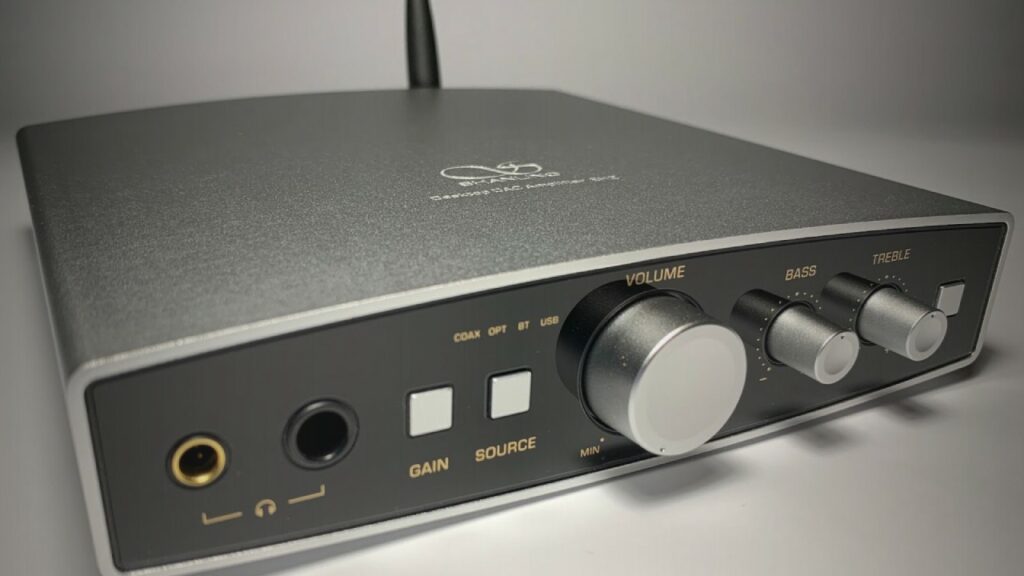
2. Topping L70: High-tech balanced headphone amplifier and preamplifier
Topping L70 balanced headphone amplifier and preamplifier designed for headphone listening and system control.
The Topping L70 is the most headphone-focused component in this selection.
It uses Topping’s NFCA module, with a hybrid voltage and current feedback architecture and UHGF technology, and the source highlights very low THD+N, very low noise, a 146 dB dynamic range, high output current, and low output impedance.
It also works as a preamplifier, offers two gain levels, includes a remote control, and uses an R2R relay-and-resistor volume system intended for precise adjustment and channel consistency.
Best for: Desktop headphone systems and preamp use
- Balanced NFCA headphone amplifier and preamplifier
- Two gain levels for different headphone needs
- 146 dB dynamic range stated in the source
- Remote control and R2R volume control
Verdict: The L70 is the practical choice here for listeners who need a dedicated headphone amplifier that can also serve as a compact preamplifier.
3. Tonewinner AD-7300PA+: 7-channel Class AB power amplifier
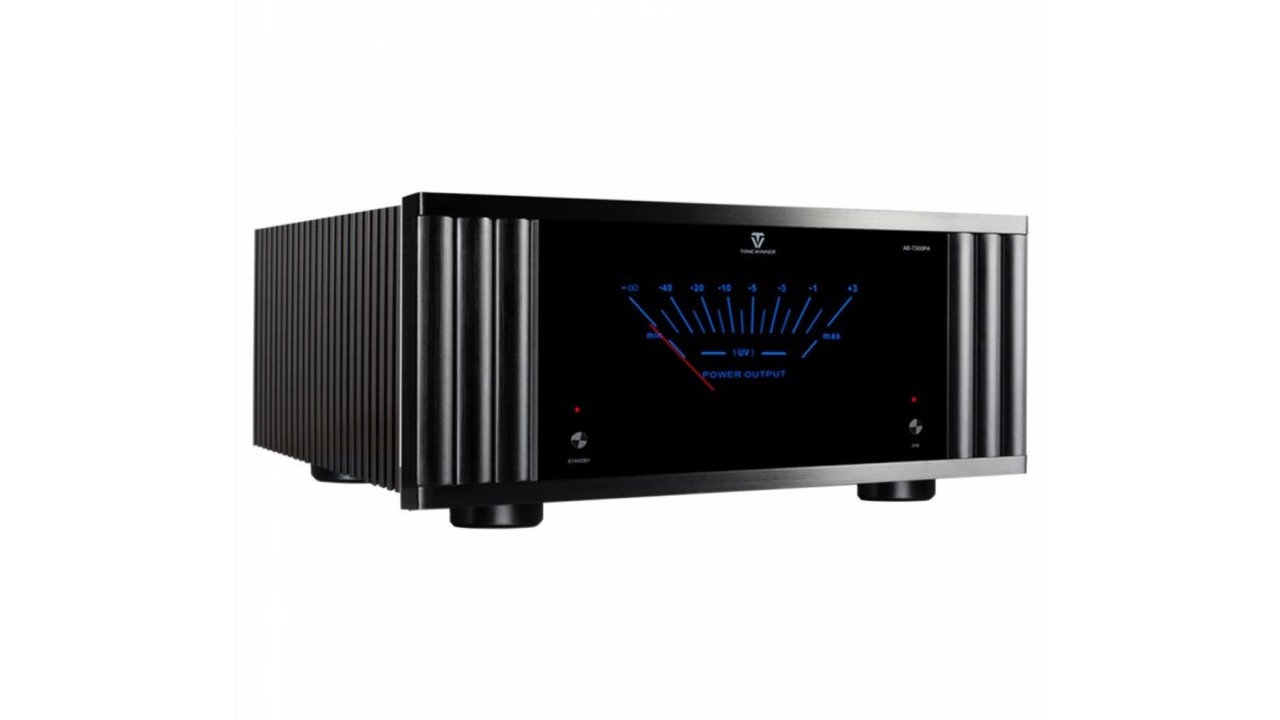
Tonewinner AD-7300PA+ multichannel power amplifier with blue front meter and large side heatsinks.
The Tonewinner AD-7300PA+ is aimed squarely at home-theater integration.
It is a 7-channel Class AB power amplifier with seven independent discrete mono amplifier modules, RCA and XLR inputs for each channel, and per-channel input switching.
The source cites 7×190 W with all seven channels driven into 8 ohms, along with short-circuit, overload, overheat, overvoltage, and overcurrent protection. A 25 kg aluminum chassis, large side heatsinks, and an adjustable blue front meter reinforce its role as a substantial multichannel power amp.
Best for: Separate-processor home-theater systems
- Seven-channel Class AB power amplifier
- RCA and XLR inputs for each channel
- Comprehensive protection circuitry
- Large chassis with side-mounted heatsinks
Verdict: The AD-7300PA+ is the obvious fit when the priority is powering multiple theater channels from a dedicated Class AB amplifier.
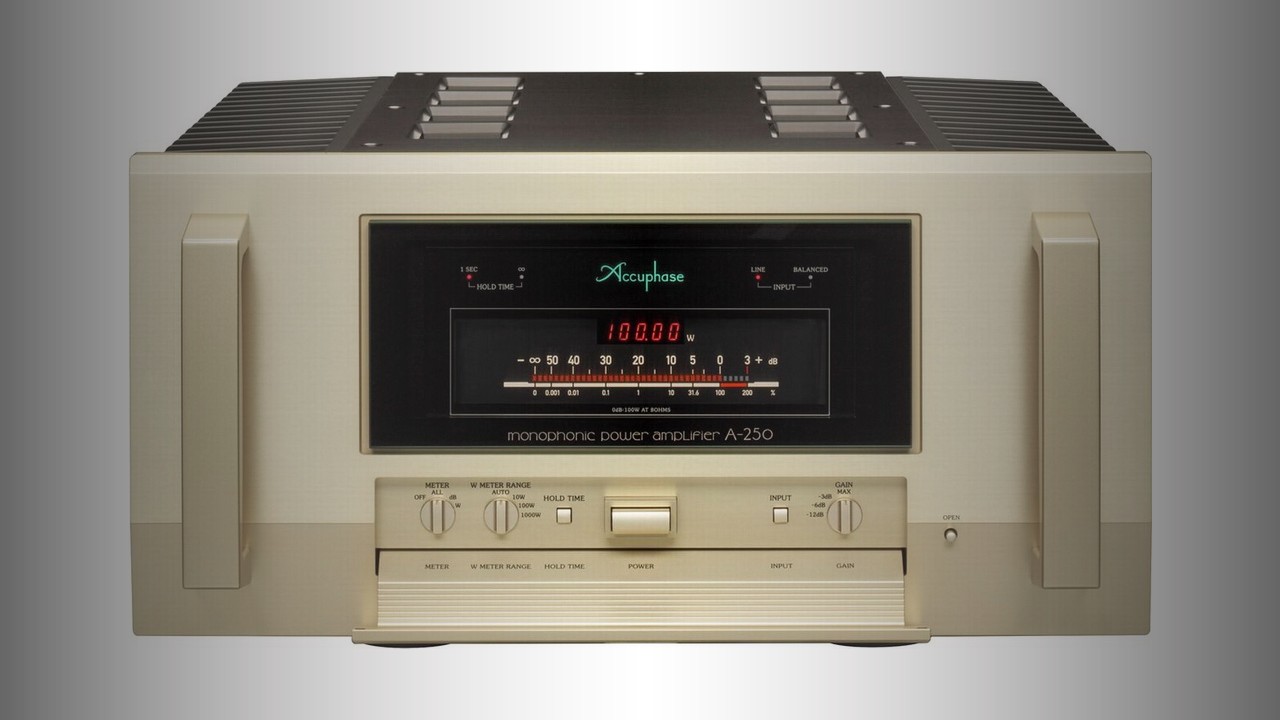
4. Accuphase A-250: Class A mono power amplifier
Accuphase A-250 Class A mono power amplifier with thick anodized aluminum front panel and substantial internal heatsinking.
The Accuphase A-250 is an uncompromising Class A monoblock built around a fully balanced circuit, a shielded toroidal transformer, and two 100,000 uF capacitors.
The source describes a substantial internal layout with large heatsinks, copper and gold-plated circuit boards, dual MCS+ technology, and current feedback.
Its output is specified as 100 W at 8 ohms, rising as impedance decreases down to the stated 800 W at 1 ohm, and it also includes selectable gain reduction.
Best for: Reference-level mono amplification with difficult speaker loads
- Pure Class A monoblock design
- Fully balanced circuit
- Specified output down to 1 ohm
- Selectable gain reduction
Verdict: The A-250 is for systems that justify a heavyweight Class A monoblock with very serious power-supply engineering and low-impedance capability.
5. 7 awesome speakers made from unusual materials
Concrete and other unconventional speaker designs can include built-in amplification, changing the need for a separate amplifier.
This source is not an amplifier product review, so it should not be treated as a direct amplifier recommendation.
Its relevance to this guide is limited to active-speaker context: the article discusses unconventional loudspeaker construction and includes Le Pavé Parisien, a compact concrete wireless speaker with a built-in 20 W Class D amplifier and 8-hour battery claim.
It also highlights larger concrete speaker design through BetonArt Arrivato Active, with attention to driver materials and cabinet construction.
Best for: Readers considering active speakers rather than separate amplifiers
- Useful context for active-speaker systems
- Includes a built-in Class D amplifier example
- Highlights unusual cabinet materials
- Discusses concrete loudspeaker construction
Verdict: This article is useful background on powered speaker design, but it is not a substitute for choosing a standalone amplifier.
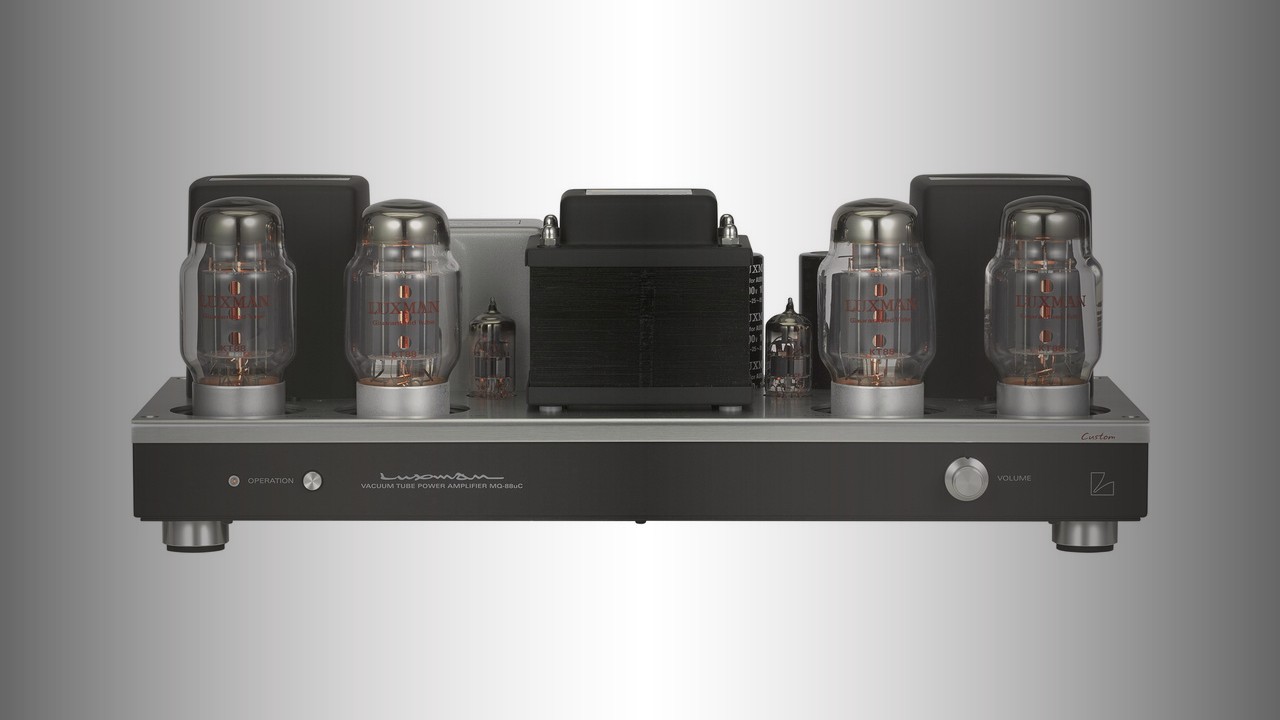
6. Luxman MQ-88uC: Stylish tube amplifier
Luxman MQ-88uC tube amplifier with exposed tubes, compact controls, and transformer housings on the top plate.
The Luxman MQ-88uC article presents a tube amplifier built with careful mechanical design, an aluminum supporting structure, and a restrained front panel.
A front volume control allows use without a separate preamplifier when only one source is connected, while fixed and adjustable RCA inputs provide flexibility.
The circuit described includes ECC83 input tubes, ECC82 driver tubes, Luxman OY-15 output transformers, a W-shaped power transformer, and four KT88 beam tetrodes at the output.
Best for: Tube-based two-channel systems with simple source needs
- Tube amplifier with KT88 output stage
- Front volume control for simple one-source use
- Fixed and adjustable RCA inputs
- Luxman output transformers described in the source
Verdict: The MQ-88uC is appealing when a listener wants a classic tube amplifier layout with enough input flexibility to run either directly from a source or with a preamplifier.

7. The New Moon Compass 371, A Future Classic for Audiophiles
Moon Compass 371 streaming amplifier with central color display, front controls, and a 6.3 mm headphone output.
The Moon Compass 371 is the most modern all-in-one style amplifier in the source list.
It is described as a streaming amplifier that combines Moon’s analog heritage with newer digital engineering and is intended to act as the center of a system.
The article emphasizes its seamless enclosure, curved aluminum cheeks, hidden cooling slots, central color display, slim function buttons, volume encoder, and 6.3 mm headphone output, along with a choice of matte black or silver finish.
Best for: Listeners wanting one amplifier to anchor modern source use
- Streaming amplifier concept
- Designed as a system hub
- Color display and front headphone output
- Modern Moon enclosure design
Verdict: The Compass 371 is the shortlist candidate for buyers who want amplification, streaming orientation, system control, and a contemporary Moon design in one component.

8. Accuphase E-800S: Class-A precision integrated stereo amplifier
Accuphase E-800S Class A integrated amplifier with balanced circuitry, front-panel level controls, and substantial heatsinking.
The Accuphase E-800S is a Class A integrated stereo amplifier with balanced architecture from input to output.
Its Balanced AAVA volume control is described as reducing noise compared with earlier designs by avoiding a conventional variable-resistor approach, while an ANCC circuit is used in the IV conversion amplifier to mitigate noise and distortion.
The final stage uses six pairs of parallel MOSFETs in push-pull Class A operation, supported by substantial side heatsinks, with specified output of 50 W at 8 ohms, 100 W at 4 ohms, and 200 W at 2 ohms.
Best for: High-end integrated stereo systems
- Class A integrated amplifier
- Balanced architecture from input to output
- Balanced AAVA volume control
- Specified output down to 2 ohms
Verdict: The E-800S is the integrated Accuphase option for listeners who want Class A output and sophisticated volume-control architecture without moving to separate preamp and power amp boxes.

9. Pier Audio MS-1000SE: Impressive integrated amplifier from France
Pier Audio MS-1000SE hybrid integrated amplifier with amber-lit tubes, central VU meter, and selectable front-panel finish.
The Pier Audio MS-1000SE is a hybrid integrated amplifier pairing a tube-based preamplifier section with a transistor power amplifier.
The source states 20 W per channel in Class A mode, with Class AB operation available at 150 W per channel into 8 ohms and 300 W into 4 ohms.
It also includes a tube rectifier in the input stage, visible 6N11 tubes behind an amber-lit front glass panel, a central VU meter, RCA line inputs, PRE-IN, an MM phono input, Bluetooth, and a removable protective glass panel for production units.
Best for: Integrated systems needing analog, phono, and Bluetooth convenience
- Hybrid tube and transistor design
- 20 W per channel in Class A mode
- MM phono input and Bluetooth
- PRE-IN for external preamplifier use
Verdict: The MS-1000SE offers a broad feature mix for a hybrid integrated amplifier, combining visible tube circuitry, phono support, wireless convenience, and higher-power Class AB operation when required.

10. Pioneer A-40AE: Classic integrated stereo amplifier
Pioneer A-40AE integrated stereo amplifier with metal case, aluminum front panel, and conventional control layout.
The Pioneer A-40AE is a traditional integrated stereo amplifier rather than a wireless or streaming component.
The source says it includes a Wolfson-based digital-to-analog converter supporting 24-bit signals up to 192 kHz, while the transformer windings for the preamplifier, power amplifier, and control unit are isolated to reduce mutual interference.
It also uses ELNA capacitors developed for Pioneer audio equipment, a metal case with an aluminum front panel, and internal layout measures intended to reduce standing waves inside the cabinet.
Best for: Conventional stereo systems with digital inputs but no streaming requirement
- Traditional integrated stereo amplifier
- Built-in Wolfson-based DAC
- No wireless modules or built-in streamer
- Separated transformer windings for key circuits
Verdict: The A-40AE suits listeners who want a straightforward integrated amplifier with a built-in DAC and a deliberately traditional feature set.
Quick comparison
These components are not direct substitutes for one another.
The useful comparison is by system role: monoblock power amplification, multichannel theater use, headphone listening, all-in-one streaming, tube or hybrid integrated design, and traditional stereo integration.
| Product | Best for | Verdict |
|---|---|---|
| McIntosh MC301 | High-power monoblock applications | Choose it when a 300 W McIntosh monoblock with Quad Balanced topology and autotransformer load taps fits the system plan. |
| Topping L70 | Headphones and compact preamp duties | Choose it for a balanced headphone amplifier that can also operate as a preamplifier with precise relay-based volume control. |
| Tonewinner AD-7300PA+ | Multichannel home theater | Choose it when seven channels of separate Class AB power, RCA and XLR inputs, and protection circuitry are priorities. |
| Accuphase A-250 | Class A monoblock systems | Choose it for a fully balanced Class A mono amplifier with substantial power supply design and stated low-impedance capability. |
| 7 awesome speakers made from unusual materials | Active-speaker context | Use it as background if considering powered speakers with built-in amplification rather than separate amplifier components. |
| Luxman MQ-88uC | Tube amplifier setups | Choose it if KT88-based tube amplification, RCA input flexibility, and optional direct source connection are central needs. |
| Moon Compass 371 | Streaming-centered systems | Choose it when the amplifier also needs to serve as a modern hub with display, headphone output, and Moon styling. |
| Accuphase E-800S | Class A integrated stereo | Choose it for an integrated Accuphase design with balanced architecture, AAVA volume control, and Class A MOSFET output. |
| Pier Audio MS-1000SE | Hybrid integrated systems | Choose it for a feature-rich hybrid integrated amplifier with MM phono, Bluetooth, PRE-IN, visible tubes, and Class A or AB operation. |
| Pioneer A-40AE | Traditional integrated stereo | Choose it for a classic integrated amplifier with a built-in DAC and no emphasis on wireless or streaming features. |
Frequently asked questions
Should I buy an integrated amplifier or a separate power amplifier?
An integrated amplifier such as the Accuphase E-800S, Pier Audio MS-1000SE, or Pioneer A-40AE combines control and power amplification in one chassis, which simplifies a stereo system.
A separate power amplifier such as the McIntosh MC301, Accuphase A-250, or Tonewinner AD-7300PA+ makes more sense when you already have, or plan to use, a separate preamplifier or surround processor.
When does a multichannel amplifier make sense?
A multichannel power amplifier is useful when a home-theater processor needs external amplification for several speakers.
The Tonewinner AD-7300PA+ is the dedicated example here, with seven Class AB channels, per-channel RCA and XLR inputs, and protection circuits suited to a larger theater installation.
Do I need streaming or Bluetooth in the amplifier?
Only if those functions match how you listen.
The Moon Compass 371 is described as a streaming amplifier and system hub, while the Pier Audio MS-1000SE includes Bluetooth.
The Pioneer A-40AE takes the opposite approach, omitting wireless modules and built-in streaming while retaining a built-in DAC for a more traditional stereo setup.
How should I think about Class A, Class AB, tube, and hybrid designs?
Use the topology as a practical clue, not a guarantee of suitability.
The Accuphase A-250 and E-800S are Class A designs, the Tonewinner AD-7300PA+ is a Class AB multichannel amplifier, the Luxman MQ-88uC is a tube amplifier, and the Pier Audio MS-1000SE combines tube preamplification with transistor power amplification.
System role, speaker requirements, input needs, and heat or space considerations matter as much as amplifier class.
How to choose from this amplifier shortlist
Start with the role the amplifier must play.
For a headphone-first system, the Topping L70 is the only dedicated headphone amplifier and preamplifier in the group.
For a theater built around a processor, the Tonewinner AD-7300PA+ is the clear multichannel candidate. For two-channel separates, the McIntosh MC301 and Accuphase A-250 belong in very different monoblock conversations: the McIntosh centers on 300 W output, Quad Balanced topology, and autotransformer load taps, while the Accuphase emphasizes pure Class A operation, a fully balanced circuit, and specified low-impedance output capability. If you want one box for a stereo system, narrow the field by source requirements. The Accuphase E-800S is the Class A integrated option with balanced architecture and AAVA volume control. The Pier Audio MS-1000SE adds hybrid tube and transistor design, MM phono, Bluetooth, and PRE-IN flexibility. The Pioneer A-40AE is the more traditional integrated amplifier with a built-in DAC but no wireless or streamer emphasis. The Moon Compass 371 is the streaming-oriented hub for listeners who want a modern amplifier built around contemporary source use. The Luxman MQ-88uC stands apart as a tube amplifier with fixed and adjustable RCA inputs, front volume control, and a KT88 output stage, making it attractive for simpler tube-based systems. The unusual-material speakers article should be treated differently: it is useful background if you are deciding whether an active speaker with built-in amplification might replace the need for a separate amplifier, but it is not a standalone amplifier recommendation.