Building a home cinema is no longer just a matter of choosing the largest receiver and adding speakers.
The source material here points to a market split between ambitious surround processors, slim AV receivers for discreet installations, practical speaker-layout guidance, and a shrinking field of optical-disc hardware.
For buyers, that means priorities matter. A dedicated theater room may justify a processor such as the Marantz AV 30 or a powerful Arcam receiver with Dirac calibration, while a smaller living room may be better served by a compact Anthem or Pioneer unit. Disc collectors also need to pay attention to availability, as several major brands have stepped away from Blu-ray or optical-drive production. The recommendations below are grounded in the supplied articles rather than lab measurements or fresh listening tests. Treat them as a practical map of the category: what each product or article is most useful for, where it fits, and what kind of home cinema buyer should pay closest attention.

1. LG stops production of Blu-ray players
LG Blu-ray player market update for home cinema buyers who still rely on physical discs.
This is not a product recommendation so much as an important buying signal for home cinema fans who still value physical media.
LG has halted development and manufacturing of Blu-ray players, including its UHD UBK80 and UBK90 models, with remaining stock available only while supplies last.
The article also notes that Sony and Panasonic continue to offer UHD players, though without recent product-line refreshes mentioned in the source.
Best for: Disc collectors checking player availability
- Important context for Blu-ray buyers
- LG UBK80 and UBK90 stock may still be available
- Highlights Sony and Panasonic as remaining UHD-player options
Verdict: Anyone planning a disc-based home cinema should treat LG’s exit as a reason to think carefully about current hardware availability rather than assuming new models will keep arriving.

2. Arcam AVR31: Powerful 7.1-channel AV receiver
Arcam AVR31 AV receiver with front-panel volume control, VF display, headphone output, and auxiliary input.
The Arcam AVR31 is presented as the most powerful model in Arcam’s updated AV receiver series, built around seven channels of amplification and support for Dolby Atmos in a 5.1.2 configuration.
It can also be used in a 7.1.4-channel system with added external amplification, and the article lists DTS:X, IMAX Enhanced, full 16-channel Dirac calibration, Apple AirPlay 2, and Google Chromecast support.
Its G-class amplifier stages, toroidal transformer, and stated 7 x 100 W output into 8 ohms position it as a serious receiver for users who want both home cinema flexibility and stereo attention through Direct mode.
Best for: Ambitious surround systems with calibration needs
- Dolby Atmos, DTS:X, and IMAX Enhanced support
- Full 16-channel Dirac calibration
- Apple AirPlay 2 and Google Chromecast streaming
- G-class amplification with toroidal transformer
Verdict: The AVR31 suits buyers who want a powerful Arcam receiver at the center of a scalable Atmos-capable system, especially if they are prepared to add amplification for larger layouts.
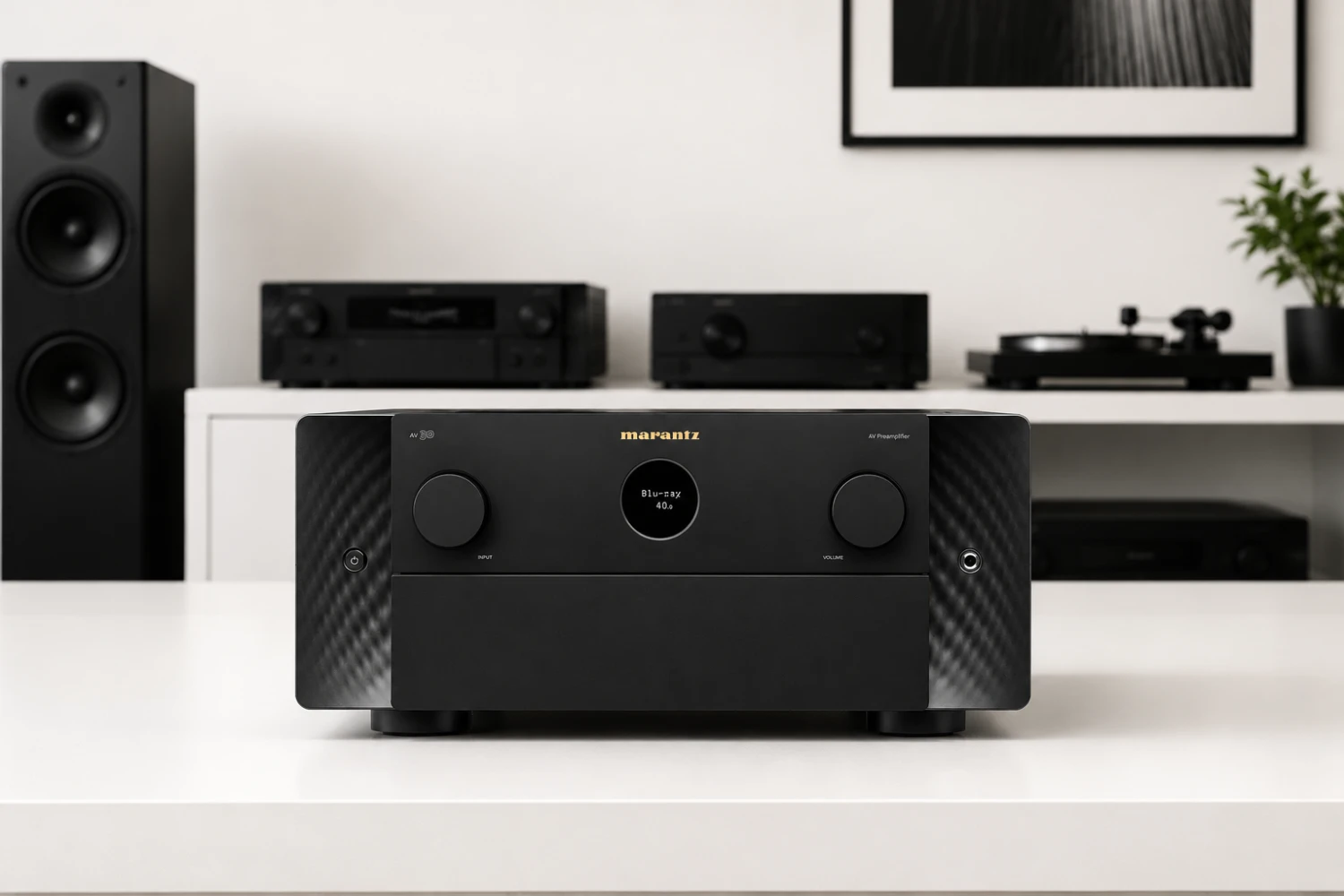
3. Marantz AV 30 Review: Premium Japanese Engineering for Ultimate Home Cinema
Marantz AV 30 surround processor with signature porthole display, illuminated front panel, and hidden secondary controls.
The Marantz AV 30 is described as an 11.4-channel surround preamplifier and processor for high-end home theater systems rather than a conventional AV receiver.
The article frames it as a centerpiece for systems up to 7.4.4, especially when partnered with matching Marantz AMP 20 or AMP 30 power amplifiers.
Its appeal is also strongly aesthetic and structural, with an aluminum chassis, Marantz porthole display, softly illuminated front panel, hidden secondary controls, and a clean minimalist design.
Best for: High-end separates-based home theaters
- 11.4-channel surround processing
- Suitable for systems up to 7.4.4
- Designed to pair with Marantz AMP 20 or AMP 30
- Solid aluminum chassis and refined Marantz styling
Verdict: The AV 30 is the choice here for buyers who want a processor-led Marantz system and are comfortable building around separate power amplification.

4. Anthem MRX SLM is a compact and powerful five-channel AV receiver
Anthem MRX SLM compact five-channel AV receiver designed for space-saving home cinema installations.
The Anthem MRX SLM is aimed at installations where space and visibility matter.
The article describes a compact five-channel receiver measuring 4.3 x 27.9 x 27.9 centimeters and weighing three kilograms, with HDMI 2.0b eARC, HDCP 2.3, Dolby Atmos, and DTS:X support.
It also includes Spotify Connect, AirPlay, Chromecast built-in, Bluetooth, analog jack and optical inputs, plus Anthem’s ARC Genesis platform for room correction.
Best for: Discreet installations and small media spaces
- Very compact five-channel design
- Dolby Atmos and DTS:X support
- Spotify Connect, AirPlay, Chromecast built-in, and Bluetooth
- ARC Genesis room-correction platform
Verdict: The MRX SLM is best suited to buyers who need a compact AV receiver that can be hidden easily while still supporting modern surround formats and streaming options.

5. Arcam AVR11: High-performance 12-channel AV receiver
Arcam AVR11 AV receiver with prominent front-panel volume control and 12-channel surround processing capability.
The Arcam AVR11 is described as a premium AV receiver with 12-channel surround processing, Class AB amplification, and full 12-channel Dirac Live calibration.
It supports Dolby Atmos in a 5.1.2 setup and can be expanded to 7.1.4 with an additional four-channel amplifier or two stereo amplifiers.
The article also lists IMAX Enhanced, Apple AirPlay 2, Google Chromecast, and DTS:X support via software update, while each of its seven powered channels is specified at 60 W into 8 ohms.
Best for: Premium systems needing Arcam processing with expansion room
- 12-channel surround processing
- Full 12-channel Dirac Live calibration
- Dolby Atmos and IMAX Enhanced support
- Apple AirPlay 2 and Google Chromecast streaming
Verdict: The AVR11 is a strong fit for buyers who want Arcam’s calibration and processing features but can accept external amplification for larger Atmos layouts.

6. Onkyo TX-NR696: AV receiver with plenty of bass
Onkyo TX-NR696 seven-channel AV receiver with traditional styling and support for immersive home cinema formats.
The Onkyo TX-NR696 is presented as a seven-channel AV receiver from Onkyo’s 600 series, with an emphasis on a favorable quality-to-price ratio and bass-capable amplifier design.
The article cites Dolby Atmos and DTS:X support, along with Dolby Atmos Height Virtualizer and DTS Virtual:X for creating a three-dimensional sound field when height speakers are not used.
It also notes THX Select certification, Dynamic Audio Amplification, stereo output to a second room, a custom low-noise power transformer, and high-capacity capacitors.
Best for: Value-focused surround systems with strong bass emphasis
- Dolby Atmos and DTS:X support
- Height virtualization options without height speakers
- THX Select certified
- Second-room stereo output
Verdict: The TX-NR696 is a practical option for buyers who want a traditional seven-channel receiver with immersive-format support and virtualization for simpler speaker layouts.

7. How many speakers should a home theater system have?
Home theater speaker-layout guide explaining full-range channels, subwoofers, and height speakers.
This article is a useful starting point before buying any receiver, processor, or speaker package.
It explains channel-number formats such as 5.1, 7.2, and 7.1.4, including the roles of full-range speakers, subwoofers, and height channels.
Its main value is helping newcomers understand how many speakers they may need and how surround layouts become more spacious and immersive as additional channels are added.
Best for: First-time buyers planning a speaker layout
- Explains channel-number formats
- Clarifies subwoofer and height-channel roles
- Useful for planning speaker quantity
- Accessible for home cinema beginners
Verdict: Read this before choosing hardware, because understanding channel notation makes receiver and speaker decisions much easier.

8. End of an Era: Pioneer Says Goodbye to Optical Disc Drives
Pioneer optical disc drive business update relevant to CD, DVD, and Blu-ray users.
Pioneer’s exit from the optical disc drive business is another market signal for home cinema users who still depend on physical media and disc authoring.
The article traces Pioneer’s long association with CD, DVD, and Blu-ray drives, noting praise for writing quality, low error rates, and broad media compatibility.
It also explains that digital downloads, cloud storage, high-speed internet, streaming platforms, and USB-based transfer have contributed to a sharp decline in optical storage media.
Best for: Physical-media users tracking long-term format support
- Important optical-media market context
- Covers CD, DVD, and Blu-ray drive history
- Notes Pioneer’s reputation for writing quality and compatibility
- Explains the shift toward streaming and digital storage
Verdict: For home cinema owners with disc libraries, Pioneer’s move reinforces the need to think about hardware availability and backup playback options.

9. Pioneer VSX-S520 AV Receiver: Compact Design with Wireless Connectivity and 4K Support
Pioneer VSX-S520 slim AV receiver with wireless connectivity and a compact 70 mm-high chassis.
The Pioneer VSX-S520 is a slim AV receiver aimed at users who want modern connectivity without a full-size chassis.
The article describes a 70 mm-high, 4 kg unit with Wi-Fi and Bluetooth, five amplification channels, and an additional channel that can be configured for a passive subwoofer.
It also notes 80 W per channel into 4 ohms or 55 W per channel into 8 ohms, while acknowledging omissions versus the earlier VSX-510, including no Pre Out, standard clip speaker terminals, a single subwoofer output, and no rear-panel USB port.
Best for: Compact AV setups needing wireless connectivity
- Slim 70 mm-high design
- Wi-Fi and Bluetooth built in
- Five amplification channels
- Can configure an additional channel for a passive subwoofer
Verdict: The VSX-S520 is best for space-conscious buyers who prioritize a slim receiver and wireless convenience over the connectivity retained by larger or earlier models.
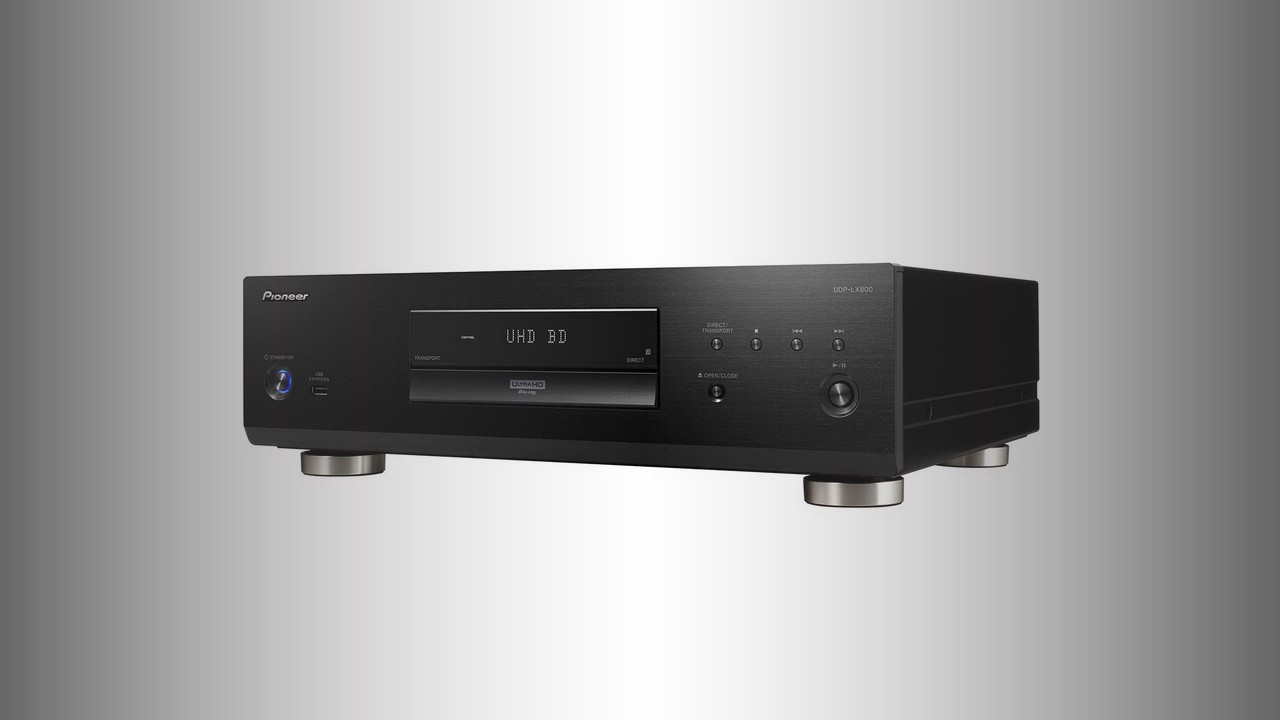
10. Pioneer UDP-LX800: Top-class universal player
Pioneer UDP-LX800 universal disc player with anti-vibration construction and support for Ultra HD Blu-ray and SACD.
The Pioneer UDP-LX800 is the most fully featured disc player in this selection.
The article states that it plays CD, DVD, DVD-Audio, DVD-Video, SACD, and Ultra HD Blu-ray, with Dolby Vision and HDR10 support.
Its construction is heavily emphasized, including a floating drive in an anti-vibration housing, a 4.6 mm-thick steel optical-drive chassis, isolated internal sections for power supply, digital, and analog circuitry, two HDMI outputs for separating audio and video, and PQLS jitter-reduction support with compatible Pioneer AV receivers.
Best for: Disc collectors wanting one high-end universal player
- Plays CD, DVD, DVD-Audio, DVD-Video, SACD, and Ultra HD Blu-ray
- Dolby Vision and HDR10 support
- Separate HDMI outputs for audio and video
- Anti-vibration drive housing and isolated internal sections
Verdict: The UDP-LX800 is the clearest fit for serious physical-media libraries, especially where both video disc playback and legacy audio-disc support matter.
How to choose the right home cinema route
Start with the room and the speaker layout rather than the most complex specification sheet.
If you are still working out what 5.1, 7.1.4, or subwoofer counts mean, the speaker-layout guide belongs at the beginning of the process.
It will help you decide whether a compact five-channel receiver is enough, whether you need Dolby Atmos height channels, or whether a larger layout with external amplification is realistic. For compact rooms or discreet installations, the Anthem MRX SLM and Pioneer VSX-S520 stand out for size-conscious systems. The Anthem adds ARC Genesis, modern surround-format support, and broad streaming options in a very small chassis, while the Pioneer favors slim styling, Wi-Fi, Bluetooth, and a compact receiver format with some connectivity compromises clearly noted in the source. For more ambitious systems, Arcam and Marantz occupy different roles. The Arcam AVR31 and AVR11 are AV receivers with Dirac calibration and expansion paths for larger Atmos layouts when extra amplification is added. The Marantz AV 30 is different: it is a surround preamplifier and processor designed for use with separate power amplifiers, making it more appropriate for buyers who already want a separates-based home theater architecture. Physical media requires special attention. LG’s withdrawal from Blu-ray player production and Pioneer’s exit from optical disc drives both suggest that disc-focused buyers should not assume an endless flow of new hardware. If disc playback is central to the system, the Pioneer UDP-LX800 is the strongest product match in the supplied material, thanks to its broad format support across CD, DVD, DVD-Audio, DVD-Video, SACD, and Ultra HD Blu-ray, plus HDR support and substantial anti-vibration construction. The best purchase path is therefore not one-size-fits-all. Choose compact receivers for small rooms, Arcam or Marantz electronics for larger calibrated systems, and a serious universal player if a disc library remains important. Above all, match the electronics to the speaker plan and source habits before spending on channels or features you may not use.