Exceptional Home Cinema Components for Serious Audiophile Rooms
A premium home cinema guide focused on system roles: AV control and room correction from Onkyo, bright 4K laser projection from Optoma, and source integrity from OPPO.

A premium home cinema is not defined by one spectacular component.
It depends on the chain: source quality, video handling, surround decoding, amplification, room setup, and the ability to integrate modern and legacy equipment without forcing compromises elsewhere in the system.
The selections here cover three core roles in a high-performance cinema room: an AV receiver with extensive decoding and connectivity, a bright 4K laser projector built for large-screen HDR viewing, and a carefully engineered Blu-ray player designed to preserve both video and audio signal quality. Each recommendation is grounded in the supplied product material rather than broad market claims. Taken together, these components show different routes to a more serious home theater: better system control, a more ambitious projected image, or a higher-integrity physical media source. The right choice depends less on status and more on where your current setup is weakest.
1. Onkyo TX-NR7100 B M2: Fully equipped AV receiver
Onkyo TX-NR7100 B M2 AV receiver with front-panel controls, extensive HDMI connectivity, network streaming support, and immersive surround processing.
The Onkyo TX-NR7100 B M2 is the most complete system hub in this selection, built around a 9-channel AV receiver platform with modern surround processing, video support, room correction, and broad connectivity.
Its THX certification and IMAX Enhanced compliance position it squarely for cinema-focused installations, while Dolby Atmos and DTS:X decoding support layouts up to 7.1.2 or 5.1.4.
The specification is particularly strong for mixed-use rooms. Seven HDMI inputs, including one on the front panel, and two HDMI outputs support 8K video, HDCP2.3, Dolby Vision, HDR10+, and eARC. Dirac Live is included for room setup, and the receiver also provides two subwoofer outputs, analog and digital inputs, an MM phono input, Ethernet, dual-band Wi-Fi, DTS Play-Fi, AirPlay 2, and Chromecast. That makes it suitable not only for movies, but also for network audio, vinyl playback, and streaming-based listening.
Best for: A feature-rich AV control center for surround-focused cinema rooms
- 9-channel AV receiver with Dolby Atmos and DTS:X
- Dirac Live room correction included
- Seven HDMI inputs and two HDMI outputs with modern video support
- THX certified and IMAX Enhanced compliant
Verdict: The Onkyo TX-NR7100 B M2 is the most versatile all-in-one foundation here, especially for systems that need current HDMI handling, immersive audio decoding, room correction, and multiple source options.
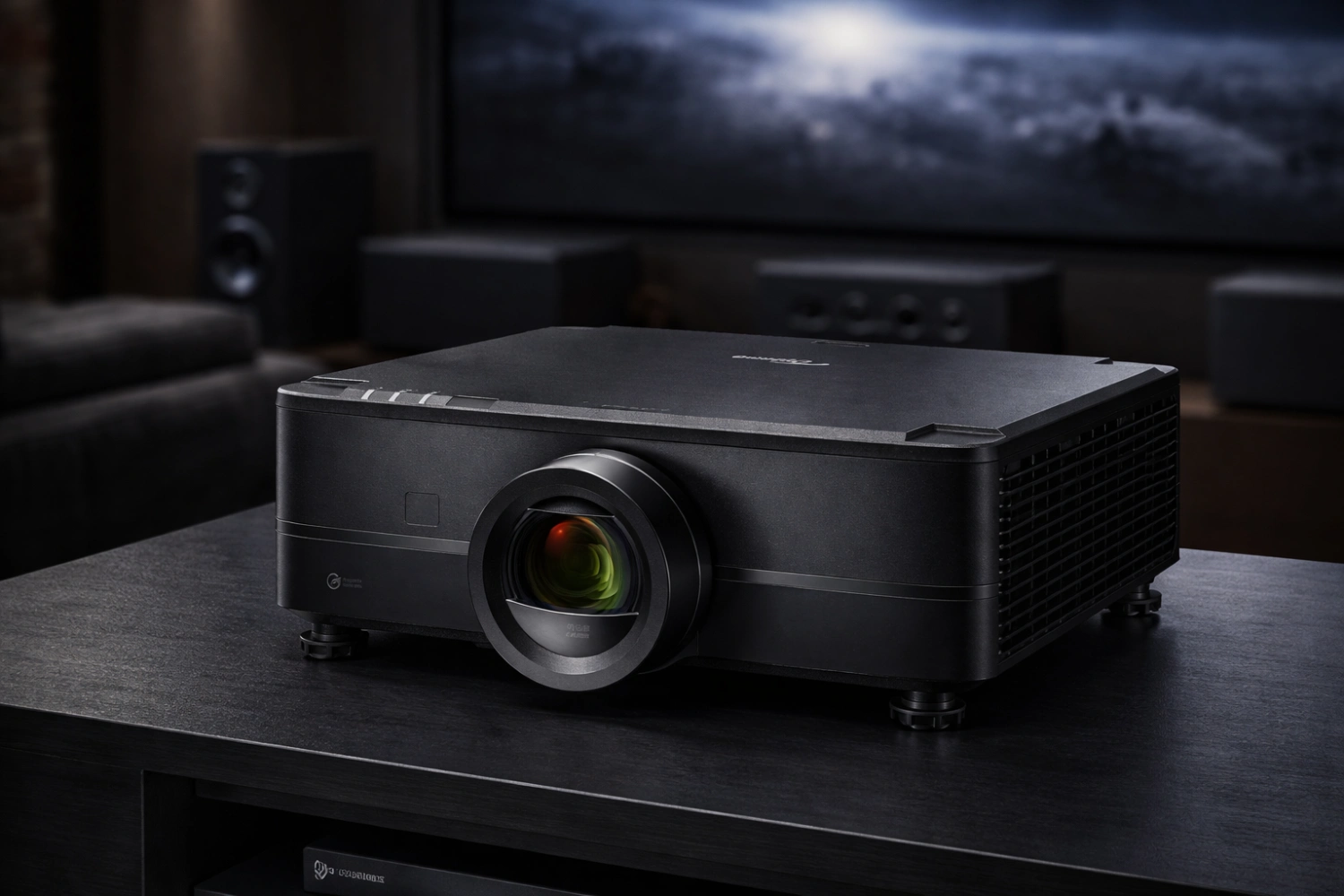
2. Optoma UHZ78LV 4K Laser Projector: 5,000 Lumens, Dolby Vision & HDR10+ Home Cinema Powerhouse
Optoma UHZ78LV 4K laser projector designed for bright large-screen home cinema use with Dolby Vision, HDR10+, and flexible installation options.
The Optoma UHZ78LV is aimed at home cinema installations where a large, bright projected image is the priority.
It is specified as a 4K laser projector with a peak brightness of 5,000 lumens, making it suitable for larger projection screens according to the source material.
Support for both Dolby Vision and HDR10+ gives it dynamic HDR compatibility for content that can take advantage of those formats. Its 3RGB laser design is specified with 98% DCI-P3 color accuracy, and Optoma pairs the projector with PureEngine Ultra processing for calibrated color and detail. Installation flexibility is also a clear part of the appeal, with front, rear, or ceiling mounting options. The laser light source is rated for up to 30,000 hours of viewing, which is relevant for buyers who want a projection system intended for regular use rather than occasional special-event viewing.
Best for: Large-screen projection systems that need high brightness and dynamic HDR support
- 4K laser projection with specified 5,000-lumen peak brightness
- Dolby Vision and HDR10+ support
- 3RGB laser design with claimed 98% DCI-P3 color accuracy
- Front, rear, or ceiling mounting options
Verdict: The Optoma UHZ78LV is the image-led recommendation here, suited to rooms where screen size, laser projection, HDR format support, and flexible mounting matter most.

3. OPPO UDP-203: Classic Easy-to-use Blu-ray player
OPPO UDP-203 Blu-ray player with understated design, dual HDMI outputs, HDMI input, 4K HDR handling, and dedicated DAC-based analog audio output.
The OPPO UDP-203 is presented as a competently designed Blu-ray player with a restrained, functional chassis and a focus on signal integrity.
Its MediaTek OP8591 chipset supports 4K video with HDR10 and Dolby Vision, and the player uses two HDMI outputs: a universal HDMI 2.0a output and a separate HDMI 1.4 output.
The source material emphasizes this arrangement as a way to avoid unnecessary video switching by third-party components. The UDP-203 also includes an HDMI input for external sources such as game consoles or Smart TV dongles, with the source noting that 12-bit 4K video can pass through it practically unchanged. On the audio side, the player uses an Asahi Kasei AK4458VN DAC, allowing it to feed analog signals directly to separate power amplifiers if the system is configured that way. For owners who still value disc playback and flexible integration, it remains a purposeful source component in this group.
Best for: Disc-based systems that prioritize clean video routing and flexible audio output
- 4K video decoding with HDR10 and Dolby Vision
- Dual HDMI outputs for system integration
- HDMI input for external sources
- Asahi Kasei AK4458VN DAC for analog audio output
Verdict: The OPPO UDP-203 is the source-first choice, best suited to home cinemas where physical media playback, HDMI routing, and analog audio output are still central to the system.
Frequently asked questions
Should I start with an AV receiver, projector, or disc player?
Start with the component that addresses the main limitation in your room.
If your system lacks modern surround decoding, HDMI support, or room correction, the AV receiver is the logical foundation.
If the image is the weak point, a projector such as the Optoma UHZ78LV is more relevant. If you rely on discs and want careful signal routing, a player such as the OPPO UDP-203 is the source-focused upgrade.
How important is room correction in a home cinema receiver?
Room correction is highly useful because speaker placement, room shape, and bass behavior can strongly affect cinema sound.
In the supplied material, the Onkyo TX-NR7100 B M2 includes Dirac Live, which is intended to help optimize the home theater setup rather than relying only on manual adjustment.
Do Dolby Vision and HDR10+ matter for home cinema?
They matter if your display or projector and content support them.
Dolby Vision and HDR10+ are dynamic HDR formats, and the supplied material highlights both on the Optoma UHZ78LV and modern HDMI video support on the Onkyo receiver.
For buyers building an HDR-capable cinema chain, format compatibility should be checked across every device, not just one component.
Why choose a dedicated Blu-ray player when streaming is available?
A dedicated player can still make sense for systems built around physical media, stable disc playback, and precise signal routing.
The OPPO UDP-203 is described with 4K HDR and Dolby Vision decoding, dual HDMI outputs, an HDMI input, and a dedicated DAC section, making it relevant where source quality and integration flexibility are priorities.
How to Choose the Right Premium Home Cinema Upgrade
Choose by role rather than by category prestige.
The Onkyo TX-NR7100 B M2 is the most broadly capable anchor for a modern home cinema because it combines immersive audio decoding, Dirac Live room correction, extensive HDMI connectivity, network streaming, and useful legacy inputs, including MM phono.
It is the clearest fit when your system needs a central component to manage speakers, sources, video formats, and streaming. The Optoma UHZ78LV belongs at the top of the list when the screen experience is the priority. Its specified 5,000-lumen peak brightness, 4K laser platform, Dolby Vision and HDR10+ support, 3RGB laser design, claimed 98% DCI-P3 color accuracy, and flexible mounting options make it the most image-focused recommendation in this guide. It is especially relevant for larger projection screens where brightness and installation flexibility matter. The OPPO UDP-203 is the specialist choice. It is not trying to replace the AV receiver or projector; it serves the source end of the chain. Its 4K HDR10 and Dolby Vision support, dual HDMI outputs, HDMI input, and Asahi Kasei DAC make it a practical fit for systems that still value disc playback, clean video routing, and analog audio output. For a balanced buying decision, map the signal path from source to screen and speakers. Check that HDR formats, HDMI capabilities, speaker layouts, subwoofer needs, room correction, mounting options, and audio outputs align across the whole system. A premium home cinema works best when every component supports the same goal rather than when one impressive product is forced into an otherwise mismatched chain.