Stereoindex Picks: DACs Worth Considering for Serious Listening
A carefully differentiated selection of portable and desktop DACs, covering USB and Bluetooth listening, headphone amplification, streaming, balanced outputs and direct power-amplifier connection.

Choosing a DAC starts with deciding where and how it will be used.
A compact USB model can improve wired headphone listening from a phone, tablet or computer, while a desktop converter may add more digital inputs, stronger headphone amplification, variable outputs or network playback.
This selection covers both approaches. Portable options from FiiO, Hidizs, Shanling and xDuoo emphasize compact dimensions and direct headphone connectivity. Larger models from Musical Fidelity, Gold Note, Gustard, Exposure and FiiO are intended for stationary systems, with features ranging from preamplifier functionality to streaming and discrete R2R conversion. The headline specifications help establish compatibility, but they should not be the only basis for a decision. Pay particular attention to input types, headphone outputs, volume control, gain settings and whether the DAC can safely connect directly to active speakers or a power amplifier.

1. FiiO unveils BTR13 DAC and Headphone Amplifier
The FiiO BTR13 provides dedicated mode switching alongside 3.5mm and balanced 4.4mm headphone connections.
The FiiO BTR13 combines a portable DAC, headphone amplifier and Bluetooth receiver in one device.
A three-position switch moves between PC, Bluetooth and phone modes, while 3.5mm and balanced 4.4mm outputs accommodate common wired headphone connections.
Its Qualcomm QCC5125 platform supports LDAC, and separate CS43131 DAC chips handle the left and right channels. A parametric equalizer can be configured through an app or web interface, making this a flexible option for listeners who move between several digital sources.
Best for: Portable use across phones and computers
- PC, Bluetooth and phone operating modes
- LDAC and USB DAC support up to 96kHz
- 3.5mm and balanced 4.4mm outputs
- App- and web-adjustable parametric EQ
Verdict: A well-connected portable DAC and amplifier for listeners who want wired, USB and Bluetooth operation in one device.

2. The Hidizs SD2 is a compact DAC and headphone amplifier
The compact Hidizs SD2 uses USB Type-C input and a single 3.5mm output for wired headphones or powered speakers.
The Hidizs SD2 is a small USB Type-C DAC and headphone amplifier built around the ESS ES9270 chip.
It supports PCM up to 32-bit/384kHz and native DSD64/128, with a built-in SABRE headphone amplifier rated at 70mW per channel into 32 ohms.
Its single 3.5mm output keeps the layout simple, and the Type-C connection supports use with smartphones, computers, tablets and compatible game consoles.
Best for: Simple USB-C headphone listening
- Compact 34.5 x 20 x 10mm enclosure
- PCM up to 32-bit/384kHz and native DSD128
- USB Type-C device compatibility
- Built-in 3.5mm headphone output
Verdict: The SD2 is a straightforward choice when compact dimensions and a conventional 3.5mm output matter more than balanced connectivity.

3. Musical Fidelity M6S DAC: Promises the highest quality sound
The Musical Fidelity M6S DAC is a full-width converter with multiple optical, coaxial and USB connections.
The Musical Fidelity M6S DAC is a full-size converter with a broad set of digital connections: three coaxial inputs, three optical inputs and USB.
It accepts DSD64/128, while incoming PCM is upsampled to 32-bit/768kHz.
Internally, the circuit uses a dual-mono, fully balanced topology with four stereo DAC chips and data resynchronization intended to reduce jitter. A headphone amplifier is included, and both balanced and unbalanced outputs can operate at fixed or variable level for integration with an amplifier, active speakers or a power amplifier.
Best for: Full-size systems with several digital sources
- Three coaxial, three optical and USB inputs
- Dual-mono fully balanced circuit topology
- Built-in headphone amplifier
- Fixed or variable balanced and unbalanced outputs
Verdict: The M6S DAC combines extensive input capacity, headphone listening and variable-output flexibility in a dedicated desktop component.

4. Gold Note DS-1000 MKII: A true high-end DAC
The Gold Note DS-1000 MKII uses a 3.5-inch TFT display and single-knob interface to navigate its digital and network sources.
The Gold Note DS-1000 MKII goes beyond basic conversion by incorporating network-player functions.
Its coaxial and optical inputs accept PCM up to 24-bit/192kHz, while USB supports PCM and DSD64/128/256.
It can also read compatible files from FAT32 USB drives and hard disks, stream through supported online services, and access internet radio over LAN or Wi-Fi. A 3.5-inch TFT screen and Single Knob Control provide local access to inputs, radio stations and media-server functions.
Best for: Networked systems needing DAC and streaming functions
- Integrated LAN and Wi-Fi streaming
- USB playback from compatible drives
- DSD256 support through USB
- 3.5-inch TFT information display
Verdict: The DS-1000 MKII suits listeners who want digital conversion, network playback and local USB media access in one source component.

5. Gustard DAC-X30: Streamer and DAC with 4 ES9039SPRO DAC chips from ESS
The Gustard DAC-X30 combines four ESS converter chips, streaming software and relay-controlled output adjustment.
The Gustard DAC-X30 combines streaming, conversion and output-level control.
Four ESS ES9039SPRO chips are arranged with two per channel in a balanced architecture, while an FPGA manages clocking, digital processing and PCM/DSD functions.
A SHARC-based DSP filter and a discrete Class A analogue low-pass stage form part of the signal path. Its relay-based R2R volume system allows direct connection to active monitors or a power amplifier, with remote control available for level adjustment.
Best for: Streaming systems with direct amplifier connection
- Four ES9039SPRO DAC chips
- Balanced two-DAC-per-channel architecture
- Relay-based R2R volume adjustment
- Direct connection to active monitors or power amplifiers
Verdict: The DAC-X30 is aimed at systems that need a streamer, balanced multi-chip conversion and preamplifier-style volume control in one chassis.

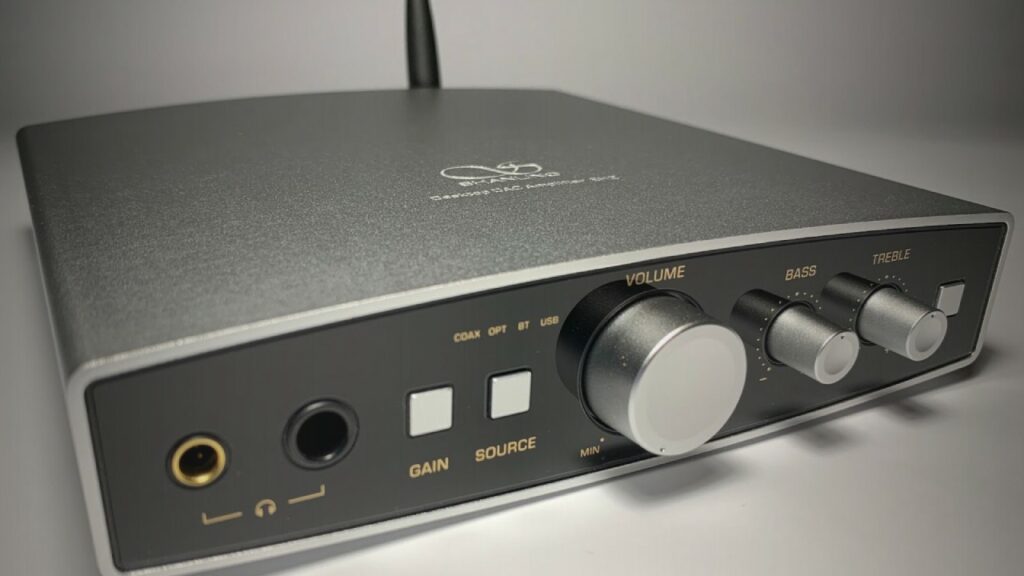
6. Shanling H0: Compact DAC and headphone amplifier with high-quality sound
The Shanling H0 offers standard 3.5mm and balanced 4.4mm headphone outputs with three selectable gain settings.
The Shanling H0 is a compact USB DAC and headphone amplifier using an XMOS XU316 processor and Cirrus Logic CS43198 converter.
It supports PCM up to 32-bit/768kHz, DSD256 and MQA, and provides both 3.5mm and balanced 4.4mm headphone outputs.
Three gain levels help adapt its output to different headphones. USB connectivity can also carry optical and coaxial signals, and the listed source compatibility includes PCs and supported game consoles.
Best for: Compact setups using varied headphone types
- PCM up to 32-bit/768kHz and DSD256
- 3.5mm and balanced 4.4mm outputs
- Three selectable gain levels
- Support for optical and coaxial signals over USB
Verdict: The H0 balances high-resolution format support, two headphone outputs and adjustable gain in a compact DAC-amplifier.

7. FiiO K9: Close to perfect
The FiiO K9 places digital conversion and headphone amplification in a stationary desktop enclosure.
The FiiO K9 is a stationary DAC and headphone amplifier positioned as a simplified relative of the K9 Pro.
The supplied article identifies an ESS ES9038 Pro converter and emphasizes high-resolution capability, but provides fewer practical connection and output details than the other sources in this guide.
On the available evidence, its clearest role is as a single desktop component for digital conversion and headphone amplification rather than as a portable accessory.
Best for: Desktop DAC and headphone-amplifier systems
- ESS ES9038 Pro conversion
- Integrated stationary headphone amplifier
Verdict: The K9 is worth considering as an integrated desktop DAC-amplifier, although the supplied material offers limited detail for closer system matching.

8. Exposure DAC: High-Resolution British DAC with 99-Step Volume Control and Power Amp Output
The Exposure DAC combines extensive S/PDIF connectivity with RCA, XLR and variable-level output options.
The Exposure DAC concentrates on digital conversion rather than adding streaming or analogue inputs.
Seven S/PDIF inputs accept PCM from 44.1kHz to 192kHz, while USB supports signals up to 32-bit/768kHz and DSD256.
Its 99-step digital volume control enables direct connection to a power amplifier through RCA or XLR outputs. That focused design makes it particularly relevant to systems with several conventional digital sources and no requirement for an integrated network player.
Best for: Digital-only systems with multiple sources
- Seven S/PDIF digital inputs
- USB support up to 32-bit/768kHz and DSD256
- 99-step digital volume control
- RCA and XLR output connections
Verdict: The Exposure DAC is a focused converter for users who value numerous S/PDIF inputs and direct power-amplifier compatibility over streaming features.

9. xDuoo Link10: Dual DAC Smartphone Amp Delivers 300mW Power in a 25g Aluminum Body
The 25g xDuoo Link10 uses a removable USB cable and provides both 3.5mm and balanced 4.4mm headphone outputs.
The xDuoo Link10 is a portable USB DAC and headphone amplifier for phones, computers, tablets and supported consoles.
Two CS43131 chips handle conversion, with PCM support up to 32-bit/384kHz and DSD256.
Its 3.5mm and balanced 4.4mm outputs are joined by 60-step digital volume control. UAC 1.0 and 2.0 modes broaden source compatibility, while the 25g aluminium body and removable USB cable support portable use. Power comes from the connected source because there is no internal battery.
Best for: Portable balanced headphone setups
- Dual CS43131 DAC chips
- 3.5mm and balanced 4.4mm outputs
- UAC 1.0 and 2.0 operating modes
- Lightweight 25g aluminium enclosure
Verdict: The Link10 offers dual-output headphone connectivity, precise volume adjustment and broad USB compatibility in a lightweight format.
10. FiiO K13 R2R: Fully equipped DAC and headphone amplifier
The FiiO K13 R2R pairs its balanced resistor-ladder DAC architecture with a display, headphone amplification and software-adjustable EQ.
The FiiO K13 R2R is a desktop DAC and headphone amplifier based on a fully balanced, discrete 24-bit R2R design.
Its four channels each use 48 thin-film resistors, and listeners can select between non-oversampling and oversampling modes.
Bluetooth with LDAC, balanced output and a 10-band parametric equalizer extend its flexibility. Control is available from the front-panel display, the FiiO Control app or a web interface, while the amplifier is specified to deliver up to 2400mW per channel into 32 ohms.
Best for: Desktop listeners seeking adjustable R2R conversion
- Fully balanced discrete 24-bit R2R conversion
- Selectable NOS and oversampling modes
- Bluetooth connectivity with LDAC
- Integrated 10-band parametric EQ
Verdict: The K13 R2R combines discrete resistor-ladder conversion with substantial headphone output and unusually broad control options.
Frequently asked questions
Should I choose a portable or desktop DAC?
Choose a portable model when the main sources are a phone, tablet or laptop and compactness is important.
A desktop DAC is more appropriate when you need several digital inputs, a stronger headphone amplifier, network playback or variable outputs for active speakers and power amplifiers.
Do I need a balanced 4.4mm headphone output?
Only if your headphones have a compatible balanced cable and the DAC's balanced output suits their requirements.
Models with both 3.5mm and 4.4mm sockets offer more connection flexibility, but the presence of a balanced socket alone should not determine the purchase.
Are very high PCM and DSD limits the most important DAC specifications?
No.
Format support confirms whether a DAC can accept particular files, but input compatibility, output connections, volume control, gain options and integration with the rest of the system are usually more practical considerations.
Can a DAC connect directly to a power amplifier or active speakers?
Only use a direct connection when the DAC provides a suitable variable output or preamplifier function.
The Musical Fidelity M6S DAC, Gustard DAC-X30 and Exposure DAC are described with level-control capabilities for this purpose; begin at a low volume setting before playback.
How to Choose the Right DAC for Your System
Begin with the source.
A phone-based system may need USB-C compatibility, low weight and modest power consumption, while a computer or console setup can benefit from selectable USB modes and convenient headphone outputs.
For a main hi-fi system, count the optical, coaxial and USB connections you will actually use rather than choosing by maximum sample rate alone. Headphone users should match the output format and amplification features to their equipment. A 4.4mm connection is useful only with a compatible cable, and selectable gain can make a DAC-amplifier easier to use with different headphones. Bus-powered models draw energy from the connected phone or computer, whereas larger desktop units can provide more elaborate power supplies and broader system connectivity. If the DAC will feed active speakers or a power amplifier directly, confirm that it has a controllable variable output and understand how its volume setting behaves. A fixed-level output should normally feed an integrated amplifier or preamplifier instead. Streaming is another dividing line: the Gold Note DS-1000 MKII and Gustard DAC-X30 incorporate network-oriented functions, while the Exposure DAC deliberately focuses on conversion and digital input switching. Finally, treat resolution figures and converter-chip names as compatibility and design information, not complete judgments of performance. The most suitable DAC is the one whose inputs, outputs, controls and physical format solve the needs of the system without adding unnecessary complexity.