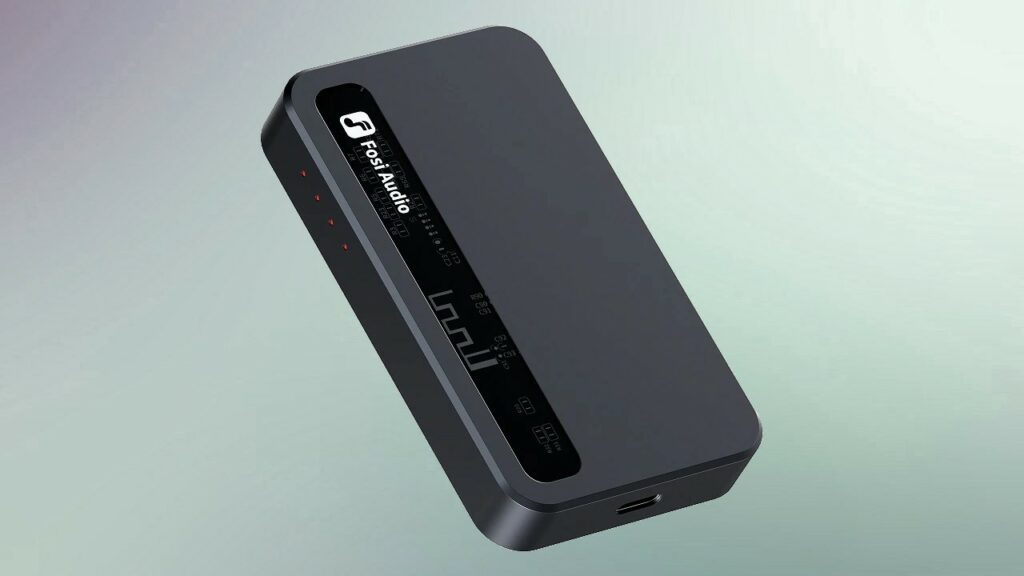
What Makes a DAC Remarkable? Standout Converters for Very Different Systems
A practical evergreen guide to distinctive DACs and DAC-adjacent digital components, focused on real system fit, supported features and clear buying distinctions.

A good DAC recommendation is rarely about chasing a single universal answer.
The most useful choice depends on where the converter will sit, what sources it must accept, whether it needs to drive headphones, and how much space the system allows.
The models gathered here are notable for different reasons: some are compact headphone-focused units, some are desktop hubs, and one is a specialist digital-to-digital converter intended to solve interface and clocking problems before the signal reaches a DAC. The source material ranges from announcement-style specification coverage to review-led product notes, so the recommendations below stay close to what is actually documented. Where a product is described with detailed format support, input options, circuit architecture or usage warnings, those details are included. Where the source is less complete, the recommendation is deliberately narrower. For buyers, the clearest pattern is that DACs are no longer simple one-input boxes. Portable units may include powerful headphone stages, desktop models often function as system control points, and high-end converters increasingly emphasise clocking, input flexibility and DSD or high-rate PCM handling. The right pick is the one whose connectivity and form factor match the system you already own, not the one with the longest specification list.

1. iBasso D16 Taipan: Portable and discrete DAC
iBasso D16 Taipan portable DAC with FPGA-Master 2.0 and a discrete PWM conversion architecture.
The iBasso D16 Taipan stands out because its DAC section is built around iBasso’s FPGA-Master 2.0 platform and a large discrete 1-bit PWM DAC architecture.
The source describes 16 sets of cascaded 8E PWM DACs, for a total of 128 PWM DACs, with FPGA-controlled signal reorganization and transcoding before the PWM DAC stage.
It is also positioned as a portable device with a super Class A transistor amplifier section similar in concept to the DX320MAX amplifier. The most relevant appeal is not just portability, but the unusual discrete conversion approach and the emphasis on FPGA-controlled timing, delay compensation and hardware analog FIR filtering.
Best for: Listeners who want a portable DAC with an unusual discrete conversion architecture
- Portable discrete DAC architecture
- FPGA-Master 2.0 signal processing core
- 128 independent PWM DACs described
- Super Class A transistor amplifier section
Verdict: The D16 Taipan is the curiosity piece here: a portable DAC built around a sophisticated FPGA and discrete PWM approach rather than a conventional off-the-shelf DAC layout.

2. E1DA 9039S: DAC/headphone amplifier announced
E1DA 9039S DAC/headphone amplifier with USB-C input and balanced 2.5 mm output.
The E1DA 9039S is a compact USB-powered DAC and headphone amplifier with a strong emphasis on measured performance and balanced output.
It uses an ESS E1DA 9039S chip alongside AD8397 and OPA1612 amplifier components, draws power from USB-C, and has no internal battery.
The article specifies support for PCM up to 32-bit/384 kHz and DSD256, plus a balanced 2.5 mm output wired according to the Astell and Kern circuit. The important practical warning is explicit: unbalanced adapters should not be used, as they may damage the DAC.
Best for: Users who want a compact USB DAC/headphone amplifier for balanced earphones or headphones
- USB-C powered with no internal battery
- PCM up to 32-bit/384 kHz and DSD256 support
- Balanced 2.5 mm headphone output
- Very low specified output resistance
Verdict: The E1DA 9039S is a specification-dense portable-style DAC/amp, but its balanced-only output guidance makes careful matching essential.
3. TEAC UD-301-X: DAC with built-in headphone amplifier
TEAC UD-301-X desktop USB DAC with headphone amplifier, RCA and XLR analog outputs.
The TEAC UD-301-X is presented as a more affordable USB DAC derived from TEAC’s higher UD-501 design language.
Its architecture includes a balanced two-channel input approach, two Burr-Brown PCM1795 DAC chips from Texas Instruments, and a power supply using a toroidal transformer.
Digital input support covers USB for DSD 2.8/5.6 MHz and PCM up to 192 kHz/24-bit, with optical and coaxial inputs also supporting up to 192 kHz/24-bit. RCA and XLR analog outputs, optional upsampling to 192 kHz, Muses operational amplifiers and a dual-mono circuit make it a serious desktop DAC rather than a minimal computer accessory.
Best for: Desktop systems needing a compact DAC with both single-ended and balanced analog outputs
- Dual Burr-Brown PCM1795 DAC arrangement
- USB input supports DSD 2.8/5.6 MHz
- RCA and XLR analog outputs
- Optional upsampling to 192 kHz
Verdict: The UD-301-X is a sensible desktop choice for buyers who value established DAC circuitry, multiple digital inputs and balanced output connectivity.

4. Van Medevoort Audio announces vM DA470 high-end DAC
Van Medevoort vM DA470 high-end stereo DAC designed for multi-source digital systems.
The Van Medevoort vM DA470 is described as a stereo DAC designed to act as the hub of a digital audio system.
Its focus is broad digital integration: CD player, tuner, server, streamer or computer sources can be routed through a DAC architecture using two vM superclocks, ASRC processing and two dedicated DA DSD converter chips, one per channel.
The source lists support for PCM up to 768 kHz and DSD512, with coaxial, XLR and optical SPDIF, USB, and two Q-Link I2S inputs. One Q-Link input is specifically intended for compatibility with existing and future Van Medevoort CD drives, making this a particularly ecosystem-aware high-end DAC.
Best for: Digital systems with multiple sources and a need for extensive input flexibility
- Designed as a digital system hub
- Two vM superclocks specified
- PCM up to 768 kHz and DSD512 support
- Includes USB and Q-Link I2S inputs
Verdict: The vM DA470 is the most system-hub-oriented DAC in this group, with its appeal centred on clocking, format support and numerous digital connection options.

5. FiiO K19: Powerful and Flexible Desktop Headphone Amplifier/DAC
FiiO K19 desktop headphone amplifier/DAC with multiple digital interfaces for computer and source integration.
The FiiO K19 is positioned as a desktop headphone amplifier/DAC that can also serve as a central hub for a desktop audio system.
The source highlights its wide interface set, including optical and coaxial S/PDIF, USB-C for connection to PCs and Macs, USB-C storage support and HDMI.
Output flexibility is also emphasised, with two pairs of RCA sockets and a pair of additional analog outputs referenced in the source excerpt. Its value lies in the breadth of system roles it can cover: computer audio, digital source connection, storage playback and desktop headphone listening are all part of the stated design direction.
Best for: Desktop users who want one component to handle several digital sources and headphone listening
- Desktop DAC and headphone amplifier format
- Optical and coaxial S/PDIF inputs
- USB-C for PC and Mac connection
- USB-C storage and HDMI support mentioned
Verdict: The K19 is the broad-connectivity desktop option for users whose DAC also needs to work as a flexible system centrepiece.

6. Mutec MC1.2+: Bidirectional digital to digital converter
Mutec MC1.2+ bidirectional DDC for converting between USB, AES/EBU, AES3/EBUid and S/PDIF digital audio interfaces.
The Mutec MC1.2+ is not a DAC in the usual analog-output sense; it is a bidirectional digital-to-digital converter.
Its purpose is to convert PCM audio streams between USB, AES/EBU, AES3/EBUid and S/PDIF interfaces, including simultaneous operation in both directions via USB.
The source presents it as especially useful in a professional recording studio, with low-noise audio clock oscillators, USB signal regeneration and USB voltage isolation intended to reduce phase noise and clock jitter according to the manufacturer’s explanation. For DAC buyers, it is relevant when the problem is not conversion to analog, but getting a cleaner or more compatible digital feed into an existing DAC.
Best for: Systems that need digital interface conversion before an external DAC
- Bidirectional digital-to-digital conversion
- USB, AES/EBU, AES3/EBUid and S/PDIF support
- Simultaneous USB in and out operation described
- USB voltage isolation and signal regeneration
Verdict: The MC1.2+ is a specialist problem-solver for digital routing and USB isolation rather than a replacement for a DAC with analog outputs.

7. FiiO K5 Pro ESS: Exceptional budget-friendly DAC
FiiO K5 Pro ESS compact desktop DAC/amplifier supplied with external power and USB accessories.
The FiiO K5 Pro ESS is introduced as a budget-friendly DAC from a manufacturer with a broad catalogue of portable and stationary audio products.
The supplied review excerpt focuses more on presentation and package contents than on detailed circuit specifications, but it does confirm a compact stationary DAC/amplifier package with an external 15 V, 1.5 A power supply, power cable and USB cable included.
Within this selection, it is the straightforward value-oriented desktop choice, especially for buyers who want a small DAC/amp without moving into the more elaborate hub-style products.
Best for: Buyers seeking a compact, value-oriented desktop DAC/amplifier
- Budget-friendly positioning stated
- Compact device format described
- DAC and amplifier package
- External power supply included
Verdict: The K5 Pro ESS is the modest, practical pick here, best considered when compact size and budget-conscious DAC/amp functionality matter more than extensive system-hub features.
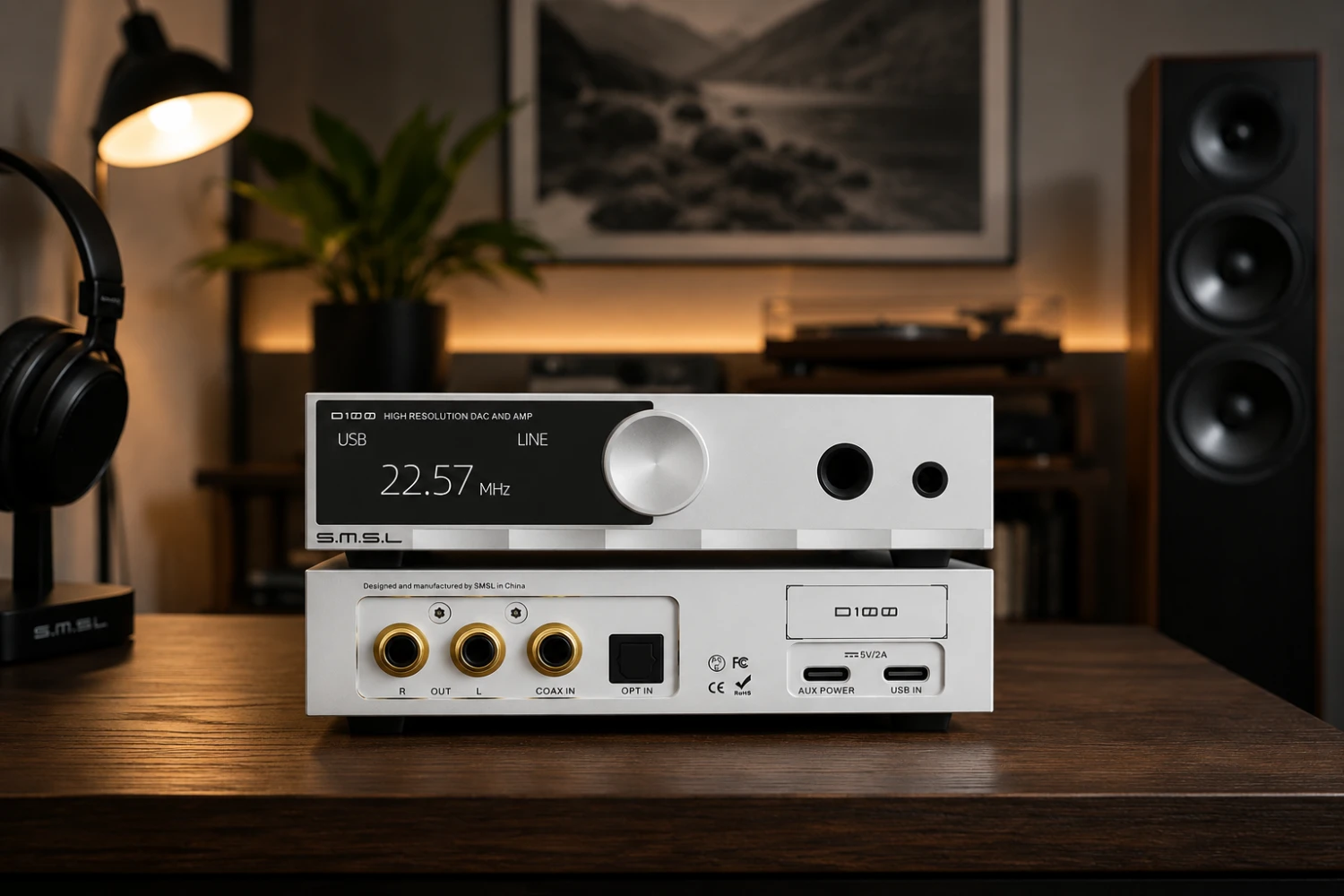
8. SMSL D100 Desktop DAC Adds Balanced Headphone Drive in a Compact Chassis
SMSL D100 compact desktop DAC/headphone amplifier with ESS conversion, USB, optical and coaxial inputs.
The SMSL D100 is a compact desktop DAC and headphone amplifier intended for computer audio, digital transports and headphone listening.
It uses an ESS ES9081 DAC platform with eight-channel parallel summing, an XMOS XU-316 USB interface, RCA line output and two front-panel headphone connections.
The source specifies PCM support up to 32-bit/768 kHz, DSD up to DSD512 and MQA support, while optical and coaxial inputs are listed up to 24-bit/192 kHz with DoP64 and MQA. This makes the D100 a fixed desktop component rather than a dongle alternative, especially for systems that need USB plus traditional digital inputs in a small case.
Best for: Small desktop systems needing USB, optical and coaxial digital input options
- Compact desktop DAC/headphone amplifier
- ESS ES9081 DAC with eight-channel parallel summing
- XMOS XU-316 USB interface
- PCM up to 32-bit/768 kHz and DSD512 support
Verdict: The D100 is a compact but well-connected desktop DAC for users who want high-resolution USB support and headphone outputs without a large chassis.

9. Musical Fidelity MX-DAC: Impressive DAC that can handle a wide range of material
Musical Fidelity MX-DAC with USB-B, coaxial and optical digital inputs plus RCA and XLR analog connectivity.
The Musical Fidelity MX-DAC is described as a USB DAC that adds DSD support to Musical Fidelity’s DAC line, with DSD up to DSD128.
It offers five digital inputs: two coaxial, two optical and USB-B.
The source notes that it does not include volume control, but it does provide both XLR and RCA analog connections, plus a digital filter settings switch for tailoring the system to taste. Its LED indication system displays input, filter settings and sample rate information, giving it practical day-to-day usability despite a clean, restrained appearance.
Best for: Systems needing a straightforward DAC with multiple digital inputs and balanced analog output
- Five digital inputs
- DSD support up to DSD128
- XLR and RCA analog connections
- Digital filter settings switch
Verdict: The MX-DAC is a cleanly focused converter for users who want flexible digital input handling without turning the DAC into a preamp.

10. SMSL DAC MINI: Mac Mini-Optimized DAC, Balanced Headphone Amp & USB Hub
SMSL DAC MINI designed to stack beneath a Mac mini with a matching aluminum chassis.
The SMSL DAC MINI is designed specifically to sit under a Mac mini, matching its footprint closely and using a CNC-milled aluminum enclosure.
The source frames it as a DAC and headphone amplifier with a USB hub function, built around an ESS ES9039Q2M DAC chip.
Its most distinctive practical feature is a mechanical power-on system: pressing the DAC MINI’s front button can wake the Mac mini without software workarounds. This is a highly specific product concept, but for the intended desk setup it offers unusually tidy physical integration.
Best for: Mac mini desktop setups needing an integrated DAC/headphone amplifier and hub-style companion
- Designed to match the Mac mini footprint
- CNC-milled aluminum enclosure
- Mechanical power-on system for Mac mini use
- ESS ES9039Q2M DAC chip mentioned
Verdict: The DAC MINI is the most setup-specific recommendation, making strongest sense for Mac mini users who value physical integration as much as DAC functionality.
Quick comparison
The comparison below keeps to high-level differences supported by the supplied material: form factor, role in a system, connectivity emphasis and the clearest editorial reason to consider each product.
| Product | Best for | Verdict |
|---|---|---|
| iBasso D16 Taipan: Portable and discrete DAC | Portable use with a discrete FPGA-controlled DAC architecture | Choose it for its unusual portable 1-bit PWM DAC design and super Class A amplifier section. |
| E1DA 9039S: DAC/headphone amplifier announced | USB-C balanced headphone listening | A compact measured-performance DAC/amp with a strict balanced-output usage requirement. |
| TEAC UD-301-X: DAC with built-in headphone amplifier | Desktop systems needing RCA and XLR outputs | A balanced desktop DAC with Burr-Brown conversion, DSD over USB and optional upsampling. |
| Van Medevoort Audio announces vM DA470 high-end DAC | Multi-source high-end digital systems | A digital hub-style DAC with extensive inputs, superclocking and high-rate PCM and DSD support. |
| FiiO K19: Powerful and Flexible Desktop Headphone Amplifier/DAC | Desktop users with many source types | A versatile DAC/headphone amplifier built around broad interface support, including USB-C, S/PDIF and HDMI. |
| Mutec MC1.2+: Bidirectional digital to digital converter | Digital signal conversion before a DAC | Not a DAC, but useful when USB, AES and S/PDIF routing or isolation is the real issue. |
| FiiO K5 Pro ESS: Exceptional budget-friendly DAC | Compact budget-conscious desktop DAC/amp setups | A practical small DAC/amplifier option with included external power supply and USB accessories. |
| SMSL D100 Desktop DAC Adds Balanced Headphone Drive in a Compact Chassis | Compact desktop DAC and headphone listening | A small ESS-based desktop component with USB, optical and coaxial inputs plus front headphone outputs. |
| Musical Fidelity MX-DAC: Impressive DAC that can handle a wide range of material | Straightforward digital input switching with balanced analog output | A focused DAC with five digital inputs, DSD128 support, RCA and XLR outputs, and filter selection. |
| SMSL DAC MINI: Mac Mini-Optimized DAC, Balanced Headphone Amp & USB Hub | Mac mini-centred desktops | A highly tailored DAC/headphone amp and hub companion designed to integrate physically with a Mac mini. |
Frequently asked questions
Should I choose a portable DAC or a desktop DAC?
Choose a portable DAC when size and direct headphone use matter most, as with the iBasso D16 Taipan or E1DA 9039S.
Choose a desktop DAC when you need more inputs, line outputs or system-hub functions, as seen in the TEAC UD-301-X, FiiO K19, SMSL D100, Musical Fidelity MX-DAC and Van Medevoort vM DA470.
How important are balanced outputs on a DAC?
Balanced outputs are useful when your amplifier or headphones are designed to use them, but they are not automatically necessary.
The TEAC UD-301-X and Musical Fidelity MX-DAC provide XLR analog connections for system integration, while the E1DA 9039S uses a balanced 2.5 mm headphone output and specifically warns against unbalanced adapters.
Do high-resolution formats matter when buying a DAC?
They matter if your music library or playback software actually uses them.
Several products here list high-rate PCM or DSD support, including the SMSL D100, Van Medevoort vM DA470, TEAC UD-301-X, E1DA 9039S and Musical Fidelity MX-DAC, but input compatibility and output needs should come before format numbers alone.
When would a digital-to-digital converter be useful instead of a DAC?
A digital-to-digital converter such as the Mutec MC1.2+ is useful when you already have a DAC but need to convert between USB, AES/EBU, AES3/EBUid and S/PDIF, or when USB isolation and signal regeneration are the priority.
It does not replace a DAC that provides analog audio outputs.
How to choose the right DAC from this list
Start by defining the job.
If the DAC will live in a pocket or travel bag and feed headphones directly, the iBasso D16 Taipan and E1DA 9039S are the relevant choices, though they differ sharply: the iBasso is notable for its discrete FPGA-controlled DAC architecture, while the E1DA is a USB-powered balanced DAC/amp with explicit adapter cautions.
For a conventional desktop hi-fi system, look first at outputs and inputs. The TEAC UD-301-X and Musical Fidelity MX-DAC both offer RCA and XLR analog connectivity, making them easier to integrate with amplifiers that accept balanced or single-ended signals. The Musical Fidelity adds five digital inputs and filter selection, while the TEAC emphasises its dual Burr-Brown DAC arrangement, toroidal-transformer power supply and optional upsampling. If the DAC needs to become the digital centre of a larger system, the Van Medevoort vM DA470 and FiiO K19 are more appropriate. The vM DA470 is described as a high-end digital hub with extensive input support, ASRC processing, superclocks and compatibility-minded Q-Link I2S connections. The FiiO K19 is the broader desktop audio workhorse, with USB-C, S/PDIF, storage and HDMI support mentioned in the supplied material. For compact computer desks, the SMSL D100 and SMSL DAC MINI serve different needs. The D100 is a compact desktop DAC/headphone amplifier with USB, optical and coaxial inputs, ESS conversion and front headphone connections. The DAC MINI is more specialised, designed to sit under a Mac mini and add DAC, headphone amplifier and USB hub functionality in a matching chassis. Finally, do not overlook the Mutec MC1.2+ if the real problem is digital compatibility rather than analog conversion. It belongs beside DACs rather than among them: a bidirectional digital-to-digital converter for routing, interface conversion and USB isolation before an external DAC. In practical terms, buy the product that solves your actual bottleneck: headphone drive, system inputs, balanced outputs, computer integration, format support or digital routing.