Home Cinema Components for Serious Listening Worth Considering
A practical Stereoindex guide to home cinema components for serious listening, covering receivers, a complete 5.1 system, media playback, projection and soundbar options.

A serious home cinema system is rarely built from one kind of product.
The core may be an AV receiver with room correction and immersive audio decoding, but the experience can also depend on source playback, display flexibility, speaker layout, and the practical compromises of the room itself.
This selection is intentionally varied. It includes full-size AV receivers for ambitious multichannel systems, a complete 5.1 package for buyers who want the components chosen for them, a dedicated media player for local libraries, a ceiling-friendly smart projector, and a 5.1 soundbar aimed at improving TV and film sound without a conventional receiver-and-speaker installation. The recommendations below stay close to the supplied product information. Where a product is strongest, the emphasis is on supported distinctions such as channel count, HDMI capability, immersive-audio formats, calibration systems, streaming features, or installation convenience rather than broad claims that cannot be verified from the source material.

1. It’s time to update the firmware of ONKYO & PIONEER AV receivers
The firmware update applies to selected Onkyo, Integra and Pioneer Elite AV receivers and expands their music and room-correction features.
This update is relevant to the Onkyo TX-RZ70, Integra DRX-8.4 and Pioneer Elite VSX-LX805.
Its most important addition is Roon Ready status, making these AV receivers more useful in music-focused systems as well as home cinema installations.
The update also adds Dolby Atmos Music support and extends Dirac Live room-correction capability for larger rooms, with longer delay handling intended for greater speaker-to-listener distances. For owners of the affected models, it is a meaningful software upgrade rather than a hardware recommendation in the usual sense.
Best for: Owners of supported Onkyo, Integra and Pioneer Elite receivers
- Adds Roon Ready status
- Supports Dolby Atmos Music
- Improves Dirac Live use in larger rooms
- Can be installed over network or by USB
Verdict: A worthwhile update for compatible receivers, especially where music streaming, Atmos Music and larger-room Dirac Live correction matter.
2. Sony STR-DN1080: AV Receiver perfect for any home theater
Sony STR-DN1080 combines Dolby Atmos and DTS:X decoding with six HDMI inputs, dual HDMI outputs and network streaming features.
The Sony STR-DN1080 is a 5.1.2 or 7.1-channel AV receiver with Dolby Atmos and DTS:X support, placing it firmly in the mainstream immersive-cinema category.
Its six HDMI inputs and two HDMI outputs are notable in the supplied material, particularly for systems that need to feed 4K video and surround sound to more than one living area.
The receiver also has a broad streaming feature set, including Chromecast, UPnP and Spotify Connect, plus Wi-Fi, Ethernet and Bluetooth. The source describes its sound as more home-theater focused than its predecessor while still competitive for overall sound quality.
Best for: Home theaters needing strong HDMI flexibility and streaming
- 5.1.2 or 7.1-channel configuration
- Dolby Atmos and DTS:X support
- Six HDMI inputs and two HDMI outputs
- Chromecast, UPnP and Spotify Connect
Verdict: The STR-DN1080 is a well-connected immersive AV receiver with unusually useful HDMI and streaming provisions for its class.

3. Denon AVR-X2800H: Advanced and versatile 7.1-channel receiver
Denon AVR-X2800H offers 7.1-channel surround, HDMI 2.1 connectivity, virtual height processing and HEOS-based music playback.
The Denon AVR-X2800H is presented as a 7.1-channel receiver rated at 95 watts under hi-fi conditions, with Dolby Atmos and DTS:X support for home cinema.
It also offers Atmos Height Virtualization and DTS Virtual:X, giving users a route to vertical-sound effects without installing ceiling speakers.
The HDMI section is a major part of its appeal: six inputs and two outputs with HDMI 2.1 features are listed, including 8K support, 4K/120Hz, ALLM, QFT and VRR. Music playback is also well covered through HEOS multiroom, internet radio, Spotify Connect, AirPlay 2 and two-way Bluetooth for wireless headphones.
Best for: Versatile cinema and music systems with modern HDMI needs
- 7.1-channel receiver with 95-watt hi-fi rating
- Dolby Atmos and DTS:X support
- Six HDMI inputs and two HDMI outputs
- HEOS, AirPlay 2 and two-way Bluetooth
Verdict: The AVR-X2800H stands out as a flexible 7.1-channel receiver for users who want immersive sound, current HDMI features and integrated music streaming.

4. Marantz SR7015: IMAX Enhanced 9.2-channel AV receiver
Marantz SR7015 is a 9.2-channel IMAX Enhanced AV receiver with broad immersive-audio support and Audyssey MultEQ XT32 calibration.
The Marantz SR7015 is a 9.2-channel AV receiver with IMAX Enhanced certification and support for current 3D audio formats, including DTS:X, Dolby Atmos up to a 7.1.4-channel layout with an added stereo amplifier, Auro-3D and DTS Virtual:X.
Its video feature set includes 8K/60Hz support, 8K upscaling, HDR10+, Dolby Vision, Dynamic HDR, HLG and HDR10, alongside 4K/120Hz, QFT and ALLM.
On the audio side, the supplied information highlights Marantz HDAM amplification modules, current feedback, 125 watts per channel at 8 ohms, a 32-bit AK4458 DAC, Hi-Res playback over network and USB, and DSD 2.8/5.6 MHz support. Audyssey MultEQ XT32 is used for speaker calibration, with Dynamic EQ and Dynamic Volume also included.
Best for: Ambitious surround systems with advanced audio-format support
- 9.2-channel AV receiver
- IMAX Enhanced certification
- Dolby Atmos, DTS:X, Auro-3D and DTS Virtual:X
- Audyssey MultEQ XT32 calibration
Verdict: The SR7015 is a feature-rich Marantz receiver for larger immersive systems where calibration, format support and video compatibility are priorities.

5. Marantz SR6015: Impressive 9.2 Channel 8K AV Amplifier
Marantz SR6015 provides nine amplified channels, 8K-capable HDMI connectivity and 11.2-channel preamp output for system expansion.
The Marantz SR6015 is another 9.2-channel Marantz AV receiver, aimed at larger rooms where additional amplified channels can help create a more cohesive sound field.
It supports Dolby Atmos and DTS:X decoding, along with Dolby Atmos Height and DTS Virtual:X virtual-emulation options.
IMAX Enhanced certification is included for compatible content, and the receiver provides seven HDMI inputs and three HDMI outputs with support for 8K, HDR10 and Dolby Vision video formats plus HDCP 2.3. The source also notes HDAM amplifier modules, premium audio-circuit components, 32-bit AKM AK4458 DACs, discrete output stages and an 11.2-channel processor output for adding external amplification when a system needs more channels.
Best for: Larger rooms and systems that may add external amplification
- 9.2 channels of amplification
- IMAX Enhanced certification
- Seven HDMI inputs and three HDMI outputs
- 11.2-channel processor output
Verdict: The SR6015 is a capable 9.2-channel AV amplifier for home theaters that need expanded HDMI connectivity and a path to more channels via external amps.
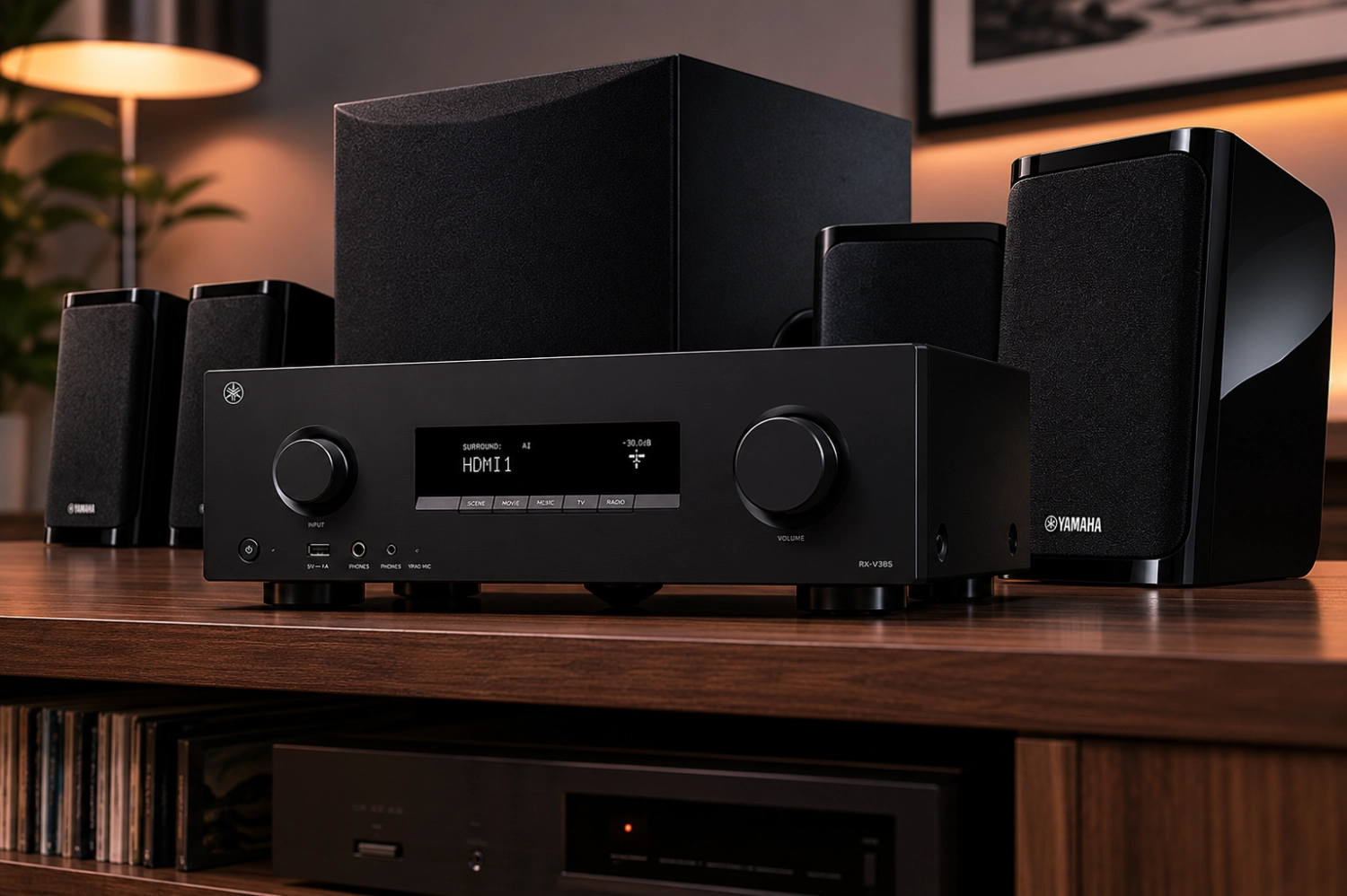
6. Yamaha YHT-4970U: Affordable 5.1 Home Theater System With 8K HDMI
Yamaha YHT-4970U bundles a 5.2-channel receiver, five compact satellite speakers and an active 8-inch subwoofer.
The Yamaha YHT-4970U is a complete 5.1-channel home theater system rather than a standalone receiver.
It includes a Yamaha RX300A AV receiver, five compact satellite speakers, an active subwoofer with an 8-inch driver, speaker cable and setup accessories, making it a practical entry point for buyers who do not want to assemble separate components.
The receiver is described as a 5.2-channel model rated at 70 watts per channel at 8 ohms, with HDMI 2.1 ports, 8K/60Hz and 4K/120Hz video support, HDR10+, Dolby Vision, VRR, ALLM, Bluetooth 5.3 Multipoint and Dolby Atmos decoding. Its strongest case is convenience: it brings an AVR-based system layout in one package while competing with premium soundbars and wireless TV audio systems.
Best for: Buyers wanting a complete component-based starter system
- Complete 5.1-channel package
- Includes receiver, satellites and active subwoofer
- HDMI 2.1 with 8K/60Hz and 4K/120Hz support
- Bluetooth 5.3 Multipoint
Verdict: The YHT-4970U is suited to listeners who want a packaged 5.1 home theater with modern HDMI features instead of choosing every part separately.

7. Zidoo Z2000 Pro: High-quality media player launched
Zidoo Z2000 Pro is a media player with HDMI 2.1 output, HDR format support, large-drive compatibility and Blu-ray menu handling.
The Zidoo Z2000 Pro is a dedicated media player built around a Realtek RTD1619BPD quad-core 64-bit processor, ARM Mali-G57 graphics, 4GB of DDR4 memory and 32GB of eMMC storage.
Its home-cinema relevance comes from broad local-playback support: HDMI 2.1 output up to 4K/60Hz, HDR10, HLG, HDR10+ and Dolby Vision, 12-bit output, BT. wide color gamut, YCbCr 4:4:4 color space and TrueHD audio passthrough are all listed.
The player supports SATA and USB hard drives up to 16TB, external unencrypted BD and CD drives, full Blu-ray menus, BD3D and UHD Blu-ray menu structures, seamless branched playback, and many 3D formats including MVC 3D. For systems built around local libraries, it is a more specialized proposition than a receiver or soundbar.
Best for: Local media libraries and disc-structure playback
- HDMI 2.1 with 4K/60Hz output
- HDR10, HDR10+, HLG and Dolby Vision support
- Supports hard drives up to 16TB
- Blu-ray menu and 3D video support
Verdict: The Z2000 Pro is a strong fit for home cinemas where high-quality local video playback and broad file-library handling are central requirements.

8. BenQ GV50: Transform Your Bedroom Ceiling into a Home Cinema Experience
BenQ GV50 is a smart laser projector designed for ceiling projection, with a rotating base and integrated 2.1-channel sound.
The BenQ GV50 is a smart laser projector designed around flexible bedroom and ceiling projection rather than a permanent theater installation.
It can project a 120-inch Full HD image onto a ceiling, with a rotating base, 135-degree vertical throw range and 360-degree horizontal throw range to simplify positioning from places such as a nightstand.
Digital image adjustment, including a zoom lever, is included to help refine the picture angle and setup. The projector also has an 18-watt 2.1-channel audio system with a ceiling cinema mode, plus Night Shift mode and a sleep timer for late viewing. Its laser light source is specified at 500 ANSI lumens.
Best for: Bedroom cinema and flexible ceiling projection
- 120-inch Full HD ceiling projection
- Rotating base with wide angle adjustment
- 18-watt 2.1-channel audio system
- Night Shift mode and sleep timer
Verdict: The GV50 is the practical choice here for relaxed ceiling-based viewing rather than a conventional living-room surround system.

9. Pioneer VSX-LX505: AV Receiver with accurate and balanced sound
Pioneer VSX-LX505 is a 9.2-channel IMAX Enhanced receiver with MCACC calibration and Reflex Optimizer for Atmos speaker setups.
The Pioneer VSX-LX505 is a 9.2-channel AV receiver from Pioneer’s premium series and carries IMAX Enhanced certification.
It supports Dolby Atmos and DTS:X, and uses proprietary Direct Power amplification according to the source.
Room adaptation is a major part of its story: MCACC auto-calibration adjusts the system for placement conditions, while Reflex Optimizer is intended to improve three-dimensional sound formation when using upward-firing Atmos speakers by accounting for ceiling reflections. The supplied information also notes a quad-core Cirrus Logic processor working with DSP Aureus and a more advanced multi-point MCACC system than on 7.1 models, used to set delays and reduce room resonances.
Best for: Atmos systems using calibration and upward-firing speakers
- 9.2-channel configuration
- IMAX Enhanced certification
- Dolby Atmos and DTS:X support
- MCACC calibration with Reflex Optimizer
Verdict: The VSX-LX505 is well suited to multichannel systems that need IMAX Enhanced support and room-calibration tools tailored to immersive playback.

10. Sony HT-S20R: 5.1 soundbar at a competitive price
Sony HT-S20R is a 5.1 soundbar package with a separate subwoofer and installation options for tabletop or wall mounting.
The Sony HT-S20R approaches home cinema from the soundbar side, using a 5.1 layout with a separate subwoofer and a quoted total output of 400 watts.
The supplied material frames it as an alternative when TV speakers lack bass and film impact, but a traditional 5.1 system is too costly or complicated.
The soundbar contains three front speakers behind a metal mesh grille, with the subwoofer and surround channels completing the 5.1 arrangement. It can sit on a table using its rubber feet or be wall-mounted, which gives it practical installation flexibility.
Best for: Simple TV upgrades where a receiver system is impractical
- 5.1 soundbar system
- Separate subwoofer
- 400-watt output
- Tabletop or wall-mount placement
Verdict: The HT-S20R is the straightforward option for adding 5.1 sound and stronger bass to a TV setup without building a full component system.
Quick comparison
The products differ most clearly by system role.
Some are AV receivers for serious multichannel speaker layouts, while others solve more specific problems such as complete starter-system assembly, local media playback, bedroom projection, or simplified TV sound.
| Product | Best for | Verdict |
|---|---|---|
| It’s time to update the firmware of ONKYO & PIONEER AV receivers | Owners of selected compatible AV receivers | A software upgrade that adds Roon Ready, Dolby Atmos Music and expanded Dirac Live capability to supported models. |
| Sony STR-DN1080 | Immersive receiver systems needing streaming and dual HDMI outputs | A 5.1.2 or 7.1-channel receiver with Dolby Atmos, DTS:X, six HDMI inputs and strong streaming support. |
| Denon AVR-X2800H | Balanced cinema, gaming and music systems | A 7.1-channel receiver with HDMI 2.1 features, virtual height processing, HEOS and two-way Bluetooth. |
| Marantz SR7015 | Larger immersive systems with broad format support | A 9.2-channel IMAX Enhanced receiver with Dolby Atmos, DTS:X, Auro-3D and Audyssey MultEQ XT32. |
| Marantz SR6015 | Expandable 9.2-channel installations | A 9.2-channel AV amplifier with seven HDMI inputs, three HDMI outputs and 11.2-channel processor output. |
| Yamaha YHT-4970U | Complete component-style starter systems | A packaged 5.1 system with receiver, compact speakers, active subwoofer and modern HDMI support. |
| Zidoo Z2000 Pro | Local video libraries and Blu-ray structure playback | A dedicated media player with HDR format support, large-drive compatibility and TrueHD passthrough. |
| BenQ GV50 | Bedroom and ceiling projection | A smart laser projector built for flexible Full HD ceiling viewing with integrated 2.1-channel sound. |
| Pioneer VSX-LX505 | Calibrated 9.2-channel Atmos systems | A premium-series Pioneer receiver with IMAX Enhanced certification, MCACC calibration and Reflex Optimizer. |
| Sony HT-S20R | Simple 5.1 TV sound upgrades | A competitively positioned 5.1 soundbar system with subwoofer and 400-watt quoted output. |
Frequently asked questions
Should I choose an AV receiver, a complete 5.1 package or a soundbar?
Choose an AV receiver if you want to build around separate speakers, calibration and expandable surround formats.
A complete package such as the Yamaha YHT-4970U is more convenient when you want the receiver, speakers and subwoofer chosen together.
A soundbar such as the Sony HT-S20R is the simpler option when space, wiring or system complexity matter more than receiver-based flexibility.
Do I need ceiling speakers for Dolby Atmos?
Not always.
Several products here support Dolby Atmos or related height processing, but some also include virtual height options.
The Denon AVR-X2800H offers Atmos Height Virtualization and DTS Virtual:X, while the Marantz SR6015 supports Dolby Atmos Height and DTS Virtual:X virtual emulation. Dedicated ceiling or height speakers remain the more system-based approach, but virtualization can help when installation is limited.
How important is HDMI capability in a home cinema component?
HDMI matters most when the system must handle modern video sources, gaming consoles, projectors or more than one display.
Products such as the Denon AVR-X2800H, Marantz SR6015, Marantz SR7015 and Yamaha YHT-4970U emphasize 8K and 4K/120Hz-related features, while the Sony STR-DN1080 is notable for six HDMI inputs and two outputs for 4K video distribution.
What role does room correction play in serious home cinema?
Room correction helps adapt speakers to the room and listening position, which is especially important in multichannel systems.
The supported Onkyo, Integra and Pioneer Elite firmware update extends Dirac Live capability for larger rooms, Marantz SR7015 uses Audyssey MultEQ XT32, and Pioneer VSX-LX505 includes MCACC calibration with Reflex Optimizer for upward-firing Atmos speaker setups.
How to choose the right serious-listening home cinema route
Start with the room and the speaker plan.
If the goal is a proper multichannel system with separate speakers, the receiver is the foundation.
A 7.1-channel model such as the Denon AVR-X2800H makes sense when you want immersive decoding, HDMI 2.1 features and strong streaming without moving into a larger 9.2-channel platform. The Sony STR-DN1080 is still defined in the supplied material by its 5.1.2 or 7.1-channel layout, six HDMI inputs, two HDMI outputs and broad streaming support. For bigger or more ambitious systems, the Marantz SR7015, Marantz SR6015 and Pioneer VSX-LX505 are the natural comparisons. The SR7015 has the widest audio-format story in the supplied material, including Auro-3D and Audyssey MultEQ XT32. The SR6015 is especially relevant where nine amplified channels, seven HDMI inputs, three outputs and 11.2-channel processor output are useful. The Pioneer VSX-LX505 is differentiated by IMAX Enhanced certification, 9.2-channel configuration, MCACC calibration and Reflex Optimizer for upward-firing Atmos arrangements. If you do not want to assemble a receiver, speakers and subwoofer separately, the Yamaha YHT-4970U offers a packaged 5.1 route with modern HDMI features. If wiring and space are the main concerns, the Sony HT-S20R is the simpler 5.1 soundbar alternative for improving TV sound and bass. These two should not be judged by the same expectations as a larger receiver-based system; they are convenience-first solutions. Source and display choices matter too. The Zidoo Z2000 Pro belongs in systems built around local files, hard drives and Blu-ray menu playback, while the BenQ GV50 addresses a very different use case: flexible Full HD ceiling projection with built-in sound for bedroom viewing. In short, the most sensible choice is the one that matches the room, the speaker layout, the video sources and the amount of setup you are prepared to accommodate.