Amplifiers Worth Shortlisting for Different Hi-Fi Systems
A practical amplifier buying guide covering integrated amplifiers, stereo power amplifiers, monoblocks, tube designs, custom-installation models, and a flexible preamplifier for separated systems.

Choosing an amplifier is less about chasing a single universal winner and more about matching the right topology, power delivery, connectivity, and installation format to the system in front of you.
The models gathered here cover several distinct roles: traditional power amplifiers, integrated amplifiers, a tube power amplifier, a custom-installation amplifier, a monoblock design, and a high-grade preamplifier for systems that separate control from power.
The source material points to clear differences. Some products are built around balanced operation and speaker control, some emphasize modular expansion or compact digital convenience, and others prioritize analog simplicity, tube architecture, or heavy-load stability. That makes this a practical buying guide rather than a ranking based on a single specification. Where specifications are available, they are included carefully. Where the source focuses on circuit design, installation flexibility, or system role, the recommendation reflects that emphasis. The aim is to help readers identify which amplifier type fits their room, speakers, sources, and upgrade path.

1. Quad Artera Stereo
Quad Artera Stereo power amplifier with balanced and RCA input options.
The Quad Artera Stereo is a fully balanced power amplifier designed for listeners who want a dedicated stereo power stage with serious speaker-control ambitions.
Its rear panel includes XLR inputs as well as RCA inputs, selected by a small push-button, so it can sit comfortably in balanced or single-ended systems.
Internally, the design uses separate boards, short power wiring, a large toroidal transformer, and buffer capacitance specified at 2 x 10000 uF per channel. Quad’s Current Dumping topology is central to the design, with the source describing an improved implementation intended to combine class A-like linearity with class AB operation and better control of complex reactive speaker loads. With 140 watts per channel into 8 ohms, it is positioned as a robust, technically distinctive stereo power amplifier rather than a minimalist black box.
Best for: Balanced stereo power amplification
- Fully balanced design with XLR inputs
- RCA inputs also provided
- Current Dumping amplifier topology
- 140 watts per channel into 8 ohms
Verdict: A strong choice for systems that need a dedicated stereo power amplifier with balanced connectivity and Quad’s distinctive Current Dumping approach.

2. NAD CI PA4-60
NAD CI PA4-60 compact custom-installation amplifier for rack-based systems.
The NAD CI PA4-60 is aimed squarely at custom-installation and professional environments where space, thermal management, and clean rack integration matter.
Its 1/3 rack-width, 1U form factor is designed to disappear into racks, walls, homes, offices, restaurants, and larger multi-zone systems.
Despite the compact chassis, the source specifies a DirectDigital amplifier rated at 2 x 120 watts, with thermostatically controlled cooling to help manage tightly stacked installations. NAD’s ChassisLink system allows up to three compatible CI units to sit side by side in a single rack space, while the modular CI Series concept supports expansion as systems grow.
Best for: Custom installation and multi-zone systems
- Compact 1/3 rack-width, 1U format
- DirectDigital amplifier rated at 2 x 120 watts
- Thermostatically controlled cooling
- ChassisLink rack integration
Verdict: A compact CI amplifier for installations where tidy rack design, scalability, and hidden power are the priorities.
3. Gato Audio PWR-222
Gato Audio PWR-222 monoblock power amplifier for true dual-mono setups.
The Gato Audio PWR-222 is a single-channel power amplifier intended for true dual-mono systems.
Each chassis is dedicated to one channel and is specified at 250 watts into 8 ohms, with the source describing that output as sufficient for heavy speaker systems.
The design uses Class A/B MOS-FET operation, Gato’s TwinFET technology, a large onboard power supply, more than 44,000 uF of capacitance, a 700W toroidal transformer, and WBT NexGen connectors. It is also designed to pair neatly with the Gato Audio PRD-3S NPM preamplifier/DAC, including a Link input for 12V trigger on/off control.
Best for: Dual-mono high-power systems
- Single-channel design for true dual mono
- 250 watts into 8 ohms
- Class A/B MOS-FET output stage
- 12V trigger input for linked operation
Verdict: A purposeful monoblock for listeners building a separated system around high power, dual-mono architecture, and matching Gato components.
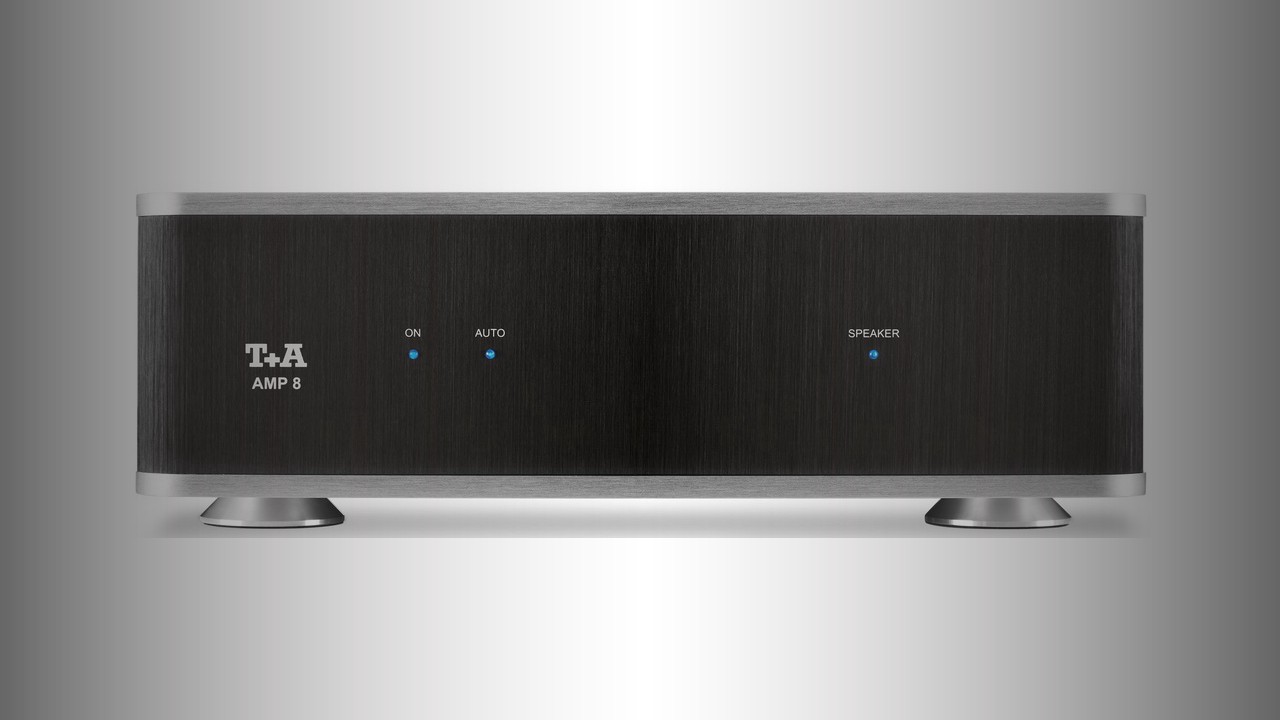
4. T+A AMP 8
T+A AMP 8 power amplifier with all-aluminum construction and isolated current amplifier design.
The T+A AMP 8 is a power amplifier built around the company’s isolated current amplifier concept and is designed to work with demanding loudspeaker loads.
The source traces parts of the circuit approach to T+A’s PA 3000 HV, including a cross-coupled J-FET cascode input stage, a Class A Hawksford FET cascode voltage amplifier, and an output stage using ThermalTrak transistors.
Voltage and current amplification sections are separated and fed by separate power supplies, a design intended to reduce the reverse influence of loudspeakers on the voltage amplifiers. T+A also specifies a signal bandwidth exceeding 200 kHz and uses selected components including Vishay non-magnetic resistors plus ELNA and WIMA capacitors in critical areas. The all-aluminum construction is also notable, with the amplifier designed as a partner for the DAC 8 DSD.
Best for: Demanding speakers and T+A system matching
- Designed to handle heavy loads
- Separated voltage and current amplification circuits
- Signal bandwidth exceeding 200 kHz
- All-aluminum chassis construction
Verdict: A technically focused power amplifier for systems where load handling, circuit isolation, and matching with T+A electronics are important.
5. Audio Research D-80
Audio Research D-80 balanced KT150 tube power amplifier rated at 70 watts per channel.
The Audio Research D-80 is a two-channel tube power amplifier built around a fully symmetrical, differential design.
Its signal path remains balanced from input to speaker terminals, while each channel uses a pair of matched KT150 power tubes supported by two 6H30 tubes.
The amplifier operates in pentode mode and includes automatic bias control, with output specified at 70 watts per channel. Audio Research has deliberately avoided switchable operating modes and complex extra features here, focusing instead on stability, reproducibility, and sonic consistency. The D-80 also draws on design principles associated with the company’s Reference line, especially in power supply and output-stage thinking, while being built in a more economical enclosure than the Reference 80S.
Best for: Balanced tube power amplification
- Fully balanced signal path
- KT150 tube output stage
- Automatic bias control
- 70 watts per channel
Verdict: A focused tube power amplifier for listeners who want balanced operation, KT150 output tubes, and Audio Research’s deliberately simplified operating approach.

6. Hattor Audio Takman REX AMRT
Hattor Audio Takman REX AMRT passive/active preamplifier with RCA and XLR connectivity.
The Hattor Audio Takman REX AMRT is not a power amplifier but a passive/active preamplifier, so it belongs in systems where source selection, volume control, and gain management are separated from power amplification.
Its design uses two high-precision Takman REX AMRT carbon-film resistor attenuators, with the source emphasizing very low distortion and transparent signal handling.
Connectivity is extensive for a line-stage component, with two RCA inputs, three XLR inputs, two RCA outputs, and two XLR outputs. The active buffer can be switched in by remote control and offers three gain levels: +3 dB, +6 dB, and +9 dB. Gold-plated CMC and Neutrik 24k PTFE connectors, silver wire cabling, channel-separation measures, and switchable per-channel level controls round out a very flexible control component.
Best for: Separated systems needing a flexible preamp
- Passive and active preamp operation
- Two RCA and three XLR inputs
- Switchable active buffer with three gain levels
- Remote control included
Verdict: A refined preamplifier option for users who want high-quality attenuation, balanced connectivity, and selectable active gain ahead of a power amplifier.

7. TEAC AI-301DA-X
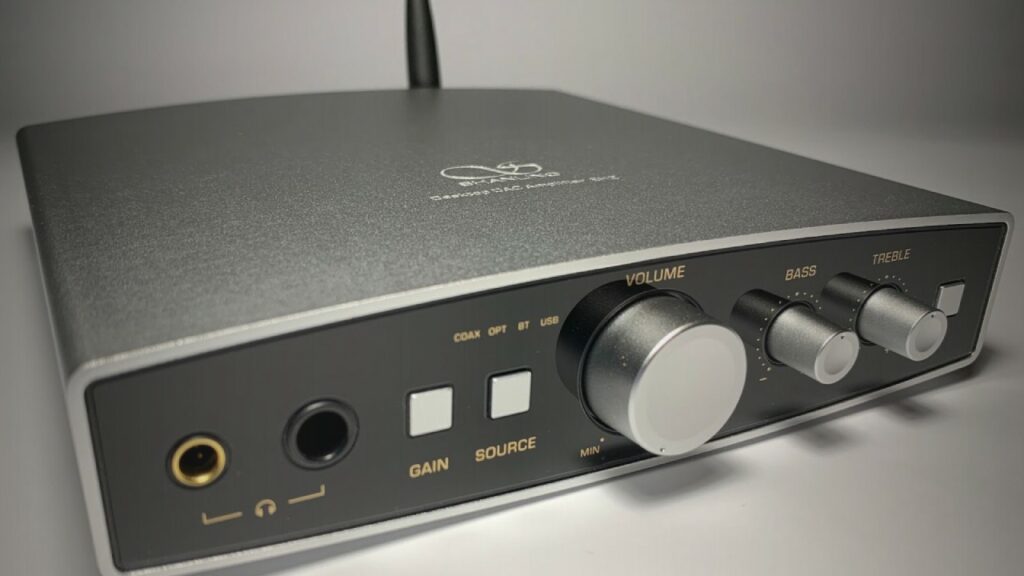
TEAC AI-301DA-X compact integrated amplifier with DAC, Bluetooth, and headphone output.
The TEAC AI-301DA-X is a compact integrated amplifier for systems that need amplification, digital conversion, Bluetooth, and headphone connectivity in one small chassis.
It is specified at 2 x 43 watts and includes a DAC based on the Burr-Brown PCM1795 chip.
Via asynchronous USB-B, it can process PCM up to 192 kHz/32-bit and DSD at 2.8/5.6 MHz, while its coaxial and optical digital inputs accept PCM at the rates stated in the source. Bluetooth support includes the aptX codec, and the front panel keeps things simple with a volume control, source selector, LED indication, and a 6.3 mm headphone output. The metal case, aluminum front panel, and black or silver finish options make it suitable for desktop or compact hi-fi use.
Best for: Compact digital and desktop systems
- Compact integrated amplifier design
- Built-in DAC and Bluetooth receiver
- aptX codec support
- 6.3 mm headphone output
Verdict: A space-saving integrated amplifier for listeners who want wired digital inputs, Bluetooth convenience, and conventional stereo amplification in one compact unit.

8. Marantz Model 50
Marantz Model 50 integrated amplifier with redesigned front panel and discrete circuitry.
The Marantz Model 50 is an analog integrated amplifier described in the source as an excellent all-rounder.
It succeeds the PM8006 and uses a redesigned front panel aligned with Marantz’s current industrial design language.
The preamplifier section uses a fully discrete current-feedback amplifier circuit, while the board layout keeps equal-length and parallel left/right channel paths to support spatial representation. Marantz’s low-distortion HDAM technology is also present. The power supply is specified with an instantaneous current capacity of 66A, and the output stage uses a parallel push-pull configuration with a robust extruded aluminum heatsink for stable operation. Output is given as 100W + 100W at 4 ohms.
Best for: Analog integrated amplification
- Fully discrete current-feedback preamp circuit
- HDAM technology
- 100W + 100W at 4 ohms
- Robust extruded aluminum heatsink
Verdict: A capable integrated amplifier for listeners who want a traditional Marantz analog design with strong current delivery and a practical all-round feature set.

9. Exposure 5510
Exposure 5510 flagship integrated amplifier with analog inputs and optional expansion modules.
The Exposure 5510 is the flagship integrated amplifier in Exposure’s integrated range, with a deliberately analog-first configuration.
It provides six RCA line inputs and can drive two pairs of speakers.
Rated output is 120 watts per channel into 8 ohms at 1 kHz, while the stated frequency response is 20 Hz to 20 kHz within +/- 0.5 dB. A key attraction is upgrade flexibility: users can add either a DAC module or one of three phono modules, covering MM cartridges, MC cartridges, or DS Audio optical cartridges, though the source notes there is room for only one module. The power supply uses a custom toroidal transformer with a hum filter, and the specified signal-to-noise ratio is greater than 100 dB A-weighted at rated power.
Best for: Analog integrated systems with upgrade options
- 120 watts per channel into 8 ohms
- Six RCA line inputs
- Optional DAC or phono module
- Can connect two pairs of speakers
Verdict: A powerful analog integrated amplifier for users who value line-level simplicity now and optional DAC or phono expansion later.

10. Wattson Audio Madison
Wattson Audio Madison power amplifier with stereo, bi-amp, and bridged operating possibilities.
The Wattson Audio Madison is a two-channel power amplifier developed through a collaboration between Wattson Audio and CH Precision.
The source highlights a circuit topology inspired by CH Precision reference designs, a distinct power-supply architecture, and a signal path intended to reduce distortion while preserving harmonic integrity.
Power output is specified at up to 50 watts per channel across two channels. Flexibility is a major part of the appeal: the Madison can be reconfigured for bi-amping or mono bridged operation. In bi-amp mode, the input signal is distributed in parallel to both channels for vertical bi-amping; in bridged mode, the amplifier operates as a single-channel unit with improved current handling as described by the source.
Best for: Flexible power-amplifier configurations
- Two-channel power amplifier
- Up to 50 watts per channel
- Bi-amping configuration supported
- Mono bridged operation supported
Verdict: A compactly specified but adaptable power amplifier for systems that may benefit from stereo, vertical bi-amping, or bridged mono operation.
Quick comparison
These amplifiers differ most clearly by system role.
Some are dedicated stereo power amplifiers, some combine preamp and power amp functions, one is a tube power amplifier, one is a custom-installation unit, and one is a preamplifier for separated systems.
The table below keeps the distinctions practical and limited to what the source material supports.
| Product | Best for | Verdict |
|---|---|---|
| Quad Artera Stereo | Balanced stereo power amplification | A dedicated 140-watt-per-channel power amplifier with balanced inputs, RCA inputs, and Quad Current Dumping technology. |
| NAD CI PA4-60 | Custom installation and multi-zone systems | A compact 1U CI amplifier with DirectDigital amplification, thermostatic cooling, and ChassisLink rack integration. |
| Gato Audio PWR-222 | Dual-mono high-power systems | A single-channel Class A/B MOS-FET amplifier specified at 250 watts into 8 ohms for true dual-mono setups. |
| T+A AMP 8 | Demanding speakers and T+A system matching | A power amplifier using separated voltage and current amplification circuits and designed to handle heavy loads. |
| Audio Research D-80 | Balanced tube power amplification | A fully balanced KT150 tube power amplifier rated at 70 watts per channel with automatic bias control. |
| Hattor Audio Takman REX AMRT | Separated systems needing a flexible preamp | A passive/active preamplifier with RCA and XLR connectivity, resistor attenuation, remote control, and selectable active gain. |
| TEAC AI-301DA-X | Compact digital and desktop systems | A small integrated amplifier with DAC, Bluetooth aptX support, USB digital input, and headphone output. |
| Marantz Model 50 | Analog integrated amplification | An all-round integrated amplifier with discrete current-feedback circuitry, HDAM technology, and 100W + 100W into 4 ohms. |
| Exposure 5510 | Analog integrated systems with upgrade options | A 120-watt-per-channel integrated amplifier with six RCA inputs and optional DAC or phono expansion. |
| Wattson Audio Madison | Flexible power-amplifier configurations | A two-channel power amplifier rated at up to 50 watts per channel and configurable for bi-amping or bridged mono use. |
Frequently asked questions
Should I choose an integrated amplifier or a separate power amplifier?
Choose an integrated amplifier if you want source selection, volume control, and power amplification in one chassis, as with the TEAC AI-301DA-X, Marantz Model 50, or Exposure 5510.
Choose a separate power amplifier if you already have, or plan to use, a dedicated preamplifier or DAC/preamp, as with the Quad Artera Stereo, T+A AMP 8, Gato Audio PWR-222, Audio Research D-80, or Wattson Audio Madison.
When do balanced inputs matter?
Balanced inputs are useful when the rest of the system supports them or when a system is built around balanced signal transmission.
The Quad Artera Stereo includes XLR inputs as well as RCA, the Audio Research D-80 maintains a balanced path from input to speaker terminals, and the Hattor Audio preamplifier provides XLR inputs and outputs.
How much amplifier power do I need?
Power needs depend on speaker demands, room size, and listening levels.
The source material shows a wide spread: compact integrated power in the TEAC AI-301DA-X, 70 watts per channel from the Audio Research D-80, 140 watts per channel from the Quad Artera Stereo, and 250 watts into 8 ohms from each Gato Audio PWR-222 monoblock.
For difficult loudspeaker loads, also consider designs specifically described around load control, such as the Quad Artera Stereo and T+A AMP 8.
What should I consider for custom installation or multi-zone use?
For rack-based or hidden systems, physical format and cooling can be as important as raw output.
The NAD CI PA4-60 is designed for custom installation, with a 1/3 rack-width, 1U form factor, thermostatically controlled cooling, and ChassisLink support for placing up to three compatible CI units side by side in one rack space.
Final buying advice
Start with the job the amplifier must do.
If you need a conventional all-in-one stereo hub, the Marantz Model 50 offers an analog integrated route, while the Exposure 5510 adds higher specified output into 8 ohms and optional DAC or phono expansion.
If the system is compact or desktop-based, the TEAC AI-301DA-X is the most source-flexible integrated option here thanks to its DAC, Bluetooth aptX support, USB input, and headphone socket. For systems already built around a preamplifier or DAC/preamp, look at the dedicated power amplifiers. The Quad Artera Stereo is the balanced stereo choice with Current Dumping technology and 140 watts per channel into 8 ohms. The T+A AMP 8 is the more load-focused technical design, especially if it will be partnered with T+A’s DAC 8 DSD. The Gato Audio PWR-222 is the true dual-mono route, using one single-channel amplifier per side and offering 250 watts into 8 ohms from each chassis. The Audio Research D-80 is the tube option, combining KT150 output tubes, balanced operation, automatic bias control, and 70 watts per channel. System layout may decide the answer before sound preferences do. The NAD CI PA4-60 is purpose-built for custom installation, rack density, and multi-zone growth. The Wattson Audio Madison stands out for configuration flexibility, as it can operate as a stereo amplifier, in bi-amp mode, or in bridged mono mode. The Hattor Audio Takman REX AMRT should be considered when the missing piece is not power but control: it is a passive/active preamplifier with strong connectivity, precision resistor attenuation, remote operation, and selectable active gain. The safest shortlist is the one that matches your actual speakers, sources, space, and upgrade path. Prioritize amplifier type first, then connectivity, then power and load suitability, and finally expansion features such as optional modules, trigger control, or rack-linking hardware. That approach will narrow this varied group quickly and help avoid paying for functions your system will not use.