
Stereoindex Picks: Amplifiers for Different Hi-Fi Systems
Stereoindex compares a varied group of amplifier products by role, including integrated amplifiers, power amplifiers, preamplifiers, a headphone amplifier and a battery-powered soundbar.

Amplifiers are not interchangeable purchases.
A compact headphone amplifier, a pure power amplifier, a streaming integrated amplifier, a tube preamplifier and a battery-powered soundbar all solve different problems, even when they share the same broad category.
This Stereoindex guide keeps those differences clear rather than forcing unlike products into a single hierarchy. The selections below are based only on the supplied product coverage. That means the emphasis is on documented design choices, connectivity, topology, power figures where stated, and the type of system each product is meant to serve. Some entries are specialist components for separates-based hi-fi systems; others are self-contained or lifestyle-oriented products with built-in amplification. Use this guide as a way to narrow the field by role first: source control, headphone listening, speaker driving, streaming convenience, tube experimentation, or compact amplified audio. Once the role is clear, the technical distinctions become much easier to evaluate.

1. BoAt Aavante Bar 520: 2.0 soundbar with battery
The BoAt Aavante Bar 520 combines a 2.0 soundbar layout, built-in amplification and a rechargeable battery for compact everyday audio.
The BoAt Aavante Bar 520 is not a traditional hi-fi amplifier, but it belongs here as an amplified 2.0 soundbar built for simple, compact audio use.
Its built-in rechargeable battery is specified for up to 6 hours of operation, and source connection is kept straightforward with Bluetooth 5.0, USB and AUX.
The acoustic section uses full-range speakers with two passive radiators, while the built-in amplification is rated at 16 watts total. Top-panel controls reinforce its practical, all-in-one approach.
Best for: Simple portable soundbar use
- Built-in rechargeable battery
- Bluetooth 5.0, USB and AUX inputs
- Top-panel controls
- Compact all-in-one 2.0 format
Verdict: A practical amplified soundbar for users who need battery-powered convenience rather than a separates-based hi-fi amplifier.

2. Ranieri Audio Labs Varieta: The Ultimate Tube Experimentation Preamp with Simplified Mechanical Switching
The Ranieri Audio Labs Varieta uses a top-mounted Rotare selector to match its circuit to a wide range of directly heated triodes.
The Ranieri Audio Labs Varieta is a directly heated triode vacuum tube preamplifier aimed squarely at listeners who want to compare different 4-pin triodes in the same system.
Its headline feature is wide tube compatibility, including types such as 300B, 2A3/6A3, 45, 50, 71A, 801A/10Y and others listed in the source.
The top-panel Rotare selector mechanically reconfigures the circuit for the installed tube type, with electrical parameters automatically adjusted to reduce the need for manual recalibration or circuit changes. A two-stage, zero-feedback topology with transformer-coupled outputs and low-noise design goals underline its specialist preamplifier role.
Best for: Tube experimentation in a separates system
- Supports a broad range of 4-pin triodes
- Rotare selector simplifies tube selection
- Automatic parameter adjustment for installed tube type
- Zero-feedback topology with transformer-coupled outputs
Verdict: A highly focused DHT preamplifier for users who want structured tube comparison without repeatedly changing hardware or recalibrating circuits.

3. McIntosh MHA200 – Awesome Vacuum Tube Amplifier for your headphones
The McIntosh MHA200 is a compact vacuum tube headphone amplifier with balanced XLR outputs and a 6.35 mm headphone jack.
The McIntosh MHA200 is a compact vacuum tube headphone amplifier designed for premium headphone listening near the seating position.
Its connectivity is the main practical strength: headphone outputs include dual 3-pin balanced XLR, a 4-pin balanced XLR and a 6.35 mm stereo jack, while system connections include balanced and unbalanced inputs.
McIntosh adapts its Unity Coupled Circuit transformer approach for headphone use, with 12AT7 tubes handling incoming signal amplification and 12BH7A tubes providing output drive. The source also notes its compact footprint, making it easier to place close to the listener.
Best for: Dedicated tube headphone listening
- Balanced and unbalanced inputs
- Multiple headphone output formats
- Compact chassis for near-seat placement
- Uses 12AT7 and 12BH7A tubes
Verdict: A compact McIntosh tube headphone amplifier with unusually broad headphone output connectivity and a design tied to the brand’s transformer-based amplification approach.
4. Accuphase A-48: Amplifier aimed at audiophiles
The Accuphase A-48 uses prominent heatsinking and a fully balanced circuit layout to support its pure Class A power amplifier design.
The Accuphase A-48 is a pure Class A power amplifier positioned between the company’s A-36 and A-75 models in the source material.
Its design centers on a fully balanced, symmetrical signal path, MCS+ topology, current feedback and an extra-large power supply.
The construction details are equally prominent: large internal radiators support Class A operation, the front panel is made from 8 mm anodized aluminum, and the article notes copper and gold-plated circuit boards. This is a separates component intended for listeners who want a dedicated power amplifier rather than an integrated solution.
Best for: Audiophile separates systems needing a Class A power amplifier
- Pure Class A power amplifier design
- Fully balanced symmetrical circuit
- MCS+ topology with current feedback
- Large heatsinking for Class A operation
Verdict: A serious Accuphase power amplifier for systems where Class A operation, balanced circuitry and substantial construction are the priorities.

5. TAD A1000: Impressive Integrated Amplifier with Symmetrical Class D Design
The TAD A1000 integrates preamplifier control and Class D power amplification with a strongly symmetrical circuit layout.
The TAD A1000 is an integrated amplifier and the company’s first of that type according to the source.
It combines current-feedback amplification, electronic volume control with a resistive ladder, and an analog Class D amplification platform in one chassis.
The design emphasis is symmetry: a bridge-tied load arrangement uses two separate amplifiers in a balanced configuration for the left and right channels from input to output. Separate transformer coils plus separate rectification, smoothing and stabilization circuits for each channel further support the symmetrical layout described in the article.
Best for: Systems needing a high-end integrated amplifier with balanced internal architecture
- Integrated amplifier format
- Analog Class D amplification platform
- Current-feedback amplification
- Symmetrical BTL design approach
Verdict: A technically ambitious integrated amplifier built around symmetry, channel separation and a consolidated preamp-power amp design.

6. Denon PMA-900HNE: Amplifier that combines both analog and digital technologies
The Denon PMA-900HNE combines integrated amplification with network playback, front USB input and conventional tone controls.
The Denon PMA-900HNE is an integrated amplifier designed as a flexible stereo system hub.
It supports network playback from computers and NAS servers via LAN or WLAN, playback from external drives through a front USB port, and access to streaming services named in the source.
Format support includes FLAC, WAV and ALAC up to 24 bit/192 kHz plus DSD at 2.8 and 5.6 MHz. On the amplification side, it uses Denon’s AHC push-pull circuit and is specified at 85 watts per channel, with bass, treble and balance controls plus the option to disable additional signal processing circuitry.
Best for: Modern stereo systems needing integrated amplification and digital playback
- Network, USB and streaming playback support
- Hi-Res PCM and DSD support as stated in the source
- 85 watts per channel
- Tone, balance and processing-bypass options
Verdict: A versatile Denon integrated amplifier for users who want analog amplification, network audio and front-panel USB playback in one component.

7. Spec RSA-EX1000: Integrated amplifier made in Japan
The Spec RSA-EX1000 uses maple side frames, a spruce laminate chassis and internal EMC measures alongside its integrated amplifier circuit.
The Spec RSA-EX1000 is an integrated amplifier with a design focus on reduced internal wiring, interference control and material choices.
The source highlights a newly designed main board, an optimized circuit between the level controller and low-pass filter, and a 600VA R-core transformer in the power supply.
EMC paint, internal EMC shielding and electromagnetic wave absorption sheets are used to mitigate interference. The amplifier is specified at a maximum output of 200 watts per channel at 4 ohms, supports 4 to 16 ohm speakers, and provides two XLR input sets, three RCA input sets and a remote control.
Best for: Integrated amplifier users wanting strong input flexibility and interference-control measures
- 200 watts per channel at 4 ohms
- Two XLR and three RCA input sets
- 600VA R-core transformer
- EMC shielding measures
Verdict: A Japanese integrated amplifier distinguished by substantial power at 4 ohms, balanced and unbalanced inputs, and extensive attention to internal noise control.

8. Simaudio MOON 761: Ultimate power amplifier
The Simaudio MOON 761 is a bi-mono power amplifier with dual custom transformers and bridgeable operation.
The Simaudio MOON 761 is a power amplifier intended to sit at the foundation of a separates-based hi-fi system.
Its bi-mono design uses two custom low-noise 700VA transformers and 152,000 uF of capacitance, while MOONLink communications allow coordination with other MOON components.
Output is specified at 200 watts per channel into 8 ohms, 400 watts per channel into 4 ohms, and 600 watts into 8 ohms when bridged as a monoblock. The MDCA amplifier design is described as following a global-feedback-free philosophy with circuitry intended to reduce distortion and noise.
Best for: High-power separates systems and bridgeable power-amplifier setups
- 200 watts per channel into 8 ohms
- 400 watts per channel into 4 ohms
- Bridgeable to 600 watts into 8 ohms
- Dual 700VA transformer power supply
Verdict: A robust MOON power amplifier for systems that need substantial stereo output, monoblock flexibility and coordination with other MOON components.

9. Audio Research LS-3: A modern, fully balanced line stage with classic ARC DNA
The Audio Research LS-3 is a solid-state line stage built around balanced differential circuitry and dual-mono power supplies.
The Audio Research LS-3 is a fully solid-state line-level preamplifier rather than a tube component.
It uses a fully symmetrical differential topology with JFETs at the input stage, bipolar transistors for voltage amplification and a pure Class A output stage.
The internal layout is true dual-mono, with each channel receiving its own transformer, separate linear power supply and independent voltage regulation. The design goal described in the source is clean signal handling, stable dynamics, low noise, wide bandwidth and strong channel separation in serious systems.
Best for: Balanced separates systems needing a solid-state line stage
- Fully balanced differential topology
- Solid-state line-level preamplifier design
- Dual-mono layout with separate transformers
- Pure Class A output stage
Verdict: A modern Audio Research preamplifier for users who want balanced solid-state control with dual-mono power architecture.
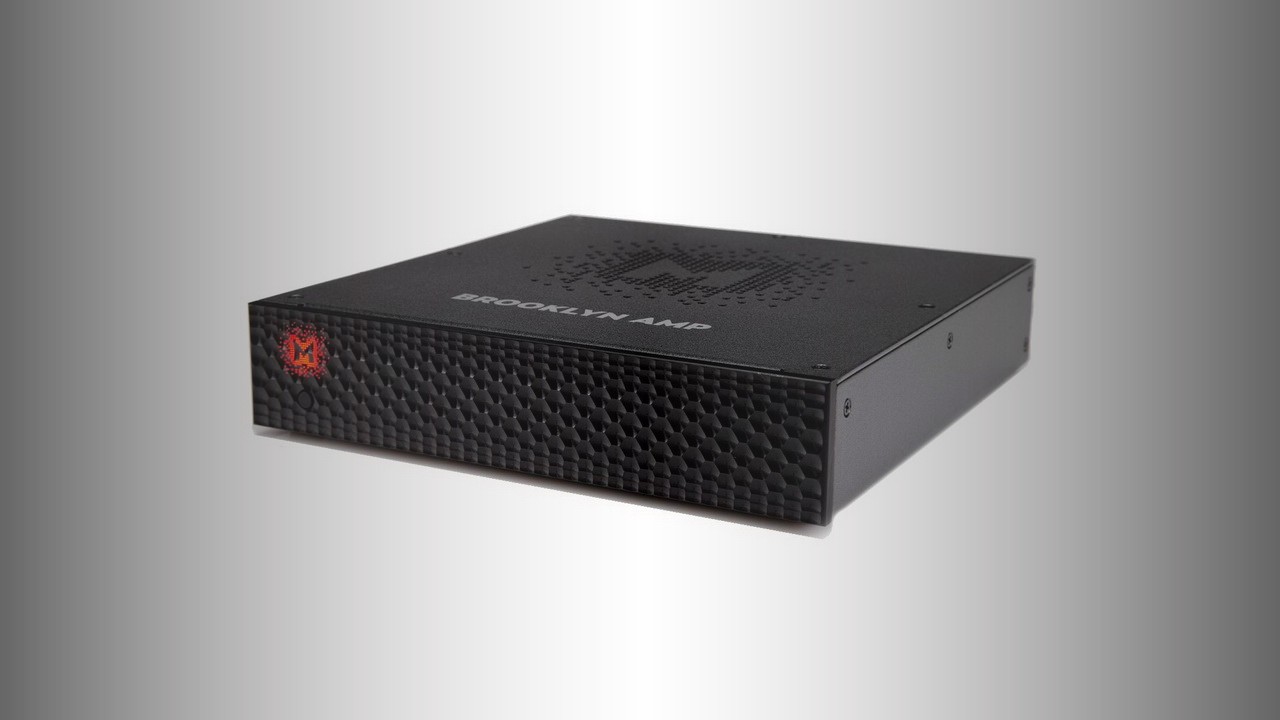
10. Mytek Brooklyn AMP: Boasting impressive power of 250 W at eight ohms
The Mytek Brooklyn AMP is a compact Class D power amplifier sized to match the Brooklyn DAC+ and offering RCA and XLR inputs.
The Mytek Brooklyn AMP is a compact Class D power amplifier designed in the same dimensions as the Brooklyn DAC+, suggesting close system pairing with that component.
Its output is specified at 250 watts into 8 ohms, 300 watts into 4 ohms, 400 watts into 2 ohms and 600 watts in bridge mode.
The source notes a Pascal Class D module that Mytek modified, including changes intended to reduce distortion, along with a pulse power supply developed by Mytek. Protection is provided for short circuit, DC at the output, current overload, overheating and supply-voltage drop, while the input count is limited to RCA and XLR.
Best for: Compact high-power separates systems
- 250 watts into 8 ohms
- Bridge mode rated at 600 watts
- Compact 22 x 4.4 x 24 cm chassis
- RCA and XLR inputs
Verdict: A small but powerful Mytek power amplifier suited to systems where space is limited but balanced or RCA input options are still required.
Quick comparison
These products are easiest to compare by role rather than by rank.
Some are preamplifiers that do not drive speakers directly, some are power amplifiers that require upstream volume control, some are integrated amplifiers, and one is a self-contained soundbar with built-in amplification.
| Product | Best for | Verdict |
|---|---|---|
| BoAt Aavante Bar 520: 2.0 soundbar with battery | Portable, simple amplified audio | Choose it for battery-powered soundbar convenience, not for a component hi-fi amplifier role. |
| Ranieri Audio Labs Varieta: The Ultimate Tube Experimentation Preamp with Simplified Mechanical Switching | DHT tube comparison and preamplifier duties | A specialist preamp for exploring multiple 4-pin triodes with simplified circuit selection. |
| McIntosh MHA200 – Awesome Vacuum Tube Amplifier for your headphones | Headphone-focused tube systems | A compact headphone amplifier with balanced and unbalanced system inputs plus several headphone output formats. |
| Accuphase A-48: Amplifier aimed at audiophiles | Class A power amplification | A dedicated power amplifier emphasizing fully balanced circuitry, Class A operation and substantial construction. |
| TAD A1000: Impressive Integrated Amplifier with Symmetrical Class D Design | Integrated amplification with symmetrical architecture | A one-box integrated amplifier built around a balanced BTL Class D platform and current-feedback technology. |
| Denon PMA-900HNE: Amplifier that combines both analog and digital technologies | Network-capable stereo systems | A practical integrated amplifier for users who want speaker amplification, streaming, local network playback and USB audio support. |
| Spec RSA-EX1000: Integrated amplifier made in Japan | Integrated systems needing multiple analog inputs | A Japanese integrated amplifier with XLR and RCA inputs, 4-ohm power capability and extensive electromagnetic isolation measures. |
| Simaudio MOON 761: Ultimate power amplifier | High-power separates systems | A stereo power amplifier with strong output figures, bridgeable operation and MOONLink integration. |
| Audio Research LS-3: A modern, fully balanced line stage with classic ARC DNA | Solid-state balanced line-stage control | A preamplifier for systems that need source control and balanced signal handling before a separate power amplifier. |
| Mytek Brooklyn AMP: Boasting impressive power of 250 W at eight ohms | Compact power amplification | A small Class D power amplifier with high stated output and both RCA and XLR inputs. |
Frequently asked questions
Should I buy an integrated amplifier, power amplifier or preamplifier?
Start with the job your system needs done.
An integrated amplifier such as the Denon PMA-900HNE, TAD A1000 or Spec RSA-EX1000 combines preamp control and speaker amplification.
A power amplifier such as the Accuphase A-48, Simaudio MOON 761 or Mytek Brooklyn AMP needs a separate preamp or source with volume control. A preamplifier such as the Ranieri Audio Labs Varieta or Audio Research LS-3 controls and conditions the signal but does not drive speakers directly.
When does a headphone amplifier make more sense than a speaker amplifier?
A headphone amplifier is the right choice when headphones are the primary listening method.
The McIntosh MHA200 is designed specifically for headphones and provides several headphone outputs, including balanced XLR options and a 6.35 mm jack, whereas the speaker amplifiers in this guide are intended for loudspeakers.
How important are digital and streaming features in an amplifier?
They matter if the amplifier will be the hub of a modern source setup.
The Denon PMA-900HNE is the clear example in this group, with LAN/WLAN network playback, front USB playback, Hi-Res file support and access to streaming services named in the source.
Other amplifiers here are more focused on analog input, preamp duties or power amplification.
What should I check before choosing one of these amplifiers for speakers?
Check whether the component actually drives speakers, then compare power ratings, speaker impedance compatibility and inputs.
For example, the Spec RSA-EX1000 is specified for 4 to 16 ohm speakers and offers XLR and RCA inputs, the Simaudio MOON 761 provides stated stereo and bridged power figures, and the Mytek Brooklyn AMP is a compact power amplifier with RCA and XLR inputs.
Preamplifiers and headphone amplifiers serve different roles.
How to choose from these Stereoindex picks
The safest way to choose an amplifier is to define the system role before comparing specifications.
If you need one box to drive speakers and handle source control, look first at the integrated amplifiers: the Denon PMA-900HNE for digital and network flexibility, the TAD A1000 for a symmetrical integrated Class D architecture, or the Spec RSA-EX1000 for multiple analog inputs, stated 4-ohm output capability and interference-control measures.
If you already own a preamplifier or source with proper volume control, a dedicated power amplifier may be the better match. The Accuphase A-48 is the Class A option in this list, the Simaudio MOON 761 offers high stated output and bridgeable operation, and the Mytek Brooklyn AMP focuses on high output from a compact Class D chassis. These are not direct substitutes for a preamplifier; they are speaker-driving components for separates systems. For systems built around signal control rather than speaker power, the Ranieri Audio Labs Varieta and Audio Research LS-3 point in different directions. The Ranieri is the tube experimenter’s choice, built to accommodate a wide range of directly heated triodes through mechanical selection. The Audio Research LS-3 is a solid-state, fully balanced line stage with dual-mono power architecture. For headphone-first listening, the McIntosh MHA200 is the dedicated option, while the BoAt Aavante Bar 520 is better understood as an amplified portable soundbar rather than a hi-fi component amplifier. After narrowing the role, compare practical fit: inputs, outputs, speaker impedance, available space, heat management, and whether your sources are analog, digital, networked or headphone-based. The most suitable amplifier is the one that solves the specific system problem without adding unnecessary boxes or unsupported expectations.