
Amplifiers That Bring Music Closer to Life
A clear buying guide to amplifier options ranging from compact all-in-one units and powered speakers to balanced preamps, tube monoblocks, and heavyweight Class AB power amplifiers.

The right amplifier is not just a power rating on a specification sheet.
It defines how sources, speakers, headphones, rooms, and daily listening habits come together, whether the system is built around a minimalist streaming hub, a serious preamplifier and power amplifier chain, or a compact desktop setup.
This guide gathers a wide spread of amplifier-related products from recent Stereoindex coverage: pure preamplifiers, monoblock power amplifiers, integrated network amplifiers, compact DAC-amp combinations, and even powered wireless speakers with built-in amplification. The point is not to rank them by brute force, but to clarify what each design is trying to solve. Some models here are aimed at highly ambitious separates systems, with balanced circuitry, tube output stages, or very high output power. Others focus on convenience, HDMI ARC, Bluetooth, headphone outputs, subwoofer integration, or compact dimensions. Use the distinctions below to decide which amplifier architecture fits the system you actually want to build.

1. Musician Monoceros
Musician Monoceros preamplifier with aluminum casework, balanced XLR connections, RCA connectivity, and remote-controlled R-2R volume adjustment.
The Musician Monoceros is a compact balanced preamplifier built around pure Class A amplification and a resistive array R-2R volume control.
Its 60-step volume system is remote-controlled, while the signal path uses current coupling and a stabilized power supply with a toroidal transformer.
With two balanced XLR inputs, one RCA input, and both XLR and RCA outputs, it is aimed at listeners assembling a separates system rather than those looking for an all-in-one amplifier.
Best for: Balanced separates systems needing a compact preamplifier
- Pure Class A amplification
- R-2R volume control with 60 steps
- Balanced XLR inputs and outputs
- Compact aluminum chassis
Verdict: A focused preamp choice for listeners who want balanced connectivity, precise volume control, and a compact Class A design.
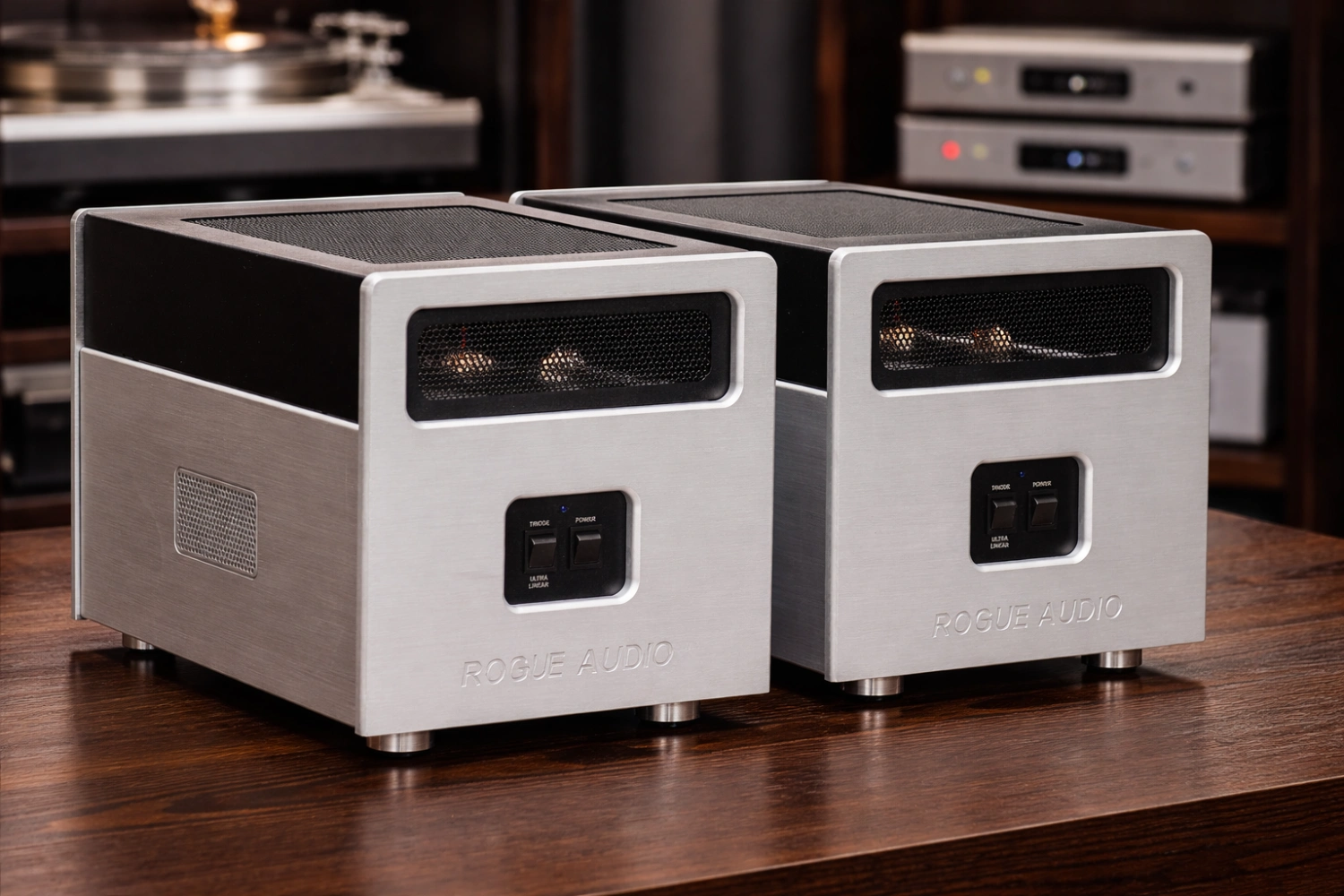
2. Rogue Audio M250 Ultra Monoblock Amplifier
Rogue Audio M250 Ultra monoblock amplifier with KT88 tube output, triode and ultra-linear switching, and machined aluminum exterior panels.
The Rogue Audio M250 Ultra is a mono tube power amplifier designed for systems that need serious tube-driven output.
It is specified at 250 watts and uses KT88 tubes, with a switch for choosing between triode and ultra-linear operation.
Rogue also highlights its linear power supplies, massive transformers, CNC-machined aluminum panels, built-in meter, and individual bias switches, making it a power amplifier for users comfortable with a high-end tube monoblock approach.
Best for: High-power tube monoblock systems
- 250-watt mono tube design
- Triode and ultra-linear operation modes
- Built-in meter and individual bias switches
- CNC-machined aluminum panels
Verdict: A substantial tube monoblock for listeners who want KT88 power, operating-mode flexibility, and a serious separates-based system.

3. Yamaha M-5000
Yamaha M-5000 power amplifier designed with symmetrical channel layout, MOSFET amplification, and mechanically grounded internal structures.
The Yamaha M-5000 is a high-end power amplifier built around a fully symmetrical, physically separated left-and-right-channel layout.
Yamaha’s design emphasizes short signal paths, low impedance, complete isolation of the power amplifier circuit from ground-noise effects, and compatibility with MOSFET output stages.
Mechanical grounding is also part of the construction, with the transformer, bypass capacitors, and heat sink mounted directly to a rigid structure to reduce unwanted vibration.
Best for: High-fidelity separates systems with an emphasis on symmetry and rigidity
- Fully symmetrical power amplifier layout
- Physically isolated left and right channels
- MOSFET-based design approach
- Rigid mechanical grounding construction
Verdict: A carefully engineered power amplifier for systems where balanced circuit architecture, mechanical stability, and speaker control are priorities.

4. Mitchell Acoustics uStream One
Mitchell Acoustics uStream One wireless bookshelf speakers with built-in Class D amplification and multiple physical inputs.
The Mitchell Acoustics uStream One is not a conventional standalone amplifier; it is a wireless bookshelf speaker system with amplification built into each speaker.
Each cabinet includes a 50-watt Class D amplifier using Texas Instruments modules, while the speakers communicate with each other via True Wireless Stereo over Bluetooth.
Physical inputs include RCA, 3.5 mm mini-jack, optical digital, and USB, making this a compact powered-speaker alternative to separate amplifier and passive speaker systems.
Best for: Listeners who want powered bookshelf speakers instead of separate amplification
- 50-watt Class D amplifier in each speaker
- True Wireless Stereo speaker-to-speaker connection
- RCA, mini-jack, optical, and USB inputs
- Can be used as a stereo pair or separately
Verdict: A practical powered-speaker route for compact systems where built-in amplification and wireless stereo operation matter more than traditional separates.

5. Topping MX3S
Topping MX3S compact amplifier with DAC, Bluetooth reception, headphone amplification, and subwoofer output for 2.1-channel setups.
The Topping MX3S is a compact multi-function amplifier that combines speaker amplification, a headphone amplifier, an AKM AK4377 DAC, and Bluetooth reception.
Its Infineon Merus Class D amplifier section is specified at 2 x 50 watts into 4 ohms, and the unit supports a 2.1 setup through its RCA subwoofer output.
Automatic digital input detection, two-level gain control, Bluetooth support for aptX, aptX HD, and aptX Adaptive, plus built-in equalization make it well suited to smaller systems that need flexibility in a small footprint.
Best for: Small to medium listening rooms needing a compact all-in-one amplifier
- Amplifier, headphone amp, DAC, and Bluetooth receiver in one unit
- 2 x 50 watts into 4 ohms
- RCA subwoofer output for 2.1 systems
- aptX, aptX HD, and aptX Adaptive support
Verdict: A space-efficient amplifier hub for users who want speakers, headphones, Bluetooth, DAC functions, and subwoofer support in one unit.
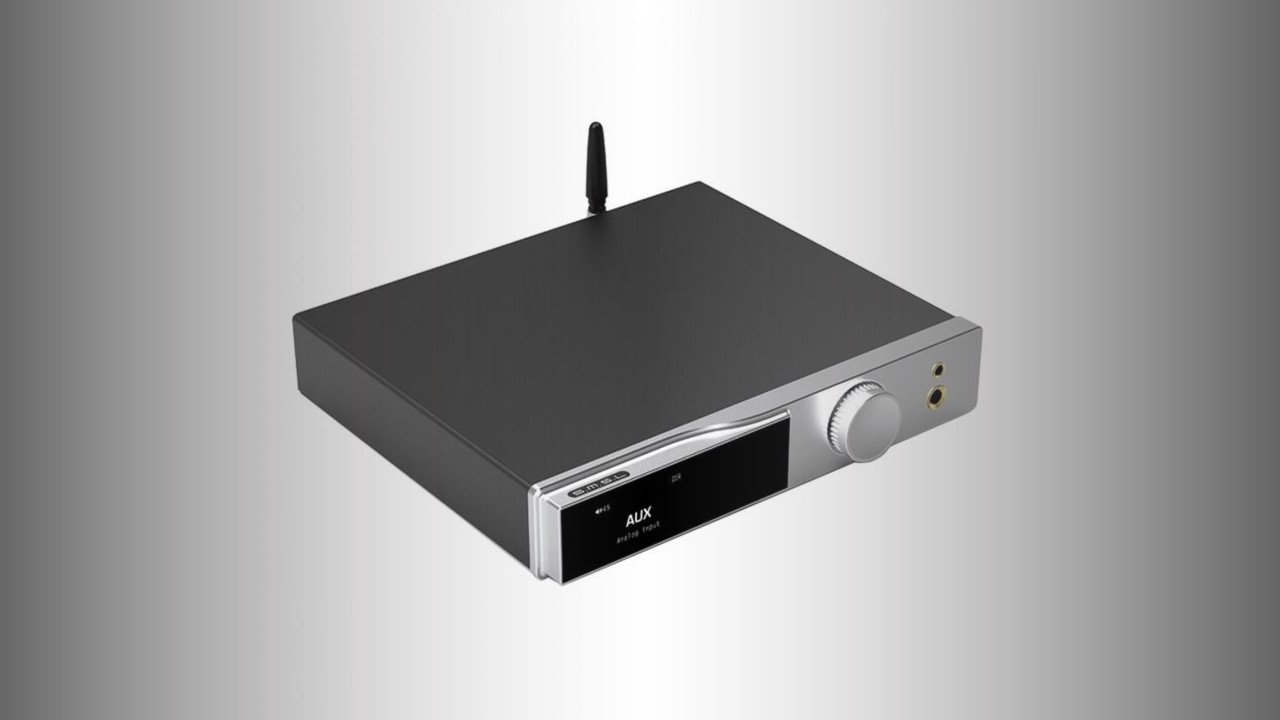
6. SMSL AO300
SMSL AO300 integrated Class D amplifier with HDMI ARC, Bluetooth, subwoofer output, and front-panel headphone connections.
The SMSL AO300 is a versatile Class D integrated device combining DAC, speaker amplifier, headphone amplifier, Bluetooth receiver, HDMI ARC, and subwoofer output.
Its MA5332MS amplifier chip is specified at up to 2 x 165 watts into 4 ohms and 2 x 85 watts into 8 ohms, while the CS43131 DAC and XU316 XMOS USB interface support PCM 32-bit 768 kHz, DSD up to DSD256, and MQA files.
With 4.4 mm balanced and 6.35 mm headphone outputs, eight equalizers, five filters, and support for codecs including aptX HD and LDAC, it is one of the more feature-dense compact amplifiers in this group.
Best for: Compact hi-fi and TV-adjacent systems needing broad connectivity
- DAC, amplifier, headphone amp, and Bluetooth in one chassis
- HDMI ARC input
- Subwoofer output for 2.1-channel use
- 4.4 mm balanced and 6.35 mm headphone outputs
Verdict: A highly versatile Class D amplifier for users who want HDMI ARC, headphone outputs, Bluetooth, DAC features, and subwoofer integration in a compact system.

7. Fezz Audio Olympia
Fezz Audio Olympia mono tube power amplifier with KT88 output tubes, balanced architecture, and microprocessor bias control.
The Fezz Audio Olympia is the company’s first mono tube power amplifier and uses four KT88 tubes in a parallel push-pull configuration.
It is a fully balanced mono design specified at more than 150 watts per channel, with a specially designed microprocessor bias control system intended to simplify operation and support consistency.
Inputs include cinch and balanced connection options, and the amplifier is also notable for Fezz Audio’s broad color choice approach.
Best for: Tube-focused mono amplifier systems with balanced connectivity
- Fully balanced mono tube design
- Four KT88 tubes in parallel push-pull configuration
- Microprocessor bias control system
- More than 150 watts per channel
Verdict: A powerful fully balanced tube monoblock for listeners who want KT88 amplification with automated bias-control support.
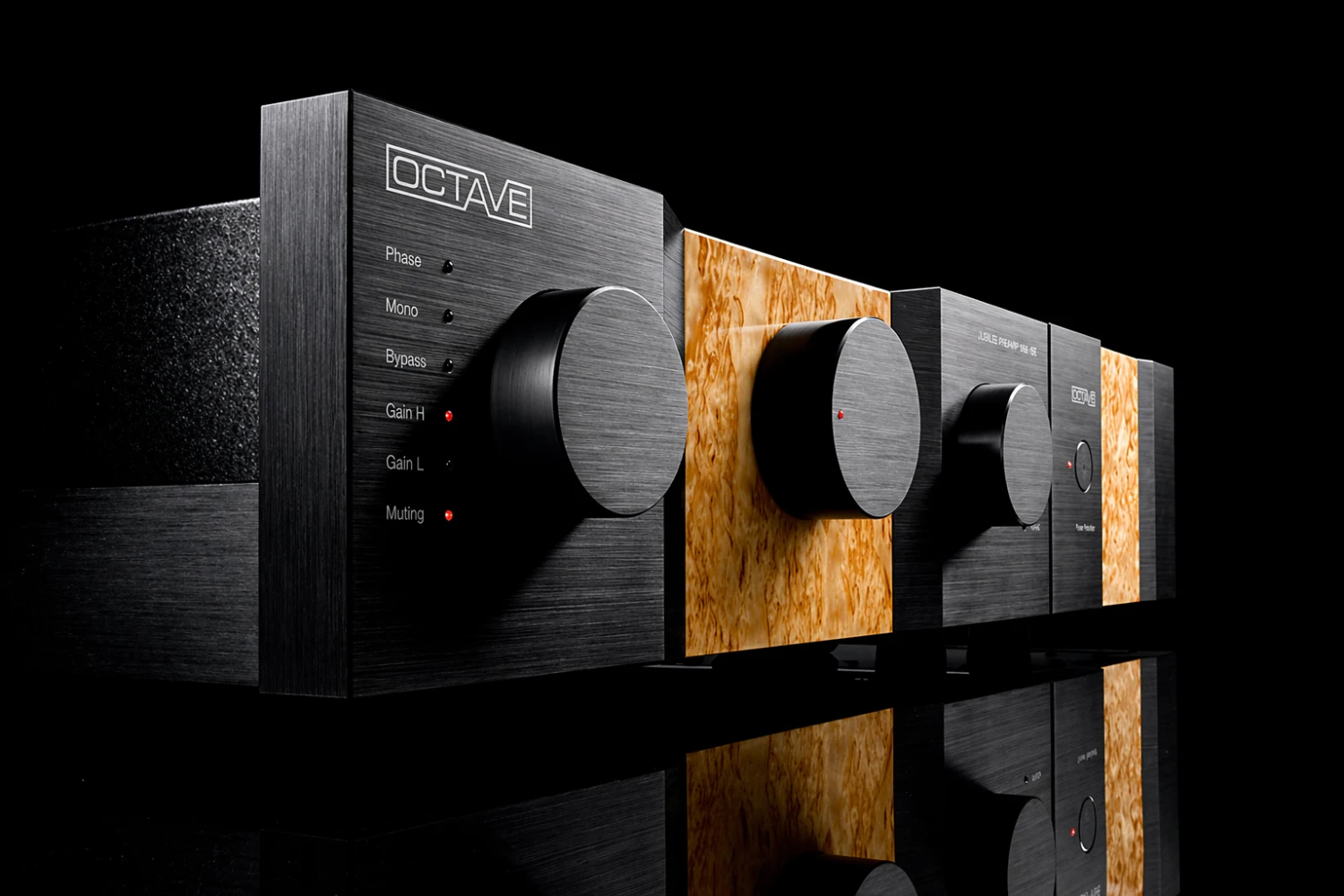
8. Octave Jubilee Preamp SE
Octave Jubilee Preamp SE preamplifier with revised circuitry and XLR input transformers designed for modern high-output sources.
The Octave Jubilee Preamp SE is a flagship preamplifier update designed for modern systems with high-output DACs and source components.
Octave uses newly developed XLR input transformers specified for output levels up to 8 V RMS and a higher 80 kOhm input impedance, improving compatibility with demanding sources.
The revised circuit is quoted at less than 0.005 percent distortion, 5 Hz to 150 kHz bandwidth, and an improved signal-to-noise ratio, positioning it as a preamp intended not to become the system bottleneck.
Best for: Reference-level systems with high-output modern sources
- New XLR input transformers
- Designed for source levels up to 8 V RMS
- 80 kOhm input impedance
- Quoted distortion below 0.005 percent
Verdict: A serious preamplifier for complex high-end systems that need stable matching with modern DACs and other high-level source components.

9. Audio Analogue ABSolute PA Mono
Audio Analogue ABSolute PA Mono Class AB monoblock with fully balanced discrete circuitry and substantial 50-kilogram construction.
The Audio Analogue ABSolute PA Mono is a Class AB mono power amplifier specified at 500 watts into 8 ohms, 800 watts into 4 ohms, and 1,400 watts into 2 ohms.
It uses a fully balanced, discrete topology without global feedback and is designed for demanding loudspeakers where high power and stable performance are central requirements.
The amplifier’s 50-kilogram construction, high structural rigidity, multiple output transistors, and specified 118 dB signal-to-noise ratio underline its reference-minded, heavyweight role.
Best for: Demanding loudspeakers requiring very high-output mono amplification
- 500 watts into 8 ohms
- Fully balanced discrete topology
- No global feedback
- Heavy 50-kilogram construction
Verdict: A heavyweight Class AB monoblock for systems where power reserves, balanced topology, and robust construction are the main priorities.
10. Premiera D2S
Premiera D2S compact network integrated amplifier with aluminum front panel, matrix display, headphone output, and built-in phono stage.
The Premiera D2S is a compact network integrated amplifier that adds higher output power and a built-in phono preamplifier to the brand’s small all-in-one concept.
It is specified at 2 x 168 watts into 4 ohms and supports up to ten sources, including seven digital inputs.
Bluetooth 5.0 with aptX, aptX HD, and AAC, a matrix display, front 3.5 mm headphone output, software-based menus, and firmware-update capability make it a practical integrated amplifier for systems mixing streaming, vinyl, headphones, and digital sources.
Best for: Compact modern systems needing streaming, vinyl, and digital input flexibility
- 2 x 168 watts into 4 ohms
- Built-in phono preamplifier
- Supports up to ten sources
- Bluetooth 5.0 with aptX, aptX HD, and AAC
Verdict: A compact network integrated amplifier for listeners who want a single chassis to handle vinyl, digital sources, Bluetooth, headphones, and speaker amplification.
Quick comparison
These products serve different roles, so the most useful comparison is not simply power output.
Start by deciding whether you need a preamplifier, a power amplifier, an integrated amplifier, or powered speakers with built-in amplification, then narrow the choice by connectivity, speaker demands, and how much system complexity you want.
| Product | Best for | Verdict |
|---|---|---|
| Musician Monoceros | Compact balanced preamplifier duties | Choose it when a separates system needs Class A preamplification, R-2R volume control, and balanced XLR connectivity. |
| Rogue Audio M250 Ultra Monoblock Amplifier | High-power tube monoblock amplification | Choose it for a serious tube power amplifier setup with KT88 output, 250-watt mono power, and triode or ultra-linear operation. |
| Yamaha M-5000 | Symmetrical high-end power amplification | Choose it when circuit symmetry, MOSFET design, channel separation, and rigid construction are central to the system brief. |
| Mitchell Acoustics uStream One | Powered wireless bookshelf speaker systems | Choose it when you prefer built-in amplification and wireless stereo speaker pairing over a separate amp and passive speakers. |
| Topping MX3S | Compact all-in-one desktop or small-room systems | Choose it for a small amplifier hub with DAC, Bluetooth, headphone amplification, and 2.1-channel subwoofer support. |
| SMSL AO300 | Feature-rich compact hi-fi and TV systems | Choose it for HDMI ARC, Bluetooth, DAC functions, headphone outputs, equalization, filters, and subwoofer support in one compact amplifier. |
| Fezz Audio Olympia | Balanced KT88 tube monoblock systems | Choose it for a fully balanced tube mono amplifier with more than 150 watts per channel and microprocessor bias control. |
| Octave Jubilee Preamp SE | Reference preamplifier matching with modern high-output sources | Choose it when source compatibility, high input headroom, XLR transformer design, and low quoted distortion are priorities. |
| Audio Analogue ABSolute PA Mono | Very demanding loudspeakers and high-power Class AB systems | Choose it when a system requires a heavyweight mono amplifier with very high output and a fully balanced discrete topology. |
| Premiera D2S | Compact network integrated systems with vinyl and digital sources | Choose it when you want a compact integrated amplifier with phono input, high power for its size, Bluetooth, and broad source support. |
Frequently asked questions
Should I choose an integrated amplifier, a preamplifier, or a power amplifier?
Choose an integrated amplifier if you want source switching and speaker power in one chassis, as with the Premiera D2S, Topping MX3S, or SMSL AO300.
Choose a preamplifier such as the Musician Monoceros or Octave Jubilee Preamp SE if you already have or plan to add separate power amplifiers.
Choose mono power amplifiers such as the Rogue Audio M250 Ultra, Fezz Audio Olympia, or Audio Analogue ABSolute PA Mono when the system is built around separate left and right amplification.
How important is amplifier power?
Power matters most when the speakers are demanding, the room is large, or high playback levels are required.
The Audio Analogue ABSolute PA Mono and Rogue Audio M250 Ultra are clearly aimed at high-power separates systems, while compact integrated units such as the Topping MX3S and SMSL AO300 balance power with convenience, connectivity, and size.
When does balanced connectivity matter?
Balanced XLR connectivity is useful in systems built around compatible sources, preamps, and power amplifiers, especially in more ambitious separates setups.
The Musician Monoceros, Yamaha M-5000, Fezz Audio Olympia, Octave Jubilee Preamp SE, and Audio Analogue ABSolute PA Mono all emphasize balanced or symmetrical design elements, but the benefit depends on the rest of the system also supporting that connection path.
Are compact Class D amplifiers a good alternative to large separates?
They can be, when the priority is efficiency, small size, and broad functionality rather than a traditional separates layout.
The Topping MX3S and SMSL AO300 combine amplification with DAC, Bluetooth, headphone, and subwoofer features, while the Mitchell Acoustics uStream One places Class D amplification directly inside the speakers.
How to choose the right amplifier for your system
Start with system architecture.
If you want the simplest path from sources to speakers, a compact integrated amplifier such as the Premiera D2S, Topping MX3S, or SMSL AO300 is the most straightforward fit.
The Premiera leans toward a compact network-style hi-fi role with phono support and many source options, the Topping focuses on small to medium rooms with DAC, Bluetooth, headphone, and 2.1-channel flexibility, and the SMSL adds HDMI ARC, high-resolution decoding, headphone outputs, filters, and equalizers for a broader entertainment setup. If you are building a separates system, decide whether the next upgrade should be control or power. The Musician Monoceros is the compact balanced Class A preamplifier option here, with R-2R volume control and XLR connectivity. The Octave Jubilee Preamp SE is the more ambitious preamplifier choice for systems using modern high-output sources, thanks to its XLR input transformers, high input headroom, and high input impedance. For power amplification, match the amplifier to speaker demands and the character of system ownership you want. The Yamaha M-5000 emphasizes symmetrical engineering, MOSFET amplification, channel isolation, and mechanical grounding. The Rogue Audio M250 Ultra and Fezz Audio Olympia are tube monoblocks with KT88 output stages, but the Rogue adds triode and ultra-linear operation while the Fezz highlights fully balanced design and microprocessor bias control. The Audio Analogue ABSolute PA Mono is the heavyweight Class AB option, specified for very high output into 8, 4, and 2 ohms. Finally, do not overlook lifestyle and wiring. If you do not want separate passive speakers and an amplifier at all, the Mitchell Acoustics uStream One offers a powered bookshelf route with Class D amplification in each speaker and multiple physical inputs. The best amplifier here is the one whose role, connectivity, and power profile fit the system you are actually assembling, rather than the one with the longest specification list.