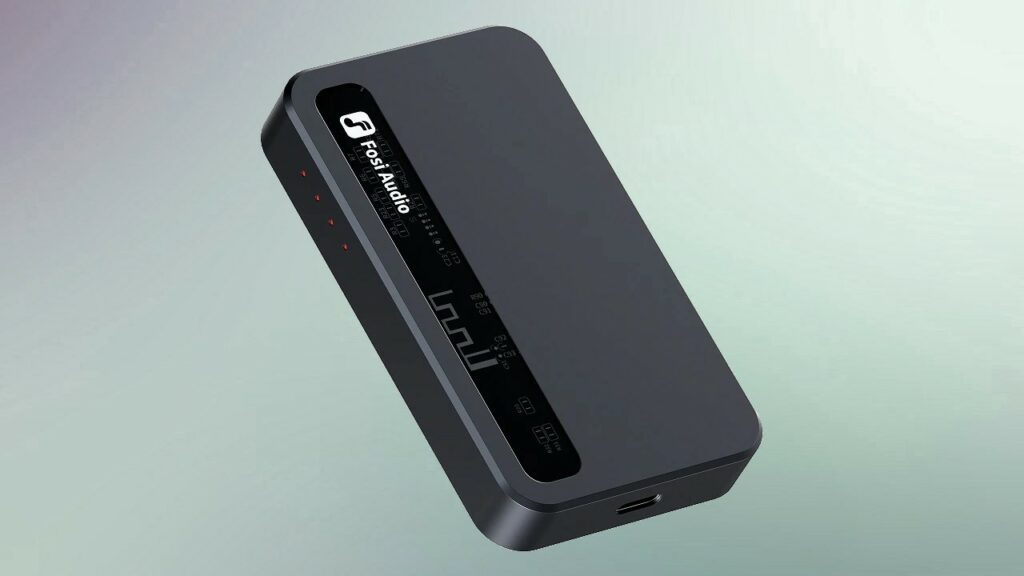
10 DACs to Shortlist for Smarter Digital Audio Systems
A practical Stereoindex guide to ten DACs, explaining which models suit headphone listening, high-resolution files, balanced systems, TV audio, tube output stages and simple PCM playback.

Choosing a DAC is less about chasing one universal specification and more about matching a digital front end to the way you actually listen.
Some systems need a simple USB-to-analog converter, others benefit from balanced outputs, multiple S/PDIF inputs, headphone amplification, Bluetooth reception, HDMI ARC, or support for DSD and MQA.
This curated selection brings together ten DAC articles from the Stereoindex archive, ranging from compact portable units to full-size desktop converters and more ambitious high-end designs. The emphasis here is practical differentiation: input flexibility, conversion architecture, headphone use, upgradeability, and the formats each model is stated to support. No single model below is presented as the universal answer. Instead, each recommendation highlights where the product makes the most sense based on the supplied specifications and design information, helping you narrow the field before comparing features against your own sources, amplifier, headphones, and digital library.

1. Luxman DA-250: DAC that delivers high-quality audiophile sound
Luxman DA-250 desktop DAC with metal casework, front display, input selector, LECUA volume control, and 6.3 mm headphone output.
The Luxman DA-250 is a desktop DAC that expands Luxman’s more accessible converter line with DSD support and a more capable headphone section.
Built around a Burr-Brown/Texas Instruments PCM1795 converter, it handles PCM up to 32-bit/192 kHz and DSD64 or DSD128, while retaining Luxman’s understated all-metal styling.
Its front panel combines a 6.3 mm headphone output, LECUA analog volume control, input selection, and a two-line display that shows input and sample rate, making it a practical component for both system and headphone use.
Best for: Listeners wanting a full-size DAC with integrated headphone control
- PCM1795 conversion stage
- DSD64 and DSD128 support
- 6.3 mm headphone output
- LECUA analog volume control
Verdict: The DA-250 is a strong fit when you want Luxman’s traditional desktop component approach with DSD support and a serious front-panel headphone facility.

2. HiFiMAN EF500: High-precision DAC and headphone amplifier
HiFiMAN EF500 desktop DAC and headphone amplifier with single-ended and balanced headphone connections.
The HiFiMAN EF500 is a desktop DAC and headphone amplifier built around the company’s Hymalaya LE R2R ladder DAC.
The source positions it as an entry-level model in HiFiMAN’s desktop line, but its connectivity is broad for a DAC/amp, with USB-C, USB-B, coaxial and network-related switching listed alongside single-ended and balanced headphone outputs.
Its specified balanced power output at 32 ohms and 4-pin XLR headphone connection make it especially relevant for users of demanding headphones.
Best for: Headphone users seeking a desktop DAC/amp with balanced output
- Hymalaya LE R2R ladder DAC
- Balanced 4-pin XLR headphone output
- USB-C, USB-B and coaxial inputs
- RCA line outputs
Verdict: The EF500 is best viewed as a headphone-focused desktop DAC/amp with R2R conversion and flexible digital input options.
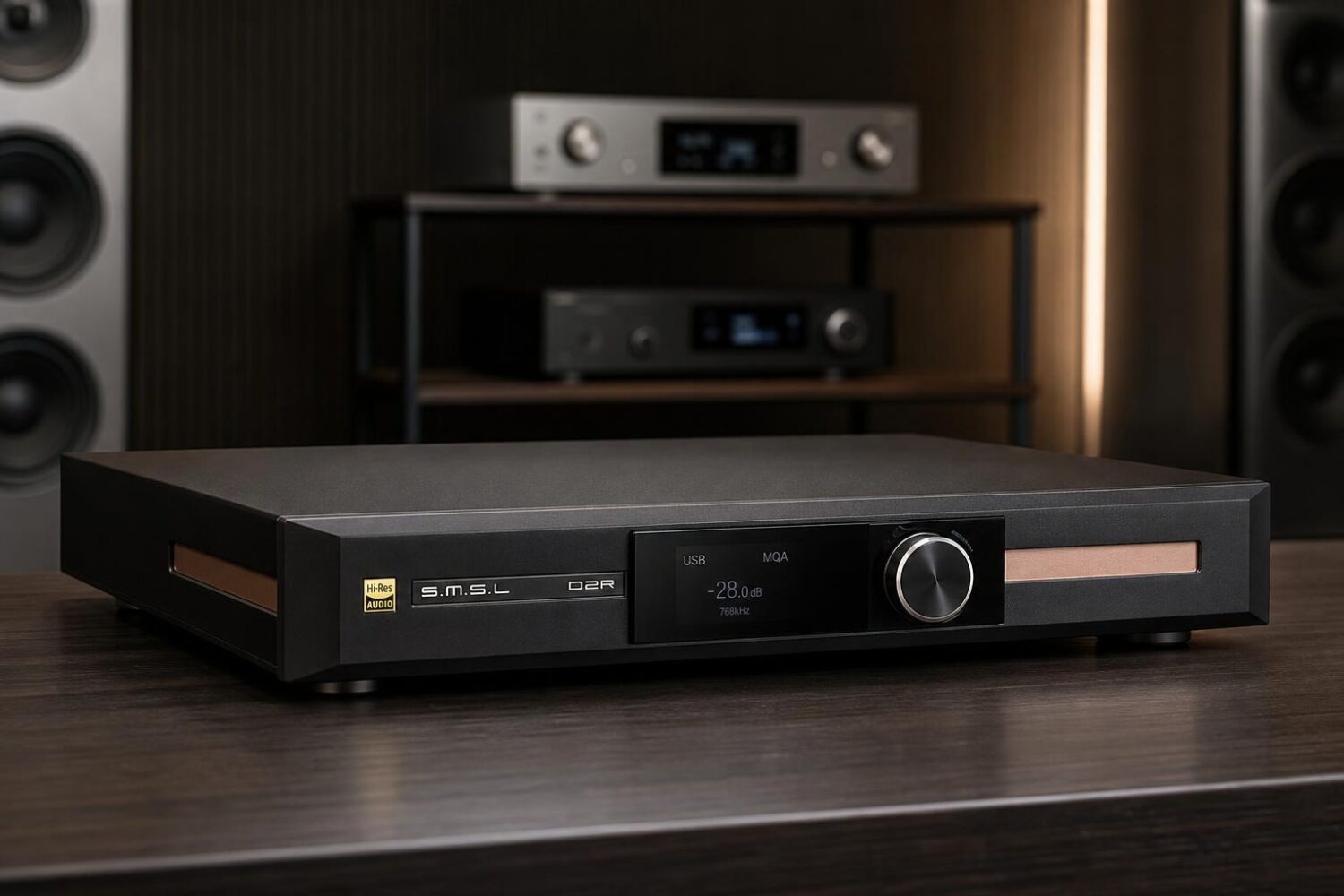
3. SMSL VMV D2R MK2 Brings ROHM Conversion and OCXO Clocking to a Desktop DAC
SMSL VMV D2R MK2 full-size desktop DAC with ROHM conversion, XMOS USB processing, and OCXO-based clocking.
The SMSL VMV D2R MK2 is a full-size desktop DAC aimed at users who want extensive digital compatibility from both wired sources and wireless playback.
It uses a ROHM BD34302EKV DAC chip, XMOS XU-316 USB interface, and an internal 10 MHz OCXO clocking system.
Format support is wide over USB and I²S, including PCM up to 32-bit/768 kHz and native DSD up to DSD512, while optical, coaxial and AES inputs cover PCM up to 24-bit/192 kHz. The model is also specified for full MQA and MQA-CD decoding across USB, optical, coaxial and AES inputs.
Best for: Systems needing broad wired digital compatibility and advanced format support
- ROHM BD34302EKV DAC chip
- Internal 10 MHz OCXO oscillator
- USB and I²S PCM up to 32-bit/768 kHz
- Full MQA and MQA-CD decoding
Verdict: The VMV D2R MK2 stands out for its combination of ROHM conversion, OCXO clocking, high-resolution USB handling and consistent MQA support across several inputs.

4. Fezz Audio Equinox: The first DAC in the history of the Polish company
Fezz Audio Equinox DAC, the company’s first digital-to-analog converter, offered with multiple finish options.
The Fezz Audio Equinox is notable as the Polish company’s first DAC and for the involvement of Lukasz Fikus from Lampizator in its development.
It uses a Burr-Brown PCM1794 chip and includes analog paths based on ECC88 and 12AU7 tubes, giving it a clearly different design emphasis from many chip-and-op-amp desktop converters.
Connectivity is straightforward, with optical, coaxial and USB Type-C inputs, RCA outputs, and no DSD support stated by the company.
Best for: Listeners interested in a tube-output DAC with simple connectivity
- Burr-Brown PCM1794 chip
- ECC88 and 12AU7 tube analog paths
- Optical, coaxial and USB Type-C inputs
- Eight color options
Verdict: The Equinox is the distinctive choice here for buyers who want a tube-based analog path and do not require DSD playback.

5. Audiolab D7: High-Resolution DAC with ES9038Q2M Chip, MQA Decoding & Versatile Connectivity
Audiolab D7 high-resolution DAC with multiple digital inputs, Bluetooth reception, RCA outputs, and balanced XLR outputs.
The Audiolab D7 is presented as a versatile digital hub, with multiple S/PDIF inputs, USB Type-B for computers and mobile devices, USB HDD playback from external flash drives, Bluetooth reception, RCA outputs, balanced XLR outputs, and digital output options.
Its ES9038Q2M Sabre DAC implementation supports high-resolution playback up to DSD512 and 32-bit/768 kHz PCM via USB, while optical and coaxial inputs support PCM up to 24-bit/192 kHz.
It is also described as a full MQA decoder, performing the complete internal unfolding process.
Best for: Users wanting one DAC to handle many digital sources
- ES9038Q2M Sabre DAC chip
- USB PCM up to 32-bit/768 kHz
- DSD512 support
- Full MQA decoding
Verdict: The D7 is a strong all-round digital hub for systems that need broad input choice, balanced outputs, Bluetooth reception and advanced file support.
6. Audio-GD HE-8: Massive R2R DAC featuring a high-end design
Audio-GD HE-8 massive R2R DAC with symmetrical architecture, discrete circuits, and regenerative power supply design.
The Audio-GD HE-8 is a large R2R DAC built around a symmetrical architecture and a component-heavy design.
Its conversion stage uses four PCM1704U-K DAC chips, with discrete audio circuits, an Accusilicon femtosecond clock, FPGA clock control, and Class A power supplies.
A major part of the design is the regenerative power supply system, intended to block much of the noise from the power line and feed separate Class A supplies for the left and right channel preamplifier stages.
Best for: Dedicated systems built around a large R2R DAC architecture
- Four PCM1704U-K DAC chips
- Discrete audio circuits
- Accusilicon femtosecond clock
- Regenerative Class A power supply design
Verdict: The HE-8 is the most architecture-driven choice in this selection, aimed at listeners who prioritize discrete R2R conversion and elaborate power supply engineering.

7. McIntosh MDA200: Upgraded DAC built on flagship technology
McIntosh MDA200 DAC with black glass front panel, illuminated logo, rotary controls, and aluminum end caps.
The McIntosh MDA200 is an upgradeable DAC based on the company’s DA2 digital audio module, a platform also used in higher-tier McIntosh electronics.
It features a quad balanced 8-channel 32-bit DAC, seven digital audio inputs, balanced and unbalanced analog outputs, and Roon Tested certification.
Its input set is especially notable for including an MCT input for McIntosh MCT Series SACD/CD transports and HDMI ARC for audio from a television, alongside USB, coaxial and optical connections.
Best for: McIntosh-centered systems and living-room audio setups
- DA2 digital audio module
- Seven digital audio inputs
- HDMI ARC for TV audio
- Roon Tested certification
Verdict: The MDA200 is the most system-integration-focused option here, especially for users combining McIntosh digital transports, USB sources, Roon, and TV audio.

8. Aune Yuki SE: Portable DAC that doubles as a headphone amplifier
Aune Yuki SE compact portable DAC and headphone amplifier with discrete gain-stage design.
The Aune Yuki SE is a compact DAC and headphone amplifier designed for portable use.
It uses an ES9280AC Pro conversion chip and a discrete 16-transistor gain stage split across four channels, rather than a fixed integrated gain-chip approach.
The source also highlights a dual-layer circuit board that separates the digital input stage from the analog amplifier stage, plus internal low-jitter crystal oscillators. Format support includes high-resolution PCM and DSD512.
Best for: Portable listeners needing a compact DAC with headphone amplification
- Portable DAC/headphone amp format
- ES9280AC Pro chip
- Discrete 16-transistor gain stage
- DSD512 support
Verdict: The Yuki SE is the compact pick for users who want USB DAC duties and headphone drive in a small device with a discrete amplifier stage.

9. Schiit Modi+: Affordable DAC with high-quality audio performance
Schiit Modi+ compact DAC with coaxial, TOSLINK, Unison USB, and USB-C connectivity.
The Schiit Modi+ is a compact DAC focused on simple, high-resolution PCM playback rather than broad format support.
It uses a custom-tweaked ESS ES9018 DAC chip and provides three digital inputs: coaxial, TOSLINK, and Schiit’s Unison USB.
The device supports PCM up to 24-bit/192 kHz and does not support MQA or DSD, which makes it a straightforward choice for users whose digital sources are conventional PCM streams. The move to USB-C for data and external power is also noted in the source.
Best for: Simple PCM-based desktop or hi-fi systems
- ESS ES9018 DAC chip
- Coaxial, TOSLINK and Unison USB inputs
- PCM up to 24-bit/192 kHz
- USB-C for data and power
Verdict: The Modi+ is the no-frills option for listeners who want a compact DAC for PCM sources without paying for DSD or MQA features they will not use.

10. Musical Fidelity M3X: A powerful and affordable DAC
Musical Fidelity M3X DAC in a heavy steel case with RCA and XLR output options.
The Musical Fidelity M3X DAC is described as a pure DAC, with no built-in headphone amplifier, and as a more budget-oriented model influenced by the company’s M6x DAC.
It uses a PCM1795 chip with a Burr Brown SRC4392 sampling rate converter that brings PCM signals to 24-bit/192 kHz.
Outputs include RCA and adjustable output options including XLR, while the design places emphasis on interference control through quiet toroidal transformers, an electromagnetic interference filter, a DC blocker, and a heavy steel case.
Best for: Hi-fi systems needing a dedicated DAC with balanced output option
- Pure DAC design without headphone amp
- PCM1795 chip
- Burr Brown SRC4392 sampling rate converter
- RCA and XLR output options
Verdict: The M3X is a sensible system DAC for users who do not need headphone amplification but do want balanced connectivity and attention to power-related interference control.
Quick comparison
The models below differ most clearly by use case: some are headphone-ready DAC/amps, some are pure system DACs, and others focus on integration, format support, R2R architecture, tube analog stages, or compact portability.
| Product | Best for | Verdict |
|---|---|---|
| Luxman DA-250 | Desktop systems with headphone listening | Adds DSD support, LECUA volume control and a more capable headphone amplifier to a traditional Luxman-style DAC. |
| HiFiMAN EF500 | Balanced headphone setups | Combines Hymalaya LE R2R conversion with single-ended and balanced headphone outputs in a desktop DAC/amp. |
| SMSL VMV D2R MK2 | High-resolution digital source flexibility | Pairs ROHM conversion and OCXO clocking with broad USB, I²S, S/PDIF, AES, DSD and MQA support. |
| Fezz Audio Equinox | Tube-output DAC systems | Uses a Burr-Brown PCM1794 chip with ECC88 and 12AU7 tube analog paths, but does not support DSD. |
| Audiolab D7 | Multi-source digital hubs | Offers extensive input and output flexibility, Bluetooth reception, full MQA decoding, DSD512 and balanced XLR outputs. |
| Audio-GD HE-8 | Large R2R-focused hi-fi systems | Prioritizes discrete R2R conversion, symmetrical architecture, advanced clocking and a regenerative Class A power supply design. |
| McIntosh MDA200 | McIntosh systems and TV audio integration | Stands out with DA2 module architecture, HDMI ARC, MCT transport input, Roon Tested status and balanced outputs. |
| Aune Yuki SE | Portable headphone listening | A compact DAC/headphone amp with ES9280AC Pro conversion, DSD512 support and a discrete 16-transistor gain stage. |
| Schiit Modi+ | Simple PCM playback | Keeps the feature set focused with coaxial, TOSLINK and Unison USB inputs, PCM support to 24-bit/192 kHz, and no MQA or DSD. |
| Musical Fidelity M3X | Dedicated DAC use with RCA or XLR outputs | A pure DAC design using PCM1795 conversion and interference-control measures, without a built-in headphone amplifier. |
Frequently asked questions
Do I need DSD or MQA support in a DAC?
Only if your library or streaming workflow uses those formats.
The Schiit Modi+ is deliberately PCM-only, while models such as the Audiolab D7, SMSL VMV D2R MK2, McIntosh MDA200, Aune Yuki SE and Luxman DA-250 include DSD support to varying levels.
The SMSL and Audiolab models are also specified with MQA decoding, while the Fezz Audio Equinox is stated not to support DSD.
Should I choose a DAC with a built-in headphone amplifier?
Choose one if headphones are a regular part of your listening.
The Luxman DA-250, HiFiMAN EF500 and Aune Yuki SE all include headphone amplification, with the EF500 especially oriented toward balanced headphone output.
If the DAC will feed an integrated amplifier or preamp only, a pure DAC such as the Musical Fidelity M3X may be a cleaner fit.
Are balanced XLR outputs important?
Balanced outputs are useful if your amplifier or active speakers accept XLR connections, especially in more complex systems.
The Audiolab D7, McIntosh MDA200 and Musical Fidelity M3X are all listed with balanced output options.
If your amplifier only has RCA inputs, balanced outputs are not essential.
What inputs should I check before buying a DAC?
Match the DAC to your actual sources.
Computers usually need USB; disc transports and streamers often use coaxial, optical or AES; a television may benefit from HDMI ARC, as found on the McIntosh MDA200; and wireless playback points toward a model such as the Audiolab D7 or SMSL VMV D2R MK2, both described with wireless capability in the source material.
How to choose from these 10 DACs
Start with the role the DAC must play.
If it will sit on a desk and drive headphones, shortlist the HiFiMAN EF500, Luxman DA-250 or Aune Yuki SE depending on whether you need a full-size balanced desktop unit, a traditional component DAC with front-panel volume and headphone output, or a compact portable device.
If you want a DAC that simply feeds an amplifier, the Schiit Modi+ and Musical Fidelity M3X represent two clearer system choices: the Modi+ for straightforward PCM playback through a compact box, and the M3X for a pure DAC with RCA and XLR output options. For broader source handling, the Audiolab D7 and SMSL VMV D2R MK2 are the obvious starting points. The Audiolab is positioned as a versatile digital hub with Bluetooth, USB HDD playback, full MQA decoding, DSD512 and balanced outputs. The SMSL goes further into high-resolution desktop DAC territory with ROHM conversion, XMOS USB, OCXO clocking, high-rate USB and I²S support, and MQA handling across several wired inputs. System context matters just as much as format support. The McIntosh MDA200 makes particular sense where McIntosh MCT transports, Roon use, balanced outputs or HDMI ARC for television audio are part of the plan. The Fezz Audio Equinox is more specialized, appealing to listeners who want a Burr-Brown DAC with tube analog paths and simple inputs, while accepting the lack of DSD. The Audio-GD HE-8 is the architecture-led option, built around PCM1704U-K R2R conversion, discrete circuits, advanced clocking and an elaborate regenerative power supply. Before choosing, make a short list of non-negotiables: USB requirements, optical or coaxial inputs, balanced outputs, headphone output, DSD or MQA support, television integration, and available space. The strongest DAC for your system is the one that meets those needs without forcing you to pay attention to features you will not use.