
Looking for a Smarter Way to Stream Music? Start Here
The Silent Angel H1 offers an integrated hub for streaming and local libraries, while the Leak TruStream takes a traditional separates approach. Tidal’s move from MQA to FLAC adds an important service-format consideration.

Streaming systems can take several forms.
Some listeners want one component to manage network playback, digital conversion and a local music library, while others need a dedicated streamer that fits naturally alongside an existing amplifier.
Service formats matter too, particularly when a platform changes the files and immersive-audio options available to subscribers. The Silent Angel H1 Pure Music Hub is the most integrated option here, combining streaming, conversion, library management and expandable storage with a prominent front display. The Leak TruStream takes a more conventional component approach, pairing modern network technology with Leak’s vintage-inspired design language. Tidal’s move from MQA to FLAC is not a hardware recommendation, but it is relevant when choosing a streamer or reviewing an existing setup. The three entries below therefore cover two distinct network-audio components and one important service-format explainer.
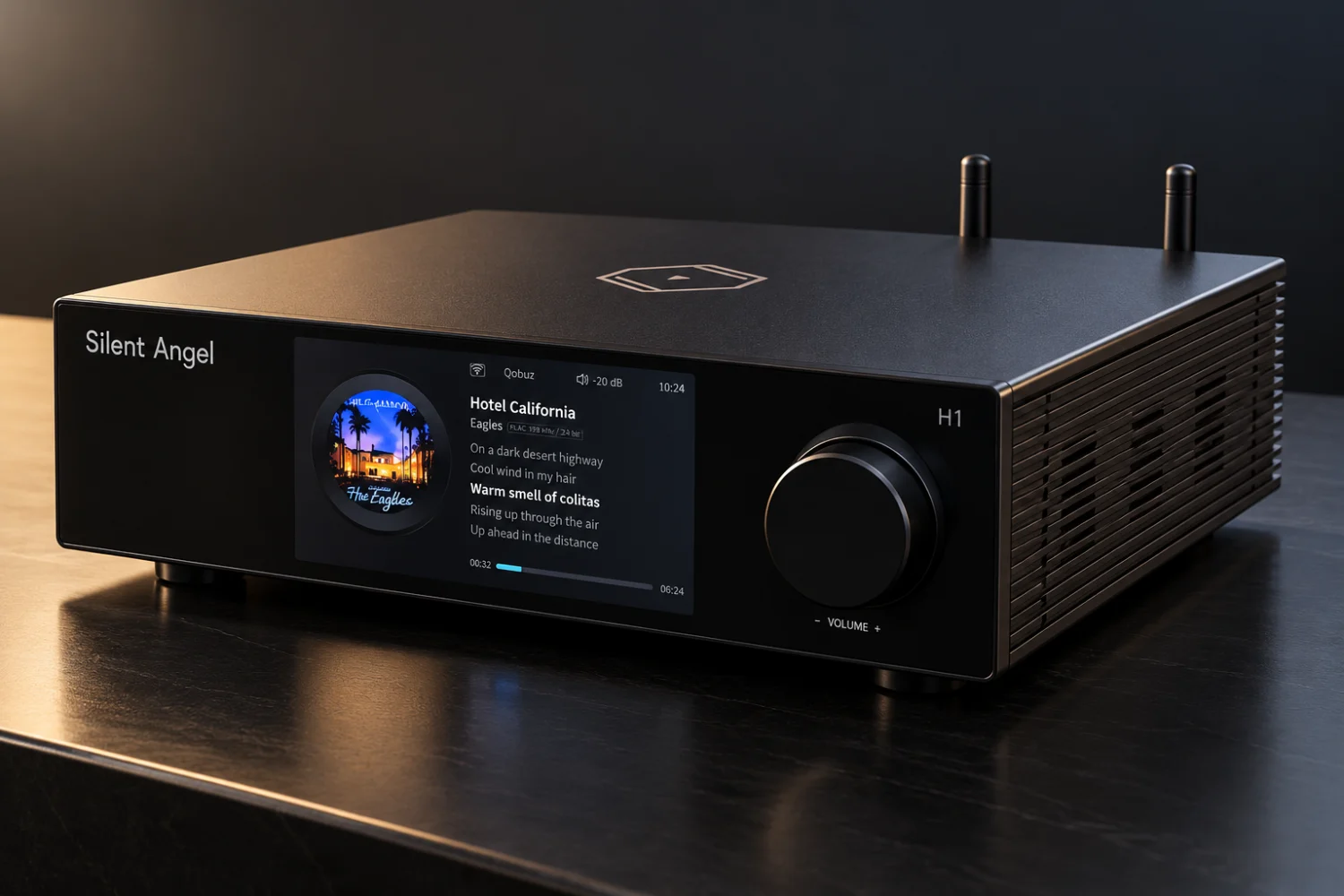
1. Silent Angel H1 Pure Music Hub Brings a Large Display to Desktop Streaming
The Silent Angel H1 Pure Music Hub places a 5.5-inch information screen at the center of its aluminum front panel.
The Silent Angel H1 Pure Music Hub is designed as both a network player and a digital control center for desktop or living-room systems.
It combines streaming, digital-to-analog conversion and music-library management in a single aluminum enclosure, reducing the need for several separate digital components.
Music can be accessed from commonly used streaming services, USB devices, network-attached storage and an optional internal solid-state drive. Its defining feature is a 5.5-inch front-panel information screen with a 1,280 x 720 resolution. Conversion is handled by two ESS Sabre ES9039Q2M DAC chips, while XMOS processing forms part of the digital architecture. This combination of a large visual interface, local-library support and integrated conversion makes the H1 the broadest all-in-one streaming proposition in this selection.
Best for: Compact systems needing streaming, conversion and library management in one component
- 5.5-inch front information display
- Dual ESS Sabre ES9039Q2M DAC chips
- USB and network-attached storage playback
- Optional internal solid-state drive
Verdict: The H1 is the strongest fit here for listeners who want a visually accessible hub for streamed and locally stored digital music.

2. Tidal says “bye bye” to MQA and here’s what that means for subscribers
Tidal’s format transition replaces MQA with FLAC while retaining Dolby Atmos as its supported immersive-audio option.
This article explains Tidal’s decision to replace its MQA streams with FLAC versions and remove 360 Reality Audio from the service.
FLAC had already been identified by Tidal as its preferred format for high-resolution audio, making the transition away from the closed MQA format a significant consideration for subscribers and hardware owners.
The change also simplifies Tidal’s immersive-audio offering: Dolby Atmos remains the service’s multichannel format, while music and podcasts previously available in 360 Reality Audio are removed. For equipment selection, the practical takeaway is to focus on compatibility with Tidal’s FLAC catalogue and Dolby Atmos where immersive playback is relevant, rather than treating MQA or 360 Reality Audio support as a priority.
Best for: Tidal subscribers assessing format and hardware compatibility
- FLAC replaces MQA streams
- FLAC is an open file format
- Dolby Atmos remains available
Verdict: This is a useful format guide for understanding why MQA and 360 Reality Audio support are no longer central considerations for Tidal playback.
3. Leak TruStream: A Premium Network Streamer for Modern Audiophile Systems
The Leak TruStream combines the brand’s vintage-inspired exterior design with an ESS-based digital stage and Silent Angel streaming platform.
The TruStream is Leak’s first dedicated music streamer, intended to add high-resolution network audio to a component hi-fi system.
Its styling follows the vintage design language associated with the brand’s Stereo 130 integrated amplifier and CDT CD transport, giving it a distinct visual identity among modern streaming products.
Digital conversion is built around an ESS Sabre ES9038Q2M DAC using HyperStream II architecture and the company’s Time Domain Jitter Eliminator. Leak also employs an active post-filter stage, which the company says is tuned to support dynamic range and preserve low-level musical information. The streaming engine was developed in partnership with Silent Angel, bringing an established network platform into Leak’s first purpose-built streamer.
Best for: Component hi-fi systems seeking a dedicated streamer with classic styling
- ESS Sabre ES9038Q2M DAC
- Silent Angel network streaming platform
- Active post-filter stage
- Vintage-inspired Leak design
Verdict: The TruStream is the more traditional component choice, combining Leak’s established visual character with a modern network platform and integrated ESS conversion.
How to choose the right streaming approach
Begin by deciding whether the streamer should serve as the center of the entire digital system or operate as one component within an established hi-fi setup.
The Silent Angel H1 is the more integrated design: it handles network playback, conversion and library management, supports several forms of local storage and provides a large front-panel display.
That combination is especially relevant when direct access to playback information and locally stored music matters. The Leak TruStream follows a more conventional separates philosophy. It is a dedicated network streamer with an ESS conversion stage, a Silent Angel streaming platform and styling designed to complement Leak’s other components. It therefore makes the most sense when the system already has amplification and the goal is to add network playback without moving to a hub-style component. Streaming-service formats should be considered alongside the hardware. Tidal’s replacement of MQA with FLAC means MQA support is no longer a decisive feature for that service, while Dolby Atmos compatibility remains relevant for listeners interested in Tidal’s immersive catalogue. Because the supplied material does not provide complete service, control-app or connection lists for either streamer, those details should be confirmed against the requirements of the intended system before a final choice is made.