
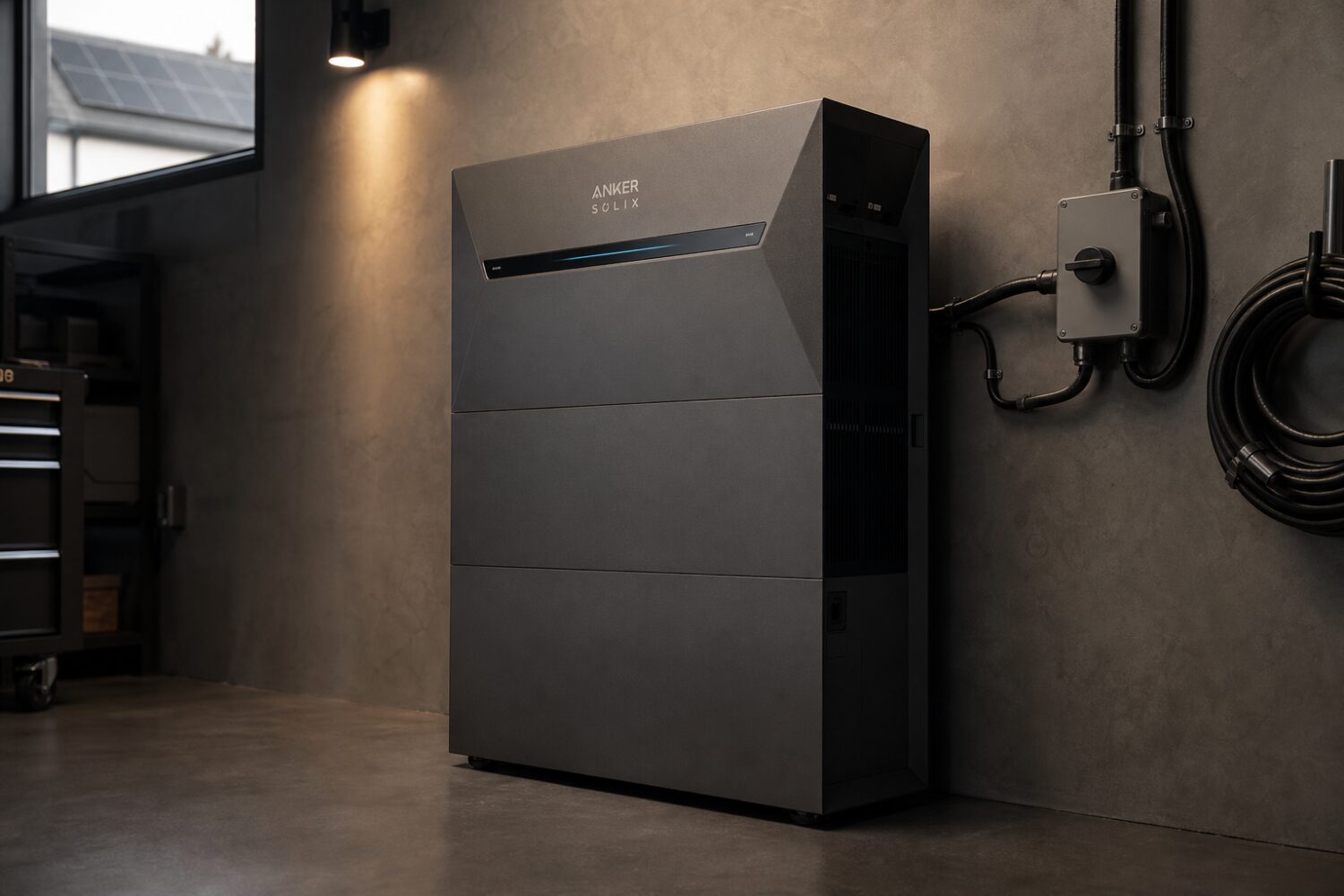
Anker Solix has announced the Solarbank Max at IFA, positioning the system as a home battery for solar households that want storage integrated more deeply into their existing power setup. The 7 kWh unit can be expanded with up to five additional batteries for a total capacity of 42 kWh, and its key distinction is that it is designed to replace a conventional string inverter rather than simply sit beside one.
A 7 kWh battery that takes over the inverter role
The Solarbank Max is built for solar installations where the battery is connected directly to the panels. Anker says the unit can accept up to 10 kWp of solar input through three MPPTs, which it frames as roughly enough for eighteen panels. That setup makes it different from a battery that is added after an existing inverter, because the Solarbank Max becomes part of the core solar conversion chain.
Anker now has two 7 kWh home battery approaches in its lineup. The earlier Solarbank Max AC is designed to leave an existing inverter in place, making it the simpler option for households that only want to add storage without reworking the roof-side solar system. The new Solarbank Max takes the opposite route by replacing the inverter and connecting directly to the solar array. That makes the choice less about capacity and more about installation strategy.
The technical reason for the distinction is conversion loss. Solar panels generate direct current, and batteries store direct current, while the home uses alternating current. A battery installed after a conventional inverter can involve converting solar power to alternating current and then back again to direct current for storage. A system that connects the panels directly to the battery can avoid that extra step, although Anker has not provided a specific efficiency gain figure for individual installations.
Power output varies by installation type
Anker lists several output levels depending on how the Solarbank Max is connected. Through a standard wall outlet, the system can deliver 800 watts. On a separate electrical group, output rises to 3,500 watts. With a fixed connection installed by an electrician, the maximum listed output is 5,000 watts.
There is also a separate emergency power output rated at 3,680 watts. For whole-panel backup, Anker refers to an associated Backup Auto Switch. The company’s materials include two different descriptions of the switchover behavior: one presents it as uninterrupted, while a footnote specifies a transfer time of under 20 milliseconds. The latter is the more concrete figure and is typically short enough that many connected devices would not notice the changeover.
The highest output mode is not a simple plug-in scenario. Once a system requires a fixed electrical connection by a certified electrician, installation becomes a more involved home-electrical project rather than a consumer appliance setup. That distinction matters for anyone comparing it with lower-power plug-in storage products.
Durability, battery chemistry and cycle claims
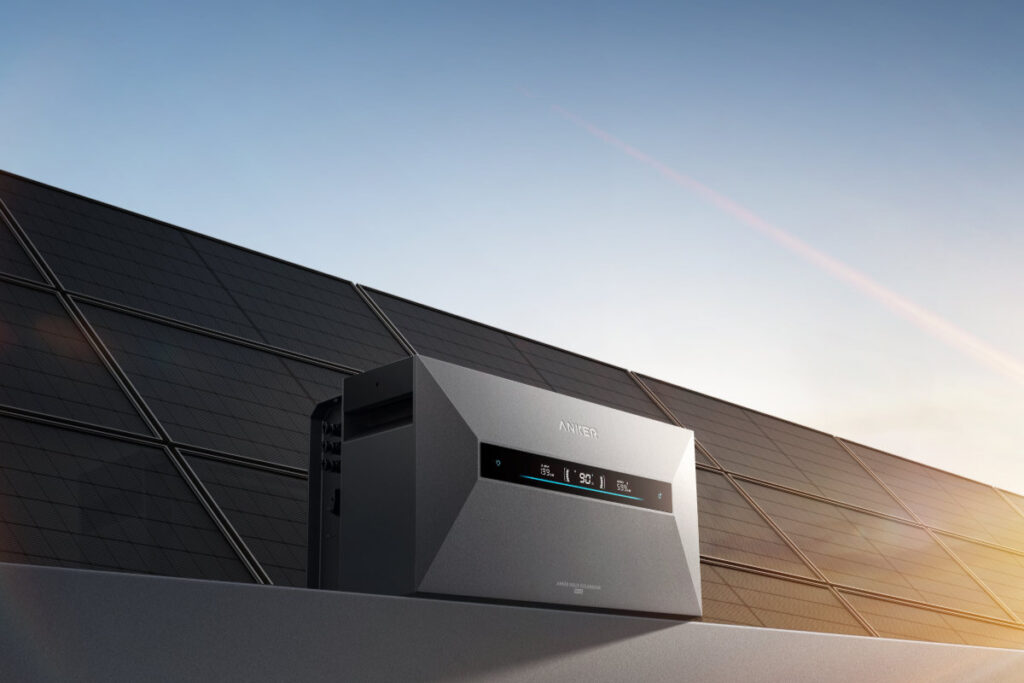
The Solarbank Max uses lithium iron phosphate cells rated at 314 Ah. Anker lists an IP66 rating and an operating temperature range from -20 to +55 degrees Celsius, indicating that the unit is designed for more demanding placement conditions than many indoor-only battery products.
The company also states a 10-year warranty, which is a meaningful baseline for a product category where long-term reliability is central to the purchase decision. Anker mentions up to 10,000 charge cycles and a service life of up to fifteen years, but the cycle figure is not accompanied by a stated remaining-capacity threshold. That omission makes it harder to compare directly with other batteries, because cycle life can be counted to different degradation points.
For buyers evaluating long-term value, the warranty is the clearest concrete support point in the information provided. The cycle-life claim may still be useful, but it should be read with the missing degradation threshold in mind.
Savings claims need household-specific math
Anker promotes a payback period of around three years under favorable assumptions, but the details behind that kind of estimate are crucial. The referenced scenario involves eighteen 500-watt panels, a 9 kWp solar array and an additional battery. That is a substantial system and is not representative of every household’s consumption pattern.
The economics of home storage depend heavily on how much energy a household can use directly instead of sending it back to the grid. A home with a heat pump, an electric vehicle or both may be able to shift and consume far more self-generated power than a typical household. In a lower-consumption home, a large solar-and-storage setup may take longer to justify financially.
The calculation also depends on installation and grid-related costs, which Anker excludes from its payback footnote. For a system that may involve replacing an inverter and, in some cases, adding or working around a large solar array, professional installation can be a significant part of the real project cost. The headline payback figure should therefore be treated as a best-case scenario rather than a universal result.
Local control and Home Assistant support stand out
One of the more important details in the announcement is not about capacity or output. Anker says household data is processed locally and that the Solarbank Max works fully with Home Assistant, allowing automation without relying on the cloud.
That matters for a long-life home energy product. A battery that depends entirely on a manufacturer’s app or remote servers can become a problem if software support changes years later. Local control and Home Assistant integration give owners a better chance of keeping automations running on their own equipment.
For technically minded households, that openness may be just as important as small efficiency gains. Home batteries increasingly sit at the center of solar generation, energy tariffs, electric vehicle charging and backup power planning, so integration with broader home automation systems can shape how useful the hardware becomes over time.
Market timing is tied to changing solar incentives
The broader timing is not accidental. In the Netherlands, net metering is scheduled to end on January 1, 2027. Until then, many solar owners can offset exported power against imported power, effectively using the grid as a kind of virtual battery. Once that framework changes, self-consumption becomes more financially important for many households.
That shift helps explain why home battery systems are becoming more prominent. The Solarbank Max is aimed at the moment when solar owners begin looking beyond panels alone and start considering storage, backup power and smarter energy routing as part of the same system.
Anker has not provided USD pricing in the supplied announcement details. Availability and final installation requirements may also vary by market, particularly because electrical standards and permitted connection methods differ from country to country.
The Anker Solix Solarbank Max is a notable step beyond add-on home batteries because it is designed to replace the solar inverter and connect directly to panels. Its expandable 7 kWh to 42 kWh design, multiple output modes and local Home Assistant support make it an ambitious energy product, but buyers should calculate their own consumption, installation costs and export-tariff outlook before relying on any payback estimate.