
Our Favorite Amplifier Choices for Different Hi-Fi Systems
A grounded amplifier buying guide comparing compact integrated amps, dedicated power amplifiers, tube designs, preamplifier options and system-matching caveats.

A good amplifier shortlist should not treat every system as if it needs the same solution.
Some listeners need a compact integrated amplifier with tone controls and wireless convenience, while others are building around a dedicated stereo power amplifier, a bridged mono setup, or a high-end preamplifier and power-amplifier chain.
This guide gathers the supplied amplifier-related coverage into an evergreen, practical reference. The emphasis is on what is actually stated in the source material: topology, connectivity, power ratings where provided, operating modes, and the type of system each product appears to suit. Not every article below is an equal buying recommendation for an amplifier shopper. A few entries are previews with limited specifications, one is a preamplifier rather than a power amplifier, and one is an in-ear headphone article included in the supplied material. Those distinctions are made explicit so the list remains useful without overstating what is known.
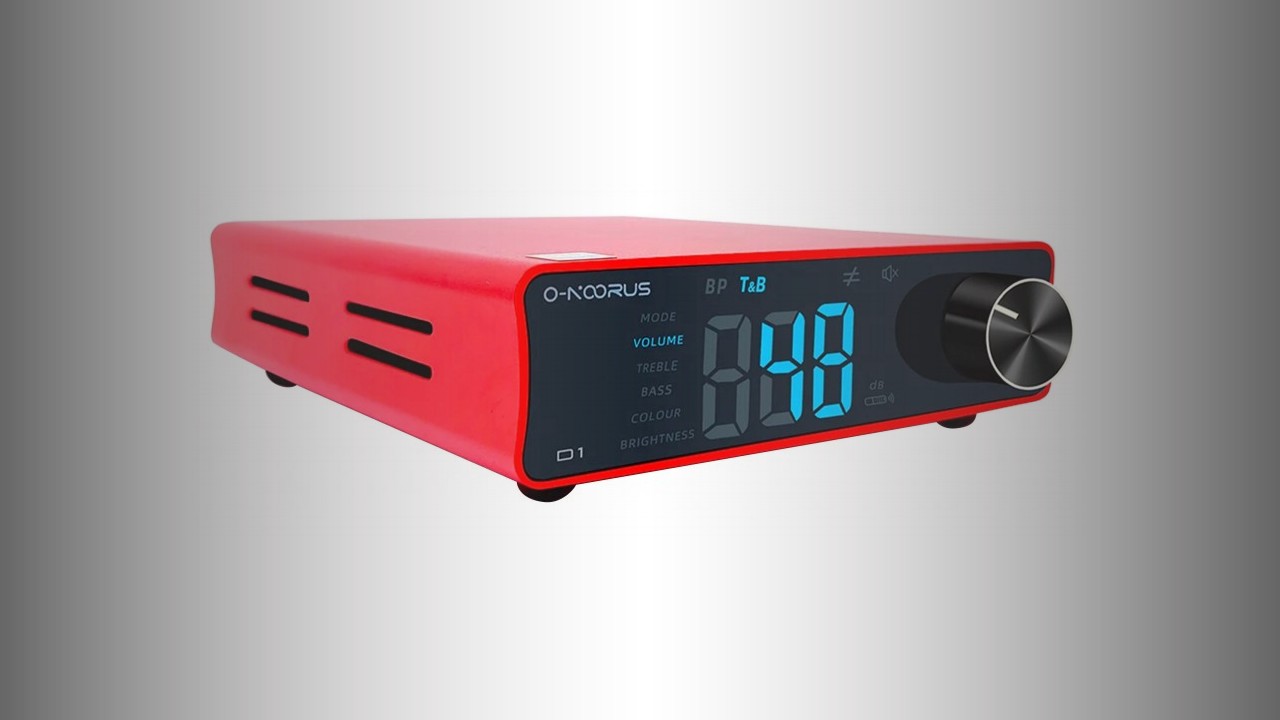
1. O-Noorus D1
O-Noorus D1 Class D amplifier with RCA input, speaker terminals, subwoofer output and 3.5 mm pre-out.
The O-Noorus D1 is the most self-contained compact amplifier in this selection.
It is a Class D design using a TPA3255 amplifier chip with PFFB architecture, and the source specifies output of up to 2 x 250 watts into 4 ohms at 1% THD+N when supplied at 50V.
Its appeal is practical as much as technical: analog RCA input, speaker outputs, a subwoofer output, and a 3.5 mm pre-out give it enough flexibility for a simple stereo or 2.1-channel system. Two operating modes broaden its use. ByPass mode runs without volume control, while Treble and Bass mode adds volume plus bass and treble adjustment over a plus or minus 10 dB range. An infrared remote control is also included, making the D1 unusually complete for a compact amplifier built around a minimalist input set.
Best for: Compact stereo or 2.1 systems with analog sources
- PFFB Class D architecture
- Subwoofer output for 2.1 systems
- Bass and treble adjustment
- Infrared remote control
Verdict: The O-Noorus D1 is a strong fit when the priority is a compact, high-feature Class D amplifier with tone control and subwoofer support.
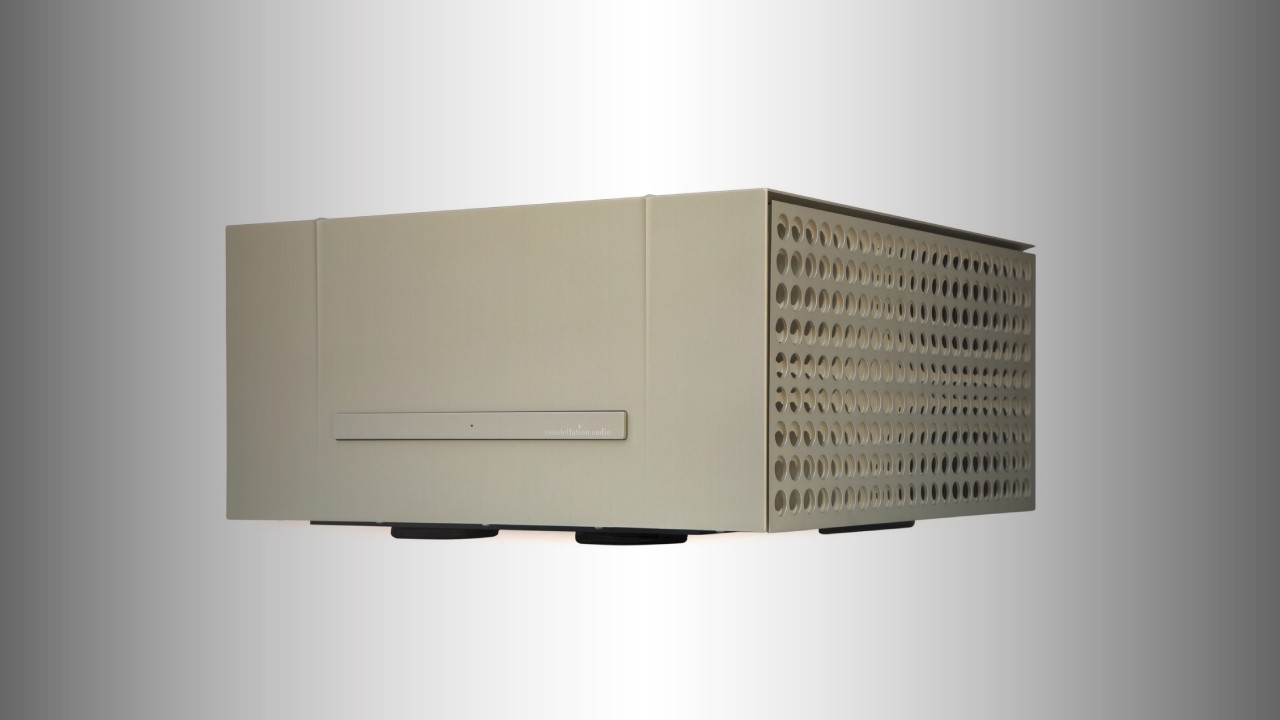
2. Constellation Audio Inspiration 2
Constellation Audio Inspiration 2 power amplifiers, previewed in stereo and mono versions.
The Constellation Audio Inspiration 2 is more of a watch-list entry than a fully formed recommendation, because detailed technical specifications, pricing, and delivery information were not released in the supplied article.
What is known is that the range includes both stereo and mono power amplifiers, and Constellation positions them as distilling elements of its Reference and Performance amplifiers into a more compact package.
The company also states that the Inspiration 2 amplifiers use C-SMPS, described by Constellation as its best power supply for an audio amplifier. Without power ratings, input details, dimensions, or pricing, the sensible editorial stance is caution: this is potentially important for high-end systems, but the article does not provide enough information for firm system matching.
Best for: High-end buyers tracking forthcoming stereo or mono power amplifiers
- Stereo and mono versions planned
- More compact package than upper lines, according to Constellation
- C-SMPS power supply stated by manufacturer
Verdict: The Inspiration 2 looks significant on positioning, but it remains a preview until specifications and availability details are available.

3. SMSL A50
SMSL A50 compact Class D amplifier with Bluetooth 5.0, preset EQ options and tone controls.
The SMSL A50 is aimed squarely at listeners who need a very compact amplifier with simple wireless convenience.
It uses Class D amplification based on two Texas Instruments TPA3116 amplifier chips and is specified at 2 x 60 watts into 4 ohms or 2 x 33 watts into 8 ohms, both at 1% THD+N.
Bluetooth 5.0 is the headline convenience feature, allowing playback from a smartphone or tablet, and the amplifier can automatically reconnect to a previously paired device when powered on. The A50 also offers tone control and preset equalizers, giving it more day-to-day adjustability than a stripped-back miniature power amp. The source describes its sound as dynamic, detailed, accurate, and transparent, while also noting oscillator and PLL circuitry intended to reduce noise and jitter.
Best for: Small systems that need Bluetooth and simple sound adjustment
- Bluetooth 5.0 streaming
- Compact Class D design
- Preset equalizers
- Bass and treble tone control
Verdict: The SMSL A50 is the practical compact choice for casual wireless use and adjustable stereo playback.
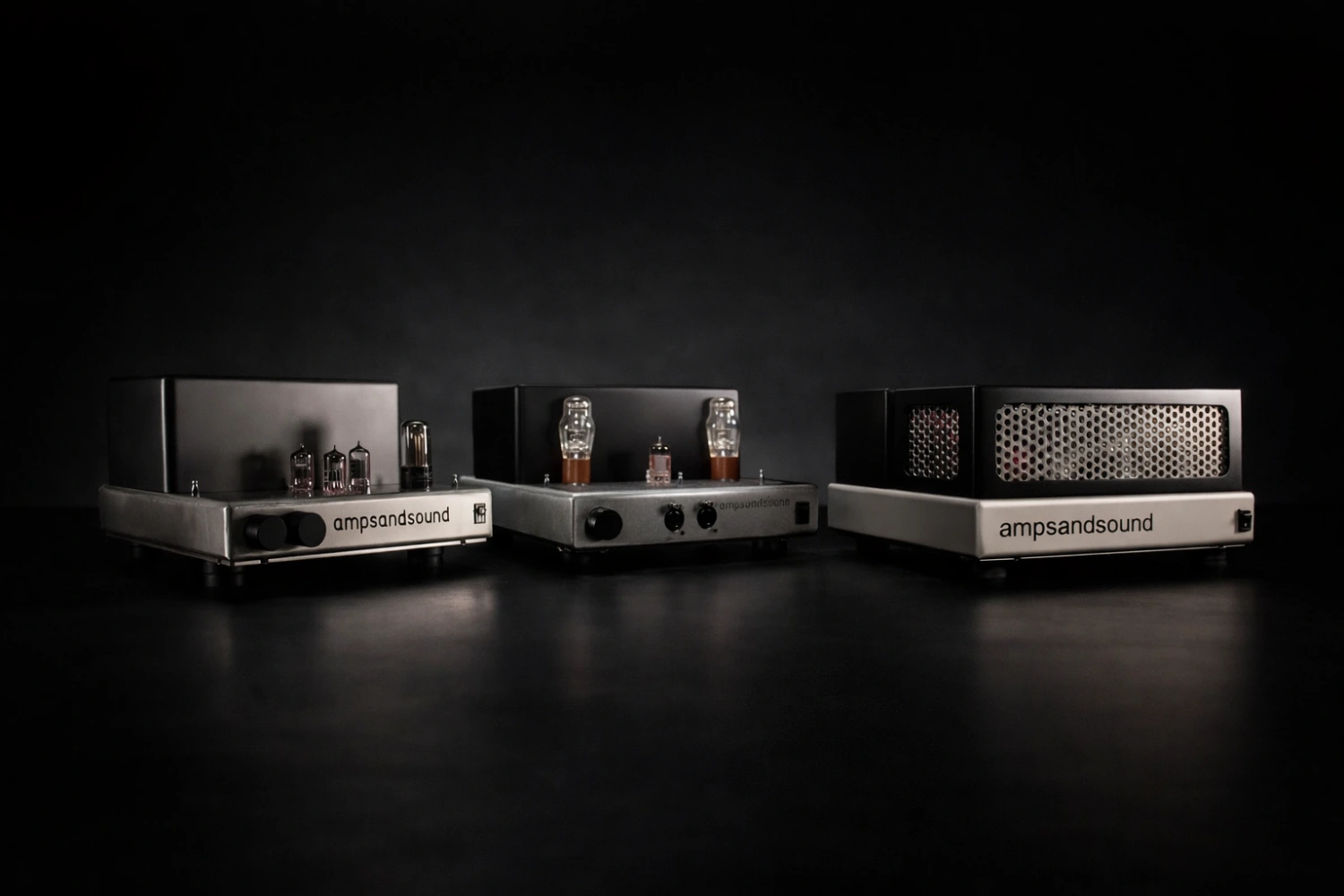
4. Ampsandsound Kenzie Reimagined, Badlands and Stereo 17
Ampsandsound tube lineup including Kenzie Reimagined headphone amplifier, Badlands preamplifier and Stereo 17 power amplifier.
This Ampsandsound article covers a three-product tube lineup rather than one conventional amplifier recommendation.
The clearest specification detail is for the Kenzie Reimagined headphone amplifier, which uses 5751 or 12AX7 input tubes with 1626 or VT-137 output tubes, has a stated noise floor of 30 µV, total harmonic distortion below 0.7% at 750 mW, and 18 dB gain through the 12AX7 stage.
The article also names the Badlands preamplifier and Stereo 17 power amplifier as part of the same debut, framing the group around hand-built tube gear and a blend of classic vacuum tube topology with modern engineering. For headphone listeners, the Kenzie Reimagined is the most clearly described product here, particularly because the source states that its improved noise floor makes it suited to high-sensitivity headphones. For two-channel buyers, the Stereo 17 is relevant, but the supplied text does not provide enough technical detail to compare it deeply with the dedicated stereo power amplifiers elsewhere in this guide.
Best for: Tube enthusiasts spanning headphone and two-channel systems
- Tube-based lineup
- Kenzie Reimagined has a stated 30 µV noise floor
- Kenzie Reimagined specified for high-sensitivity headphones
- Includes headphone, preamp and power amp products
Verdict: The Ampsandsound lineup is most compelling where tube topology and hand-built design are priorities, though the supplied detail is strongest for the Kenzie Reimagined headphone amplifier.

5. Teac AP-507
Teac AP-507 compact stereo power amplifier using Hypex NCOREx Class D technology.
The Teac AP-507 is a compact stereo power amplifier built around Hypex NCOREx Class D technology, with Teac describing it as an advance over the earlier AP-505 through an upgraded amplifier module, higher output power, and lower distortion.
It is not an integrated amplifier, so it belongs in systems that already have a source with volume control or a separate preamplifier.
Its flexibility is a major strength. The AP-507 can operate as a stereo amplifier, a bi-amp amplifier, or a bridged mono amplifier. Output is specified at 70 watts per channel into 8 ohms and 125 watts per channel into 4 ohms, rising to 230 watts into 8 ohms in bridged mono configuration. The source also notes a fully balanced design, a factory-engineered dual-mono buffer amplifier, and a power supply using a toroidal transformer with 18,800 µF of smoothing capacitance per channel.
Best for: Systems needing a compact, flexible power amplifier
- Hypex NCOREx Class D module
- Stereo, bi-amp or bridged mono operation
- Fully balanced design stated by Teac
- Compact two-channel power amplifier format
Verdict: The Teac AP-507 stands out as a versatile compact power amp for stereo use, bi-amping, or bridged mono configurations.
6. Pro-Ject Amp Box RS2
Pro-Ject Amp Box RS2 compact stereo power amplifier with visible top-mounted tubes.
The Pro-Ject Amp Box RS2 is a compact stereo power amplifier with a hybrid character.
It uses a 6922 or 6DJ8 triode tube in each channel’s pre-amplifier stage, is built with discrete components, and operates in class AB.
The result is positioned by Pro-Ject as a combination of tube and transistor benefits, including reliability, low distortion, and efficiency. Power is rated at 80 watts per channel into 8 ohms and 130 watts per channel into 4 ohms. Like the Teac AP-507, it can bridge its two channels for mono operation, where the source states approximately 350 watts into 8 ohms. The full metal case is not just visual; the article describes it as important for distributing and dissipating excess heat. Black and silver finishes are offered, and Pro-Ject also mentions an optional linear power supply, the Power Box RS2 Amp.
Best for: Listeners wanting a compact power amplifier with tube-stage character
- Hybrid tube and transistor approach
- Class AB operation
- Bridgeable for mono use
- Optional linear power supply mentioned
Verdict: The Pro-Ject Amp Box RS2 is the most natural pick here for a compact power amplifier that explicitly blends tube stages with class AB output.
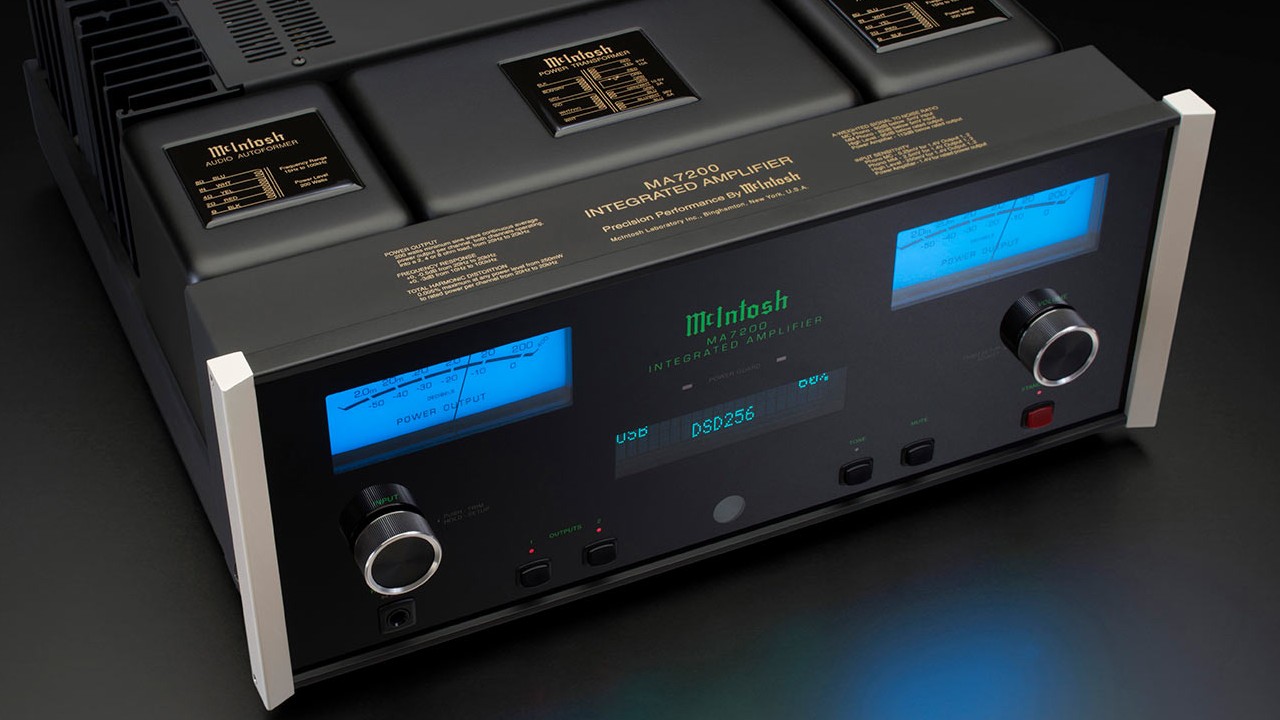
7. McIntosh MA7200
McIntosh MA7200 integrated amplifier with blue meters, black glass front panel and extensive input options.
The McIntosh MA7200 is the broadest integrated amplifier in the selection.
The article specifies 200 watts per channel and a generous input set: five unbalanced inputs, one balanced input, phono inputs for MM and MC cartridges, coaxial and optical digital inputs, USB, and McIntosh’s proprietary MCT connection.
The digital inputs are housed in the removable DA1 module, which includes an eight-channel 32-bit DAC used in Quad Balanced mode. The USB input accepts PCM up to 32-bit/384 kHz and supports DSD256 and DXD 384 kHz, while coaxial and optical inputs handle music up to 24-bit/192 kHz. System features are similarly extensive. The MA7200 includes a headphone amplifier with Headphone Crossfeed Director technology, home theater pass-through, Power Guard and Sentry Monitor technologies, assignable input names, and McIntosh’s recognizable black glass front, blue meters, aluminum end caps and backlit logo.
Best for: Full-size integrated systems needing many inputs
- 200 watts per channel
- Extensive analog and digital inputs
- MM and MC phono inputs
- Headphone Crossfeed Director technology
Verdict: The McIntosh MA7200 is the most complete integrated amplifier option here for a system built around multiple analog, digital, phono and headphone needs.

8. Eleven Audio A390
Eleven Audio A390 integrated stereo amplifier with VCIA technology and analog RCA and XLR inputs.
The Eleven Audio A390 is a compact integrated stereo amplifier built around the company’s Voltage and Current Isolated Amplify technology, or VCIA.
According to Eleven Audio, this design separates voltage and current amplification to reduce distortion and support precise reproduction, including with complex music.
The manufacturer also states that more than 300 selected components are used per channel. The A390 is deliberately modest in power compared with several larger amplifiers here, with a stated 39 watts per channel into 8 ohms. Its appeal is in design focus rather than brute output: the source highlights attention to sound quality at lower volume levels, a resistor-ladder volume control, individual volume settings for each input, and a remote control. Connectivity is simple, with two RCA inputs and one XLR input. The article provides frequency response, signal-to-noise ratio and slew-rate figures, but pricing and delivery details were unavailable.
Best for: Compact integrated systems focused on lower-volume listening
- VCIA amplifier technology
- Resistor-ladder volume control
- Individual volume settings for each input
- Two RCA inputs and one XLR input
Verdict: The Eleven Audio A390 is a specialized integrated amplifier for listeners who value compact design, careful volume control and simple analog connectivity over high output power.

9. Softear Tremolo
Softear Tremolo in-ear headphones with anatomical resin housings and detachable cable.
The Softear Tremolo is not an amplifier, so it should not be treated as a pick in this amplifier guide.
It is an anatomically shaped in-ear headphone with resin shells, a 10 mm beryllium-coated dynamic driver, an N52 neodymium magnetic system, a detachable cable with 0.78 mm connectors, and a 4.4 mm plug plus a 3.5 mm adapter.
Its relevance to amplifier buyers is limited to system matching. The source states sensitivity of 122 dB and nominal impedance of 16 ohms, describing it as a light load for an amplifier. That can matter when considering headphone outputs, noise floor, and gain, especially with high-sensitivity earphones, but the supplied article does not position the Tremolo as an amplifier or amplifier substitute.
Best for: Headphone-output matching context, not amplifier shopping
- High 122 dB sensitivity
- 16 ohm nominal impedance
- Detachable cable with 0.78 mm connectors
- 4.4 mm plug with 3.5 mm adapter
Verdict: The Softear Tremolo belongs outside an amplifier shortlist, but its high sensitivity and low impedance are useful reminders to consider noise and gain when pairing earphones with amplifiers.

10. Accuphase C-3900S
Accuphase C-3900S flagship preamplifier with Dual Balanced AAVA volume control architecture.
The Accuphase C-3900S is a flagship preamplifier, not a power amplifier or integrated amplifier.
It therefore belongs in a separates system where source selection, volume control, balance adjustment, and signal integrity are handled before a separate power amplifier.
The supplied article emphasizes construction and control architecture: the C-3900S weighs 25 kilograms and uses Accuphase’s proprietary AAVA volume control in a further-developed Dual Balanced AAVA implementation. The source explains that AAVA avoids conventional signal attenuation through resistors before amplification, with level control achieved through combinations of VI converter circuits with varying gains. Accuphase states that the Dual Balanced AAVA concept improves electrical characteristics and reduces an already low noise level by a further 30 percent compared with previous models. For amplifier buyers, the key distinction is straightforward: this is for high-end separates, not for anyone needing speaker-driving power in a single box.
Best for: High-end separates systems needing a dedicated preamplifier
- Flagship Accuphase preamplifier
- Dual Balanced AAVA volume control
- Manufacturer claims further noise reduction
- Substantial 25 kg construction
Verdict: The Accuphase C-3900S is relevant to amplifier planning only when the system is built around separate preamp and power amp components.
Quick comparison
The entries differ sharply in role.
Some are integrated amplifiers with source switching and volume control, some are power amplifiers that require upstream control, one is a preamplifier for a separates system, one is a preview with limited data, and one is not an amplifier at all.
| Product | Best for | Verdict |
|---|---|---|
| O-Noorus D1 | Compact analog stereo or 2.1 systems | Feature-rich Class D amplifier with tone control, remote control, subwoofer output and pre-out. |
| Constellation Audio Inspiration 2 | High-end stereo or mono power amp watch lists | Promising preview, but detailed specifications and pricing are not yet supplied. |
| SMSL A50 | Small Bluetooth-enabled systems | Very compact Class D amplifier with Bluetooth 5.0, preset EQ and tone control. |
| Ampsandsound Kenzie Reimagined, Badlands and Stereo 17 | Tube-focused headphone and two-channel setups | A tube lineup with strongest supplied detail around the Kenzie Reimagined headphone amplifier. |
| Teac AP-507 | Compact power amplification with flexible operating modes | NCOREx Class D stereo power amp that can also be used for bi-amping or bridged mono operation. |
| Pro-Ject Amp Box RS2 | Hybrid tube/class AB power amplification | Compact bridgeable stereo power amplifier using tubes in each channel’s pre-amplifier stage. |
| McIntosh MA7200 | Full integrated systems with many source types | Powerful integrated amplifier with extensive analog, digital, phono, headphone and home theater features. |
| Eleven Audio A390 | Compact analog integrated systems | Lower-powered integrated amplifier focused on VCIA architecture, resistor-ladder volume control and lower-level listening. |
| Softear Tremolo | Earphone pairing context | Not an amplifier; useful only as a reminder that sensitive, low-impedance earphones need careful amplifier matching. |
| Accuphase C-3900S | High-end separates systems | Flagship preamplifier with Dual Balanced AAVA control, not a speaker-driving amplifier. |
Frequently asked questions
Should I choose an integrated amplifier or a separate power amplifier?
Choose an integrated amplifier when you need volume control, input switching and amplification in one unit, as with the McIntosh MA7200, Eleven Audio A390, SMSL A50 or O-Noorus D1.
Choose a separate power amplifier such as the Teac AP-507 or Pro-Ject Amp Box RS2 when you already have, or plan to add, a preamplifier or another upstream component with volume control.
When does bridged mono operation matter?
Bridged mono operation lets a stereo power amplifier be configured as a single higher-power mono amplifier, where supported.
The Teac AP-507 and Pro-Ject Amp Box RS2 both include this kind of flexibility in the supplied material, making them relevant for systems that may evolve from one stereo amp to a pair of mono amplifiers.
Do compact Class D amplifiers always mean fewer features?
Not in this selection.
The O-Noorus D1 includes RCA input, speaker outputs, subwoofer output, pre-out, tone control modes and remote control, while the SMSL A50 adds Bluetooth 5.0, preset equalizers and tone control.
The Teac AP-507 is also compact, but it is a power amplifier rather than an all-in-one integrated unit.
How should headphone users read this amplifier guide?
Look closely at gain, noise floor and headphone-specific features rather than speaker power alone.
The McIntosh MA7200 includes a headphone amplifier with Headphone Crossfeed Director technology, the Ampsandsound Kenzie Reimagined is described with a low 30 µV noise floor for high-sensitivity headphones, and the Softear Tremolo entry shows why sensitive, low-impedance earphones can expose noise or gain mismatch.
How to Choose from This Shortlist
Start by deciding what job the amplifier must perform.
If the system needs a single control center with source switching and speaker output, an integrated amplifier is the logical path.
The McIntosh MA7200 is the broadest option in the supplied material, with extensive analog, digital, phono and headphone functionality, while the Eleven Audio A390 is a more compact analog integrated design with a stated emphasis on lower-volume sound quality. The SMSL A50 and O-Noorus D1 suit smaller systems, with the SMSL adding Bluetooth convenience and the O-Noorus adding 2.1-channel-friendly outputs and tone control. If the system already has a preamplifier or another volume-controlled source, focus on the dedicated power amplifiers. The Teac AP-507 is the flexible Class D route, with stereo, bi-amp and bridged mono operation. The Pro-Ject Amp Box RS2 takes a different path, combining class AB operation with tubes in each channel’s pre-amplifier stage and bridgeable mono capability. Those two are the clearest choices here for shoppers specifically seeking compact separate power amplification. For more specialized systems, treat the remaining entries carefully. The Constellation Audio Inspiration 2 is a high-end preview, but the supplied information is too limited for a confident recommendation. The Ampsandsound article is most informative for the Kenzie Reimagined headphone amplifier, while the Stereo 17 power amplifier is named but not deeply specified. The Accuphase C-3900S is a preamplifier for a separates chain, and the Softear Tremolo is not an amplifier at all. The safest buying approach is to match the component type first, then weigh topology, connectivity, power rating, operating modes and headphone or subwoofer needs against the rest of the system.