What Makes Certain Speakers Worth a Closer Listen?
A practical guide to notable speakers and speaker-related systems, comparing active stereo models, passive monitors, horn designs, subwoofers, surround speakers, and value bookshelf options.
Speakers are rarely interchangeable.
Some are complete active systems with streaming and inputs built in, some are passive monitors designed around carefully controlled driver geometry, and others are specialist tools for bass extension, surround effects, or high-efficiency horn listening.
The most useful way to compare them is not to ask which one is universally superior, but to ask what problem each one is trying to solve.

1. McIntosh unveiled ML1 MKII speakers at High End Munich
McIntosh ML1 MKII shown as a modern stand-mounted reinterpretation of the earlier ML-1C concept.
The McIntosh ML1 MKII is presented as a modern rethinking of the company’s classic ML-1C concept, with a substantially revised four-way sealed design.
The current version uses five drivers, including a 12-inch polypropylene-cone woofer in its own sealed inner enclosure, two 4-inch lower-midrange drivers, a 2-inch soft-dome upper driver, and a 0.75-inch titanium-dome tweeter.
McIntosh states that the design was given a complete contemporary revamp while keeping the sound character close to the original. A practical distinction from the older model is that the ML1 MKII can be used without the equalizers previously recommended for the earlier speaker.
Best for: Listeners drawn to classic McIntosh styling with modernized engineering
- Four-way sealed cabinet concept
- Five-driver layout
- Rated to handle up to 600 watts
- Can be used without the earlier dedicated equalizers
Verdict: The ML1 MKII is most compelling for buyers who want a heritage-inspired McIntosh loudspeaker without relying on the equalizer setup associated with the earlier design.
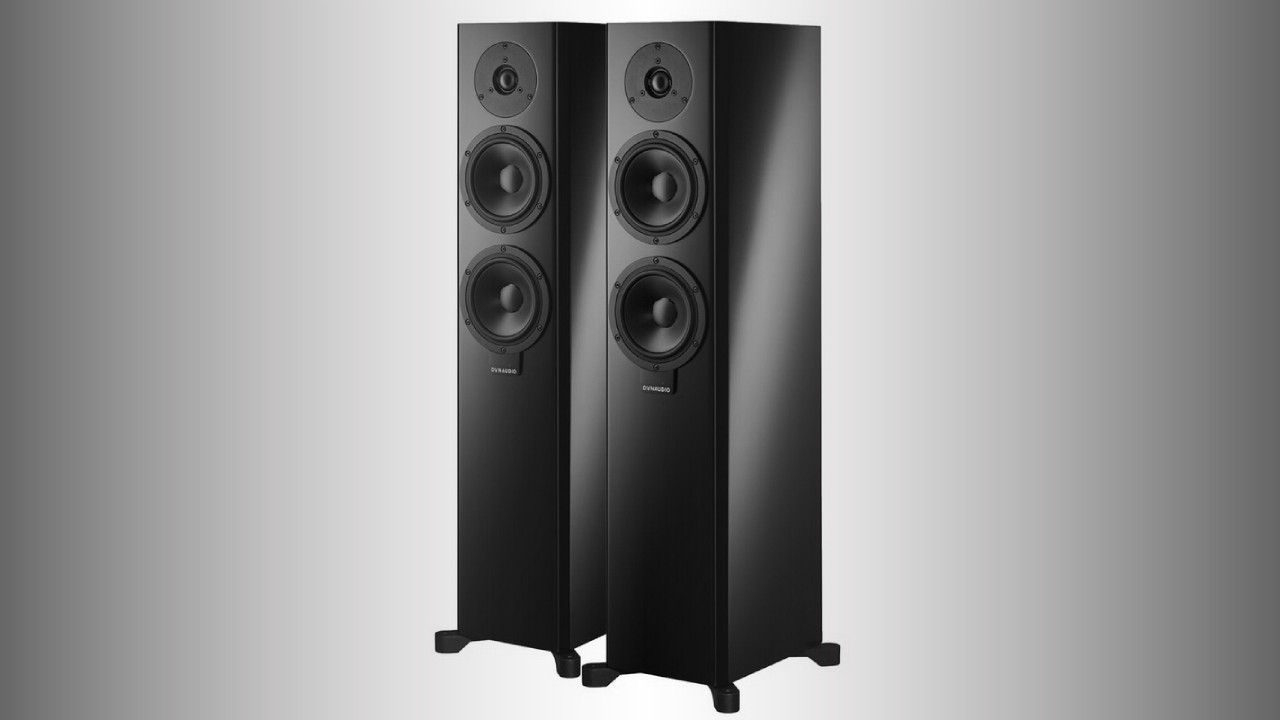
2. Dynaudio Xeo 30: Active 2.5-way speaker system
Dynaudio Xeo 30 active floorstanding speakers with revised cabinet contours and matte-black driver flanges.
The Dynaudio Xeo 30 is an active 2.5-way floorstanding speaker system that replaces the previous Xeo 6 and brings revised styling, driver control, and DSP processing.
Each speaker uses a 28 mm Esotec soft-dome tweeter and two 140 mm Esotec mid/bass drivers with MSP cones.
Each driver is powered by its own 65-watt digital amplifier, tuned for that driver type. The source material also points to an improved DSP processor, updated software, revised crossover work, stepwise frequency-response correction, and claims from Dynaudio of better low-frequency performance and wider dispersion than the predecessor.
Best for: Listeners who want an active floorstanding system with built-in amplification
- Active 2.5-way architecture
- Separate 65-watt amplifier for each driver
- Improved DSP and updated software
- Stepwise frequency-response correction
Verdict: The Xeo 30 suits buyers who prefer a speaker system where amplification, DSP, and driver matching are already integrated by the manufacturer.

3. Top 7 Horn Speakers for Audiophiles: Pure Analog Bliss & Tube Amp Magic
Horn speaker designs are highlighted for their efficiency, dynamics, and suitability with tube amplification.
This horn-speaker feature is useful for readers exploring high-efficiency loudspeakers, especially where tube amplifiers and analog listening are priorities.
The source frames horn acoustics as attractive for exceptional dynamics and compatibility with tube amplification.
The excerpt gives a concrete example in the Shinjitsu Audio Hiro, described as a gateway into horn sound, with a proprietary main driver, Beyma compression driver, optimized horn design, 93 dB sensitivity, stable 8-ohm impedance, and compatibility with tube amplifiers as low as 3 watts. Rather than focusing on one cabinet style, the article serves as a map of horn-speaker options across different levels of the market.
Best for: Tube-amp users and listeners curious about horn dynamics
- Focuses on horn-loaded loudspeakers
- Emphasizes tube-amplifier compatibility
- Highlights dynamic presentation as a key appeal
- Includes accessible horn options such as Shinjitsu Audio Hiro
Verdict: This guide is best treated as a starting point for understanding why horn speakers remain attractive to listeners who value efficiency, immediacy, and low-power amplifier matching.
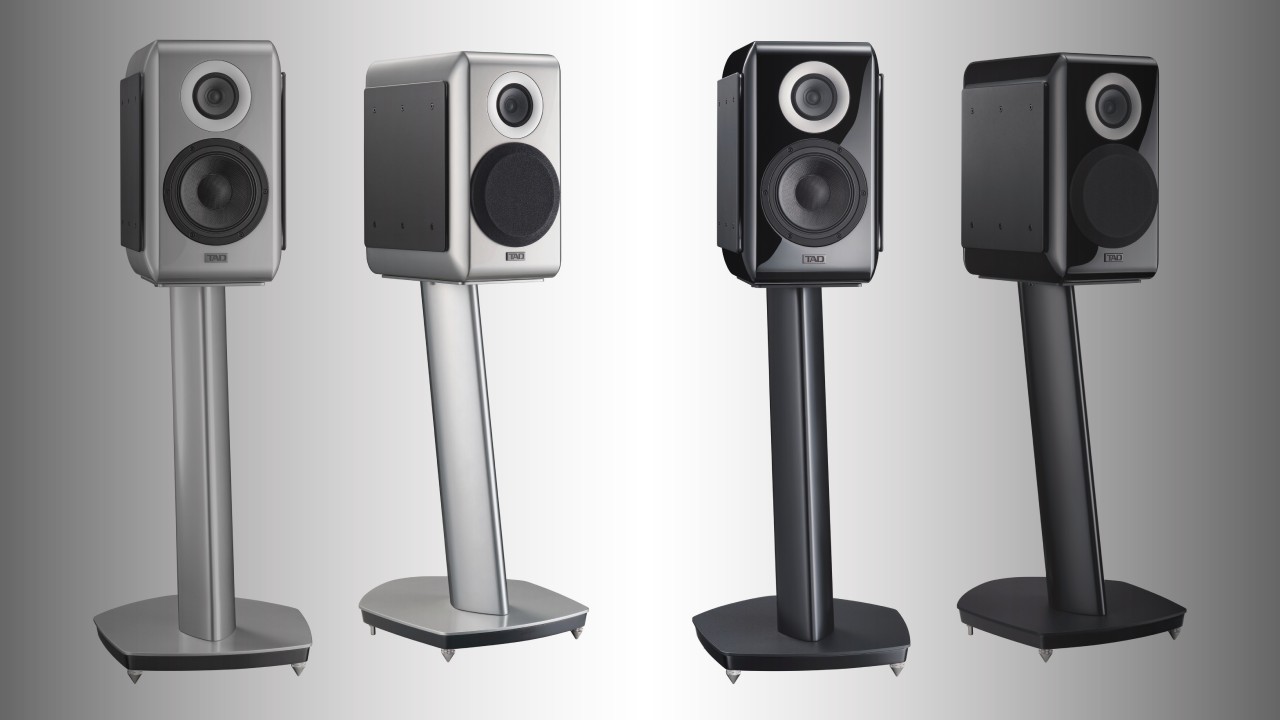
4. TAD ME1TX: High-end speakers equipped with TAD’s exclusive concentric CST driver
TAD ME1TX monitor speaker featuring the company’s concentric CST driver and ADS port architecture.
The TAD ME1TX is a high-end monitor speaker built around TAD’s proprietary concentric CST driver, which places the midrange and tweeter in a phase-conscious arrangement intended to support clear imaging and a natural sound field.
The CST driver covers a broad range from 420 Hz to 60 kHz and uses a 90 mm midrange section together with a newly engineered 25 mm beryllium tweeter diaphragm produced by a patented vapor-deposition process.
The speaker also retains the Bidirectional Aero-Dynamic Slot port design from its predecessor. The key attraction here is not convenience or compact-system integration, but controlled directivity and driver integration in a refined monitor format.
Best for: Listeners prioritizing imaging, phase coherence, and high-end monitor design
- Exclusive concentric CST driver
- Beryllium tweeter diaphragm
- Wide-band CST reproduction from 420 Hz to 60 kHz
- Bidirectional Aero-Dynamic Slot port design
Verdict: The ME1TX stands out for buyers who want a compact high-end speaker centered on TAD’s concentric driver technology and controlled dispersion.
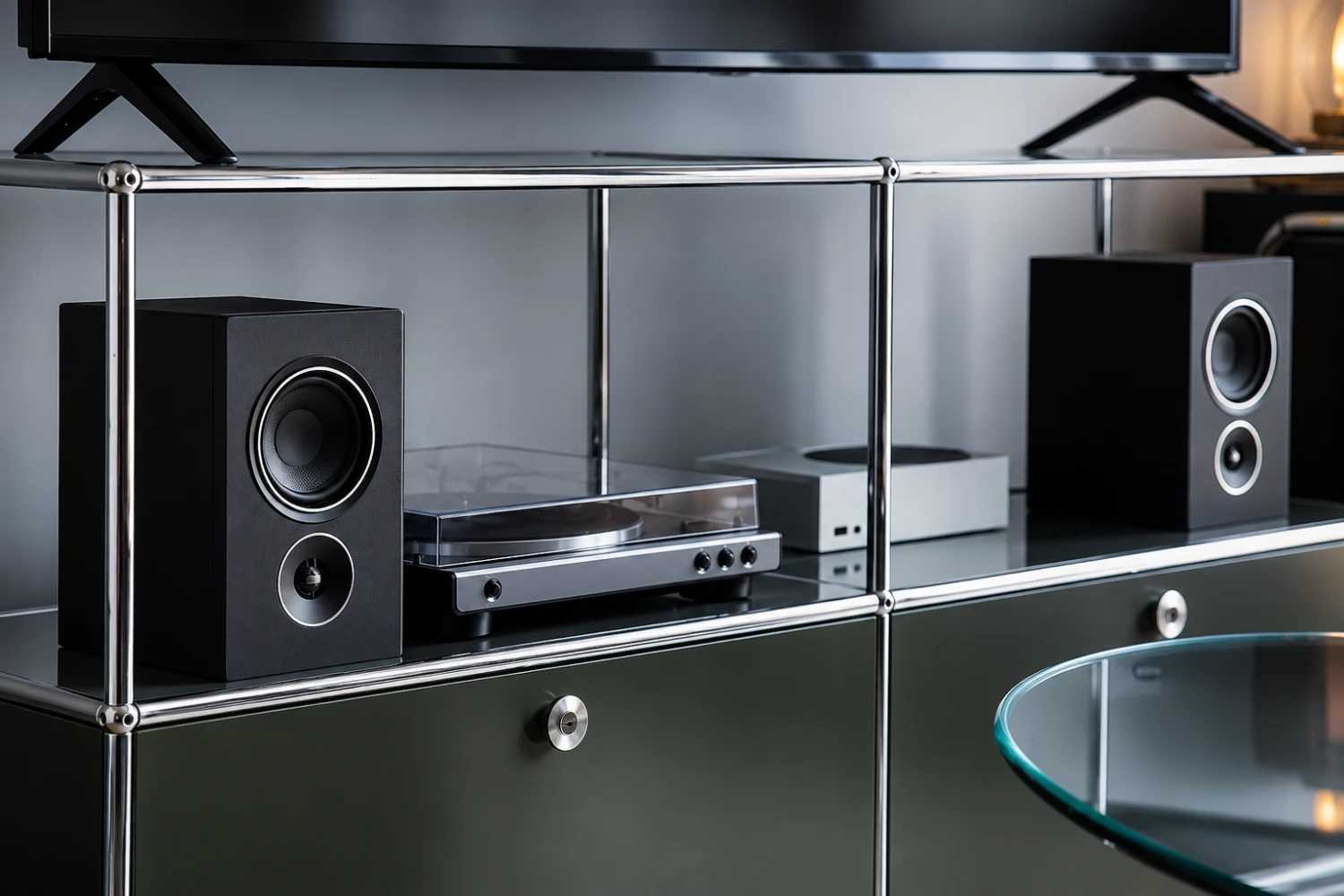
5. PSB iQ1 & iQ2: Active BluOS Speakers with HDMI eARC and Phono Input
PSB iQ active speakers combine streaming, HDMI eARC, phono input, USB connections, and subwoofer integration.
The PSB iQ1 and iQ2 are active two-way loudspeakers aimed at listeners who want a compact, complete stereo system rather than a traditional stack of separates.
Both models combine active amplification with BluOS streaming, HDMI eARC, an MM phono input, optical input, USB-A and USB-C connections, and subwoofer integration.
The source notes that the iQ series builds on the acoustic platform first used in the Alpha iQ, while improving amplification, cabinet finish, connectivity, and flexibility. The iQ2 is described as the more luxurious model and is available in more colors, while the iQ1 is limited to black and white.
Best for: Compact stereo systems with streaming, TV sound, and turntable support
- BluOS streaming built in
- HDMI eARC input
- MM phono input
- Subwoofer integration
Verdict: The PSB iQ1 and iQ2 are strong candidates for buyers who want active stereo speakers that handle modern sources without abandoning traditional inputs.

6. PSI Audio A125-M and A225-M Subwoofers: G-Class Amplifiers, 8-inch Drivers and Balanced Switching
PSI Audio A125-M and A225-M subwoofers use 8-inch drivers, slotted ports, class G amplification, and balanced XLR switching.
The PSI Audio A125-M and A225-M are subwoofers designed with system scaling in mind, as both models are said to share the same sound character.
Each is based on 8-inch drivers, with the A125-M using one driver and the A225-M using two.
Both use slotted bass reflex loading, convex metal grilles, class G amplification, and balanced XLR input and output connections. The analog signal path and balanced switching make them especially relevant where multiple synchronized subwoofers or professional-style integration are priorities.
Best for: Systems needing scalable, balanced subwoofer integration
- Shared sound character across both models
- 8-inch driver platform
- Balanced XLR inputs and outputs
- Fully analog signal path
Verdict: The PSI Audio A125-M and A225-M make the most sense for listeners or studios that value analog operation, balanced connectivity, and the option to scale bass output consistently.

7. McIntosh unveils PS2K subwoofer
McIntosh PS2K active subwoofer with four 13-inch drivers and multiple stereo and LFE connection options.
The McIntosh PS2K is an active subwoofer built around four 13-inch low-frequency drivers, each driven by its own 500-watt class D amplifier for total output of up to 2 kW.
Its drivers use McIntosh’s patented LD/HP magnetic system and multilayer carbon-fiber cones designed for rigidity and reduced distortion.
Connection flexibility is a major part of the design, with balanced and unbalanced stereo inputs and outputs, plus balanced and unbalanced LFE inputs and outputs for daisy-chaining multiple subwoofers. Protection technologies include Power Guard for clipping prevention and Sentry Monitor for short-circuit protection.
Best for: Large stereo or home-theater systems needing extensive subwoofer connectivity
- Four 13-inch low-frequency drivers
- Up to 2 kW total amplifier output
- Balanced and unbalanced stereo and LFE connections
- Power Guard and Sentry Monitor protection
Verdict: The PS2K is aimed at systems where very substantial powered bass, flexible connection options, and McIntosh protection circuitry are central requirements.

8. Magico launches the new TITAN 15 Subwoofer
Magico TITAN 15 subwoofer with dual opposing 15-inch drivers, sealed aluminum construction, and DSP control.
The Magico TITAN 15 is a sealed aluminum subwoofer built around a force-cancelling dual-driver layout and a sophisticated control center.
It uses two newly developed 15-inch drivers with rigid aluminum cones, each supported by a large magnet system, and each driver is paired with a 3200-watt class D amplifier.
The enclosure follows Magico’s QSUB platform with internal bracing and improved damping materials. Integration features include an electronic crossover, proprietary DSP control center, multiple inputs, three presets, automatic signal detection, automatic shutdown, a limit sensor, and thermal protection.
Best for: High-output systems requiring advanced sealed-subwoofer control
- Force-cancelling dual 15-inch driver arrangement
- Sealed aluminum enclosure
- Two 3200-watt class D amplifiers
- DSP control with presets and protection features
Verdict: The TITAN 15 is for buyers who want a heavily engineered subwoofer platform with powerful amplification, DSP calibration tools, and a rigid sealed enclosure.

9. Borea BRA1: Surround speakers from Triangle
Triangle Borea BRA1 surround speaker designed for top-mounted or wall-mounted use with selectable crossover modes.
The Triangle Borea BRA1 is a surround-effects speaker designed to add versatility to the Borea range.
It uses technologies borrowed from the Esprit EZ line, including a fabric-dome tweeter and a 16 cm cellulose-membrane driver in an MDF cabinet with magnetically attached protective grilles.
Its adjustable crossover offers two operating modes: linear for direct horizontal effects and upward for compensating losses associated with indirect vertical 3D effects. The BRA1 can sit on top of compatible Borea models or be used as a separate wall-mounted speaker.
Best for: Borea-based surround and immersive audio systems
- Adjustable crossover with two modes
- Can be placed on compatible Borea speakers
- Can be wall-mounted
- Fabric-dome tweeter and cellulose driver
Verdict: The Borea BRA1 is a practical add-on for Triangle Borea owners who want flexible surround placement and selectable operation for horizontal or upward effects.
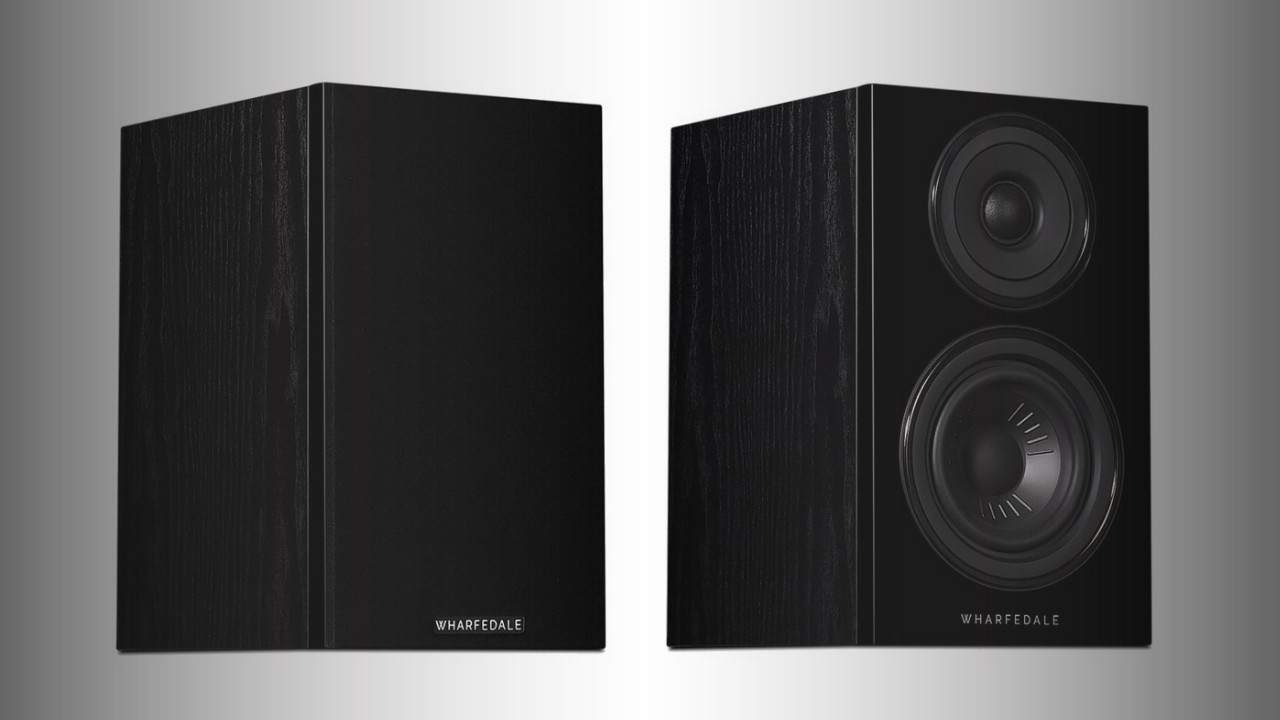
10. Wharfedale Diamond 12.2: Bookshelf speakers with excellent mid-bass reproduction
Wharfedale Diamond 12.2 bookshelf speaker from the Diamond 12 series with Klarity driver material and reinforced cabinet construction.
The Wharfedale Diamond 12.2 belongs to the Diamond 12 speaker series, which emphasizes performance at relatively low prices.
Its drivers use Klarity cone material, a mixture of polypropylene and mica intended to improve rigidity and reduce sound coloration.
Wharfedale also highlights soft surrounds for linear response, an aluminum compensation ring in the magnetic system to reduce unwanted vibration effects, and 25 mm fabric-film tweeter domes intended to sound more open. The cabinet uses a multilayer sandwich construction designed to reduce cabinet influence and help the speakers create a deep, voluminous stage.
Best for: Value-conscious bookshelf-speaker buyers
- Klarity polypropylene-and-mica cone material
- 25 mm fabric-film tweeter dome
- Multilayer sandwich cabinet construction
- Designed for broad musical versatility
Verdict: The Diamond 12.2 is an appealing bookshelf choice for listeners who want Wharfedale’s driver and cabinet refinements in a relatively accessible speaker format.
Quick comparison
These recommendations cover very different roles, so the most meaningful comparison is by system purpose.
Some are full-range or monitor loudspeakers, some are active all-in-one systems, and several are specialist subwoofers or surround add-ons.
| Product | Best for | Verdict |
|---|---|---|
| McIntosh ML1 MKII | Heritage-inspired passive loudspeaker systems | A modernized four-way sealed McIntosh design that keeps close ties to the earlier ML-1C concept while removing the need for the old equalizer pairing. |
| Dynaudio Xeo 30 | Active floorstanding stereo systems | Integrated amplification, DSP, and driver-specific tuning make it a simpler route to a complete active speaker setup. |
| Top 7 Horn Speakers for Audiophiles: Pure Analog Bliss & Tube Amp Magic | Horn-speaker research and tube-amplifier matching | A useful overview for listeners investigating efficient horn designs and their appeal with low-power tube amplification. |
| TAD ME1TX | High-end monitor listening | Its concentric CST driver and beryllium tweeter make driver integration and imaging the central appeal. |
| PSB iQ1 & iQ2 | Compact active systems with modern and traditional inputs | BluOS, HDMI eARC, MM phono, USB, and subwoofer integration make these speakers unusually source-friendly. |
| PSI Audio A125-M and A225-M | Balanced, scalable subwoofer setups | Shared voicing, analog operation, and XLR input/output switching make them suited to expandable bass systems. |
| McIntosh PS2K | Large systems needing powerful active bass and flexible connections | Four powered 13-inch drivers and extensive stereo and LFE connectivity define its role. |
| Magico TITAN 15 | Advanced sealed-subwoofer installations | Dual opposing 15-inch drivers, heavy amplification, and DSP control place it firmly in serious subwoofer territory. |
| Triangle Borea BRA1 | Surround, height, or wall-mounted effects in Borea systems | Selectable crossover modes and flexible placement make it a focused surround expansion speaker. |
| Wharfedale Diamond 12.2 | Accessible passive bookshelf systems | Klarity drivers, fabric tweeter, and cabinet attention give it a clear value-oriented bookshelf identity. |
Frequently asked questions
Should I choose active or passive speakers?
Choose active speakers if you want amplification and speaker matching handled inside the product, as with the Dynaudio Xeo 30 or PSB iQ1 and iQ2.
Choose passive speakers if you already have, or want to select, an external amplifier, as with the McIntosh ML1 MKII, TAD ME1TX, Triangle Borea BRA1, or Wharfedale Diamond 12.2.
When does a subwoofer make sense?
A subwoofer is most useful when the main speakers or room goals require deeper, more controlled low-frequency support.
The PSI Audio models emphasize balanced analog integration and system scaling, the McIntosh PS2K emphasizes powered output and broad connection options, and the Magico TITAN 15 emphasizes sealed construction, DSP control, and a force-cancelling driver layout.
Are horn speakers only for tube amplifiers?
No, but the supplied horn-speaker guide focuses on their appeal with tube amplifiers, especially low-power designs.
The Shinjitsu Audio Hiro example is described with 93 dB sensitivity, stable 8-ohm impedance, and compatibility with tube amplifiers as low as 3 watts, which explains why horn designs are often discussed in that context.
How should I think about surround or height speakers?
Start with placement and intended effect.
The Triangle Borea BRA1 can be used on top of compatible Borea speakers or wall-mounted, and its crossover can be set for direct horizontal effects or upward operation for indirect vertical 3D effects.
That makes it more specialized than a conventional bookshelf speaker.
How to Choose the Right Speaker from This List
Begin with system role.
If the speaker must be the heart of a compact, source-rich setup, the PSB iQ1 and iQ2 are the most complete option here because they combine active amplification with BluOS, HDMI eARC, MM phono, USB, optical input, and subwoofer integration.
If you prefer an active floorstanding stereo speaker with amplification and DSP already matched to the drivers, the Dynaudio Xeo 30 is the more traditional room-facing active choice. For passive stereo systems, decide whether you are buying into heritage, high-end monitor precision, or accessible bookshelf value. The McIntosh ML1 MKII is the heritage-led option, with a sealed four-way layout, modern driver array, and no need for the equalizers associated with the older design. The TAD ME1TX is the technically focused monitor, built around the concentric CST driver and beryllium tweeter for controlled directivity and imaging. The Wharfedale Diamond 12.2 is the value-minded bookshelf entry, with attention paid to cone material, tweeter design, and cabinet construction. If the system needs bass rather than main speakers, compare integration before output claims. PSI Audio’s A125-M and A225-M are attractive where balanced XLR switching, analog signal flow, and scalable matching matter. The McIntosh PS2K is framed around four powered 13-inch drivers, broad stereo and LFE connectivity, and protection circuitry. The Magico TITAN 15 takes a different route with a sealed aluminum body, dual opposing 15-inch drivers, DSP control, presets, and protection features. Specialist use cases deserve specialist products. The Triangle Borea BRA1 is not a general-purpose stereo speaker in this context; it is a surround-effects solution with flexible placement and selectable crossover behavior. The horn-speaker guide is similarly best used as research for listeners considering high-efficiency loudspeakers, particularly those pairing speakers with tube amplification. Matching the product to the system task will matter far more than chasing a single universal winner.