


The Musical Fidelity M8xi is an integrated amplifier, and a true heavyweight (in every sense of the word) in its category. Weighing in at around 40 kg, and with a 40 cm depth, it won't fit on most standard hi-fi stands. Unpacking and installing this amplifier requires two people. And, of course, the Musical Fidelity M8xi is also quite expensive, unlikely to be easily affordable for many music lovers.

In terms of power, this amplifier delivers a record-breaking 550 watts per channel into 8 ohms and 870 watts into 4 ohms. And with the load impedance dropping to 2 ohms, the Musical Fidelity M8xi can deliver up to 1.6 kW of output power (for short periods). And note that all of this is in true, traditional Class A/B, not the trendy Class D! According to Musical Fidelity, the M8xi can drive any speaker on the market, and it's hard to disagree.

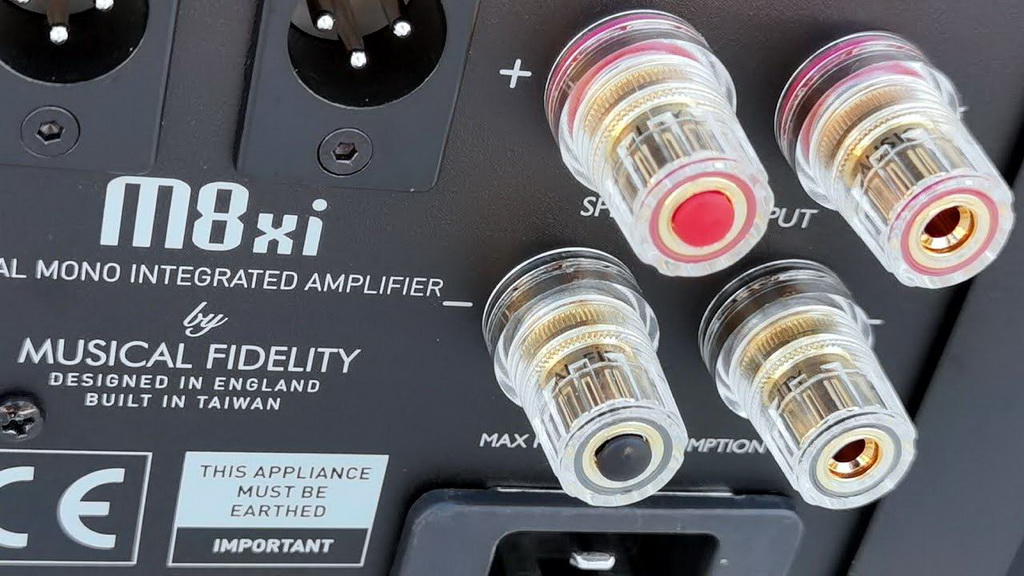
But why does a “home” amplifier need a whopping five hundred watts of output power per channel? The point isn't really about listening to music loudly (although, as you can imagine, that's not an issue here), but about the ability to control any speaker, thereby achieving its best sound.
Perhaps now is the time to dispel the rather popular myth that choosing an amplifier with an output power lower than the speaker's maximum specified will prevent damage when listening to music at high volumes. In reality, it's much easier to burn out speakers when connected to a low-power amplifier operating at the limit (or beyond) of its capabilities. Distortion is the real enemy of the voice coils in your speakers' drivers.
But, of course, you should still stop switching analog cables while the amplifier is on, especially with the volume control set to maximum. And if distortion begins to appear in the sound, turn down the system's volume a couple of notches.

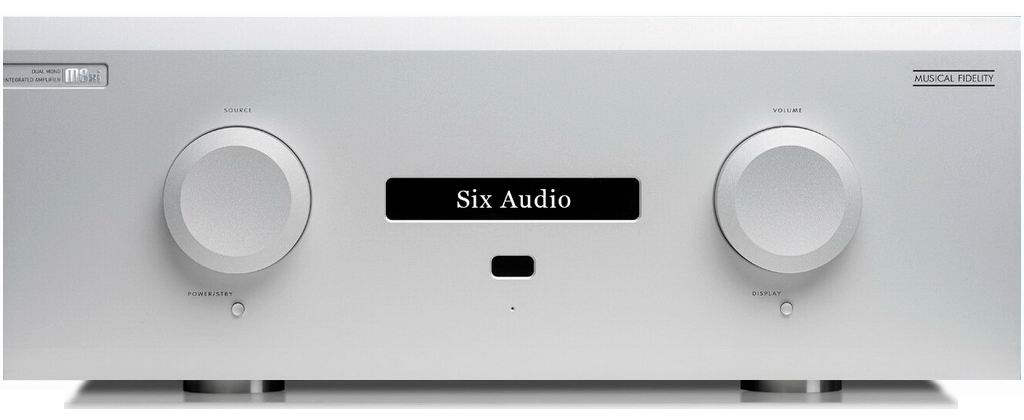
But let's return to the Musical Fidelity M8xi's appearance. This amplifier will undoubtedly stand out in any interior, though not to the same extent as devices from Gryphon or McIntosh. The aluminum front panel is half a centimeter thick and features two hockey-puck-sized knobs—an input selector and a volume control. The display shows the selected signal source, and the amplifier is turned on with a tiny button below the input selector. Two enormous cooling heatsinks are located on the sides of the enclosure. This makes perfect sense, as when the Musical Fidelity M8xi is running at full power, they will generate up to one kilowatt of heat!
The amplifier's remote control is a blue-gray plastic box that looks like it was once a CD player remote control. Perhaps, given the amplifier's price, its remote could have been a little fancier. The amplifier control buttons are located in the lower third of the remote, but there is no power on/off button.
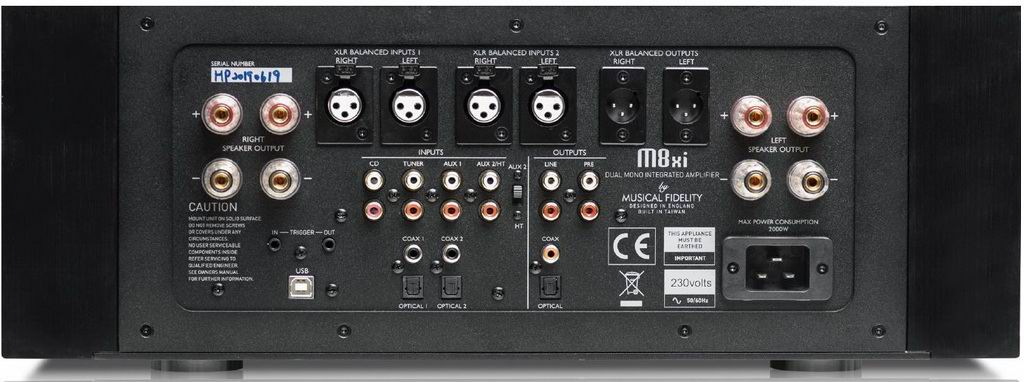
The Musical Fidelity M8xi is equipped with a wide range of analog inputs, but not a phono input. So, if you plan on listening to records, you'll need to invest in a suitable phono preamp. The amplifier also has a Home Theater input, allowing the M8xi to be used as an amplifier for the front channels of a home theater. This is a plus, but it should be used with caution, as it bypasses the amplifier's volume control. If, for example, you accidentally feed the amplifier a signal from a CD player, each speaker will receive half a kilowatt of power!
The unit also has a wide range of digital inputs: two optical, two coaxial, and an asynchronous USB port for connecting a computer. However, the Musical Fidelity M8xi lacks network functions or power inputs for external devices.
Musical Fidelity describes the M8xi as two mono amplifiers and a preamplifier, housed in a single enclosure. In principle, this is exactly what we're used to calling an integrated amplifier. But in this case, these three components have completely separate power supplies and are almost completely separated from each other within a spacious enclosure.
Since the amplifier doesn't have network capabilities, it's fairly straightforward to use. However, you'll need a helper to position the Musical Fidelity M8xi, and as we've already established, it won't fit on standard speaker stands. A sturdy coffee table would probably do, or, in a pinch, you could simply place the unit on the floor.
An amplifier with such impressive specifications and a price tag that's a bit out of my comfort zone sets high expectations for sound quality. And perhaps that's why, after listening to music through it for a while, I thought, “Is that all?” Only then did I realize how loud it actually was. With five hundred watts of output and the ability to drive any speaker without straining, this amplifier sounds a little different than most of us are used to.
Music played through the M8xi will likely be a bit harsher than through other amplifiers. And not because the device itself sounds harsh, but simply because its exceptionally clear sound will have you cranking up the volume to the point where your ear's frequency sensitivity changes. Simply return the volume control to a more realistic setting, and everything will fall into place.

One of the strengths of the Musical Fidelity M8xi is its sound dynamics. Not only can this amplifier play loudly, but it also masterfully shows the difference between the quietest sounds and explosive musical passages.
The Musical Fidelity M8xi sounds as impressive as it looks. If you have the space and can afford this giant, you will get an absolutely uncompromising foundation for your system. The most indelible impression is made by the dynamic capabilities of this amplifier, which are simply unmatched today, even among high-end models. With an output power of half a kilowatt per channel, the Musical Fidelity M8xi allows you to use any speakers in your system.
Musical Fidelity M8XI Specifications:
- Output Power (20 Hz – 20 kHz): 550 W per channel into 8Ω (870 W into 4Ω); peak 1.6 kW into 2Ω
- Maximum Output Voltage: 67 V RMS from 20 Hz – 20 kHz; clipping start at 190 V peak-to-peak
- THD+N: <0.004% typical (20 Hz – 20 kHz, XLR)
- Signal-to-Noise Ratio: >86 dB, A-weighted (XLR)
- Input Impedance: 25 kΩ (RCA), 50 kΩ (XLR)
- Frequency Response: +0 / –1 dB from 10 Hz – 100 kHz
- Maximum Peak Output Current: 105 A
- Damping Factor: 150
- Output Devices: 3 + 3 pairs (bridged) per channel
- Analog Inputs: 4 × RCA line-level, 2 × balanced XLR
- Digital Inputs: 2 × coaxial S/PDIF (24-bit / 192 kHz), 2 × optical S/PDIF (24-bit / 96 kHz), 1 × asynchronous USB-B (24-bit / 192 kHz)
- Analog Outputs: 1 × fixed RCA, 1 × variable RCA (pre-out), 1 × variable balanced XLR
- Digital Outputs: 1 × coaxial S/PDIF (24-bit / 192 kHz), 1 × optical S/PDIF (24-bit / 96 kHz)
- Dimensions (W × H × D): 440 × 162 × 400 mm
- Maximum Power Consumption: 2000 W